Best Executive Physical: Choose Depth and Follow-Up
Andrew founded Renew Health to change how cardiovascular disease is detected and treated.
Korenstein and colleagues' 2019 JAMA research letter graded the services in executive physical packages at top-ranked US hospitals against USPSTF guidelines and found that Papanicolaou test/pelvic examination was the only service that was grade A for all relevant ages (Korenstein et al., JAMA 2019). Sutter Health says the executive receives the remaining test results along with a detailed summary of findings and recommendations within seven days, while National Jewish Health says a comprehensive medical report will be available within four to six weeks of your examination and finalized test results (Sutter Health Executive Health Program; National Jewish Health Executive Health). Korenstein and colleagues' 2019 study found that 32 of 50 top-ranked US hospitals (64%) offered executive physical packages, and that low-dose CT screening for lung cancer, a USPSTF grade A service, was not included in any package (Korenstein et al., 2019). Performance at $999/mo is primary. Executive at $5,000/mo is secondary.
A peer just had a heart attack. Your own physical took seven minutes and ended with "see you next year," and now you want to see the numbers.
What "best" should mean
You look up best executive physical after a brochure, a colleague, or an employer has already named a famous program. Best for which job?
Three jobs get mixed together:
- Logistics. One coordinated block of time, privacy, and a written summary before you fly home.
- Depth. Tests chosen for your age, sex, and risk, read by a clinician who will say what matters.
- Follow-through. Someone owns the plan after the binder is closed, and something is re-measured later.
A program can win the first job and leave the second and third to your local clinician. That can be the right purchase if you already have a physician who will treat what comes back. It is a weak purchase if you came looking because of silent arterial disease and you will not look again until next year.
A brand name tells you about coordination and specialist access. It tells you little about whether your arterial wall is changing.
For the plain definition of the visit, see what is an executive physical.
Top 10 executive physical programs, matched to what each publishes
Ten programs, each paired with one feature its own page publishes, ordered by job.
- Cleveland Clinic, one-day format. Its employer page says a thorough preventive exam is delivered in an efficient 6-to 8-hour, single-day experience, and that most test results are available the same day (Cleveland Clinic Executive Health).
- Northwestern Medicine, same-day results review. It says you review your results with one of its experts within the same day (Northwestern Medicine Executive Health).
- Houston Methodist, a choice of length. Its comprehensive health assessment takes three to four hours to complete, and its premier health assessment usually takes five to seven hours (Houston Methodist Executive Health).
- Mass General Brigham, cardiologist review. Its cardiovascular assessment includes an interpretation and action items from a senior Mass General cardiologist (Mass General Brigham Executive Health).
- Duke Executive Health, a behavioral team. Its team includes health psychologists and counselors, certified exercise physiologists, and registered dietitians (Duke Executive Health).
- UCLA Health, electronic results. It says patients will have real-time, secure electronic access to testing results and customized medical advice (UCLA Health Executive Health).
- Atrium Health, named add-on exams. It lists Healthy Brain, Healthy Heart, Healthy Body, Healthy Gut, and Healthy Genome exams (Atrium Health Executive Physical).
- National Jewish Health, tiered packages. It says it offers four different Executive Health packages (National Jewish Health Executive Health).
- Sutter Health, a written summary within a week. It publishes a seven-day window for the remaining results and a written summary (Sutter Health Executive Health Program).
- Mayo Clinic, a career-long annual relationship. Its FAQ flyer describes a career-long care relationship, centered around an annual visit including unhurried physician time (Mayo Clinic Executive Health FAQ, MC1927-43).
- Executive Checkup: What's Included and What Comes After
- Executive Health Assessment: What It Checks, What Follows
- Mayo Clinic Executive Health vs Renew Health: Key Facts
A checklist before you book
Use this list with any program, including ours.
- What is on the base itinerary, and what is optional? If a clinic will not write the list down, you cannot compare it.
- Who interprets abnormal results before you leave, and who treats them after? A portal PDF with no named owner leaves you without a plan.
- What is the handoff? Mayo Clinic's Executive Health FAQ says it requires executive patients to have a local primary care provider for personal health needs, and that with your permission it will share information from your appointment with that provider (Mayo Clinic FAQ). Confirm the same question locally.
- What will be repeated, and when? Duke Executive Health says most people return annually (Duke). Mayo Clinic's experience page says the Executive Health visit is typically annual (Mayo Clinic). Northwestern Medicine describes its executive physical as a comprehensive annual examination (Northwestern Medicine).
- What is the cash exposure if insurance pays little? See executive physical cost and does insurance cover an executive physical.
- Are you being asked to self-read a number?
If you are asking which building is closest, use executive physical near me. If the employer is paying, use corporate executive physical.
Personalized action plans
Duke Executive Health says your doctor will review your results and the team's recommendations to develop an effective, realistic health plan that incorporates exercise, diet, and stress management into your busy life, and that you will leave with a schedule for periodic health maintenance (Duke Executive Health). Duke Executive Health also says most people return annually to assess their progress and update their action plan (Duke). Mayo Clinic's Executive Health FAQ says certified Mayo Clinic wellness coaches help executive patients set goals, create an action plan, address barriers, build confidence, and address the lifestyle changes that the physician recommends (Mayo Clinic Executive Health FAQ, MC1927-43). The 2019 ACC/AHA prevention guideline by Arnett and colleagues says adults who are 40 to 75 years of age and are being evaluated for cardiovascular disease prevention should undergo 10-year ASCVD risk estimation and have a clinician-patient risk discussion before starting on pharmacological therapy (Arnett et al., Circulation 2019). Arnett and colleagues also call a team-based care approach an effective strategy for the prevention of cardiovascular disease.
Where Renew fits
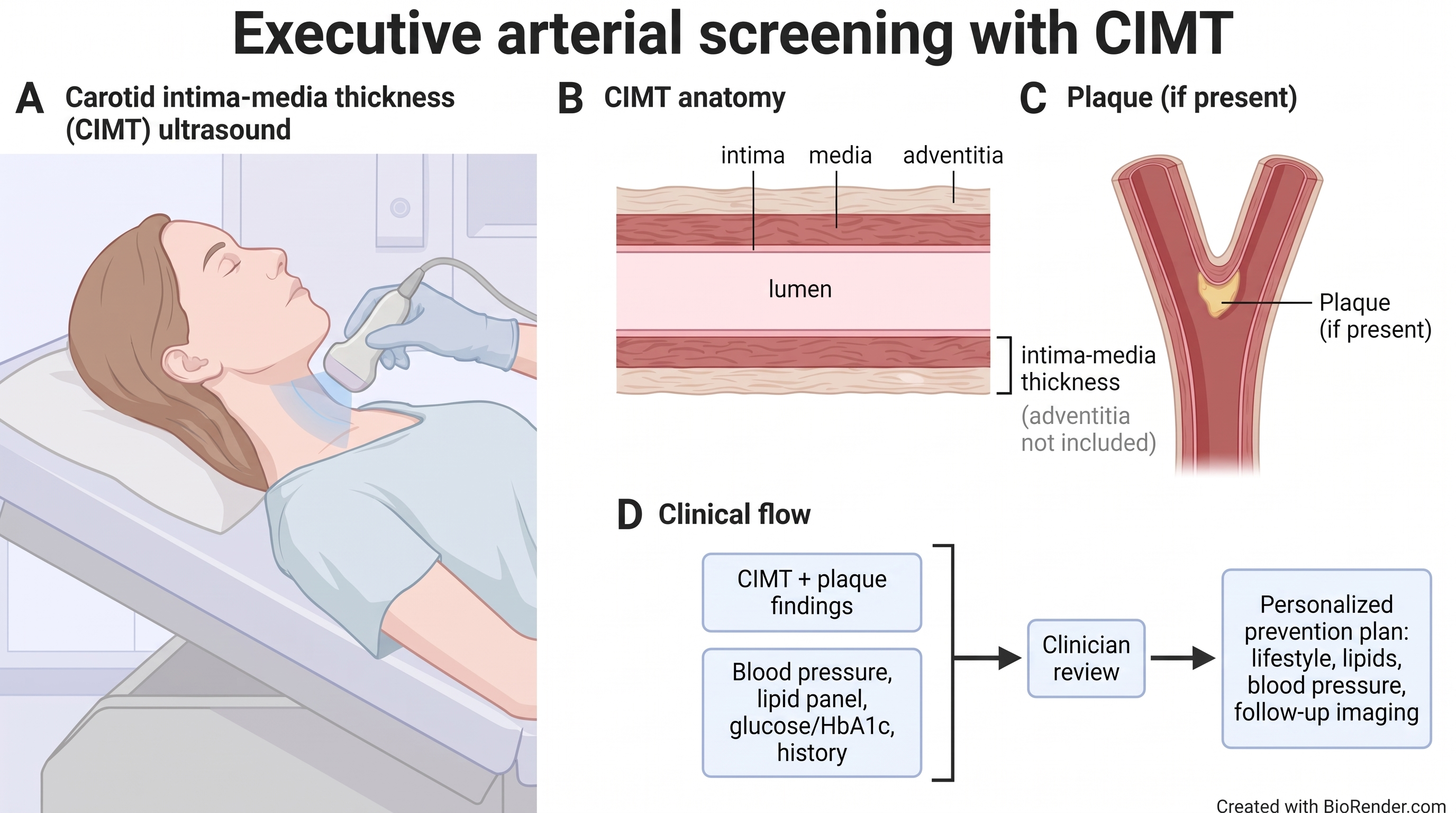
Renew's Pricing page says every membership includes "CIMT arterial imaging, advanced lab panels testing for 33 known drivers of arterial damage, a dedicated physician, care coordinator, and our money-back guarantee" (Pricing). CIMT stays the anchor of the arterial story: ultrasound of the carotid arteries so a physician can read wall thickness and plaque. The method page is How it works. Performance and Executive add DEXA body composition scans and VO2 Max testing (Pricing). Renew's Executive Health page says "A dedicated physician and care team adjust the protocol" (Executive health).
A UK Biobank cohort describes carotid intima-media thickness as a surrogate marker of atherosclerosis (Mitra et al.). The same cohort reports an association between higher thickness and later coronary disease in adults free of cardiovascular disease at baseline. That finding is about the measurement. Do not treat it as a Renew outcome rate (Executive health). Do not calculate a personal prediction from a screenshot.
Cardiovascular risk assessment in the itinerary
A serious executive itinerary should say how cardiovascular risk is assessed. A list of labs drawn does not answer that by itself.
- Blood Tests in an Executive Physical: The Panel, Explained
- Executive Physical With Calcium Score: What It Decides
- Executive Physical With CIMT: What the Artery Scan Adds
Cost and insurance coverage questions
What you might pay, and how insurance splits the bill, changes what best means for you. Mayo Clinic's Executive Health FAQ says the cost of an appointment will vary based on factors including gender, age, visit, campus, added tests, and optional services (Mayo Clinic FAQ). Read executive physical cost and does insurance cover an executive physical before you treat a brochure as a net price.
Genetic and ancestry testing
Genetic testing in an executive physical ranges from a structured family history to exome sequencing, and ancestry changes which questions are worth asking. The USPSTF recommends that primary care clinicians assess women with a personal or family history of breast, ovarian, tubal, or peritoneal cancer or who have an ancestry associated with BRCA1/2 gene mutations with an appropriate brief familial risk assessment tool (USPSTF BRCA-related cancer). It recommends against routine risk assessment, genetic counseling, or genetic testing for women whose personal or family history or ancestry is not associated with potentially harmful BRCA1/2 gene mutations (USPSTF BRCA-related cancer). Atrium Health says its Healthy Genome exam combines a detailed family history and consultation with a genetic counselor with custom DNA exome testing (Atrium Health Executive Physical). Ask who orders each test and whether a genetic counselor reviews the result with you.
Nutritional and lifestyle analysis
A lifestyle analysis should measure first, then prescribe. The AHA's Life's Essential 8 advisory scores cardiovascular health on eight components: healthy diet, participation in physical activity, avoidance of nicotine, healthy sleep, healthy weight, and healthy levels of blood lipids, blood glucose, and blood pressure (Life's Essential 8, PMC10503546). The 2019 ACC/AHA prevention guideline says adults should engage in at least 150 minutes per week of accumulated moderate-intensity physical activity or 75 minutes per week of vigorous-intensity physical activity (Arnett et al., Circulation 2019). The USPSTF recommends offering or referring adults with cardiovascular disease risk factors to behavioral counseling interventions to promote a healthy diet and physical activity (USPSTF healthy diet and physical activity counseling). Mass General Brigham includes a consultation with a registered dietitian including a SECA scale body composition analysis and results review (Mass General Brigham Executive Health). Ask whether your plan names a target for each of these and when each will be rechecked.
Mental health and cognitive function
Ask whether the itinerary screens mood and memory, because many published packages list only physical tests. The USPSTF recommends screening for depression in the general adult population, with adequate systems in place to ensure accurate diagnosis, effective treatment, and appropriate follow-up (USPSTF, Siu et al., JAMA 2016). The USPSTF also recommends screening for anxiety disorders in adults, and it concludes the evidence is insufficient on screening for anxiety disorders in adults 65 and older (USPSTF, Barry et al., JAMA 2023). For adults 65 and older without recognized signs or symptoms of cognitive impairment, the USPSTF concludes the evidence is insufficient to assess the balance of benefits and harms of screening (USPSTF, Owens et al., JAMA 2020). If a program offers a cognitive test, ask what a result would change and who follows it up.
Cancer screening and biomarkers
Check each cancer test on an itinerary against the USPSTF grade for your age and risk. The USPSTF recommends screening for colorectal cancer in adults aged 45 to 49 years and in adults aged 50 to 75 years (USPSTF A and B recommendations). It recommends biennial screening mammography for women aged 40 to 74 years (USPSTF A and B recommendations). For lung cancer, it recommends annual screening with low-dose computed tomography in adults aged 50 to 80 years who have a 20 pack-year smoking history and currently smoke or have quit within the past 15 years (USPSTF A and B recommendations). For men aged 55 to 69, the USPSTF says the decision to undergo periodic PSA-based screening should be an individual one, made after a chance to discuss the potential benefits and harms with their clinician, and it recommends against PSA-based screening in men 70 years and older (USPSTF prostate cancer screening). The USPSTF recommends against screening for ovarian cancer in asymptomatic women who are not known to have a high-risk hereditary cancer syndrome (USPSTF ovarian cancer screening). The USPSTF also found that testing for the serum tumor marker CA-125, transvaginal ultrasound, or both does not reduce ovarian cancer mortality (USPSTF ovarian cancer screening). A tumor marker on a package list is worth a question about what a positive result would trigger.
How long each published day runs
Length is the easiest feature to compare, because most programs print it. Houston Methodist says its executive assessments include same-day results of labs and imaging tests and are typically completed within four to seven hours (Houston Methodist executive exams). Houston Methodist describes its premier health assessment as its most extensive offering, with comprehensive lab and diagnostic tests, a fitness assessment, wellness coaching, and a therapeutic massage after a medical history review and exam (Houston Methodist Executive Health). Its comprehensive health assessment pairs a thorough exam and testing with wellness coaching (Houston Methodist Executive Health). Houston Methodist also says the program gives access to primary, specialty, and subspecialty medical consultants in a package built around your needs (Houston Methodist Executive Health).
Mayo Clinic runs its Executive Health Program in Rochester, Minnesota, and Scottsdale, Arizona, and puts the itinerary and appointment details in an Executive Health app (Mayo Clinic Executive Health Program). Mayo Clinic's experience page says the length of each visit can vary based on your health needs and priorities (Mayo Clinic Executive Health: Your Experience). Cleveland Clinic lists its Main Campus, Weston Hospital, and Canada Downtown as the locations that offer its Executive Health solution (Cleveland Clinic Executive Health).
What happens before and after the day
The hours on site are only part of the purchase. Cleveland Clinic says pre-appointment consultations with a nurse make sure all needs are addressed before the visit (Cleveland Clinic Executive Health). Cleveland Clinic says the physician prepares a written report with your results and clear next steps, and that virtual and in-person visits are available for follow-ups with the executive health team (Cleveland Clinic Executive Health). Cleveland Clinic adds that participants who need specialty consultations get priority access to more than 120 of its medical and surgical experts (Cleveland Clinic Executive Health).
Mayo Clinic's experience page says the visit ends with an Executive Summary and defined Action Plan covering test results, clinical insights, personal goals, and recommended interventions (Mayo Clinic Executive Health: Your Experience). The same Mayo page says results stay in the Mayo Clinic patient app and are accessible to your primary care provider at home (Mayo Clinic Executive Health: Your Experience). Mayo Clinic also says active Executive Health patients receive a quarterly newsletter and speaker series (Mayo Clinic Executive Health: Your Experience).
Read those as each program's own description of follow-up. In each case the next set of measurements still depends on the next visit or on your local clinician.
How common these packages are
Korenstein and colleagues identified 50 top-ranked hospitals and found that 32 of them (64%) offered executive physical packages (Korenstein et al., JAMA 2019). In the same letter, eight hospitals offered more than one package, five of them split by patient age and three by price (Korenstein et al., JAMA 2019). The authors obtained most package information from hospital websites, with telephone calls adding details for 4 packages (Korenstein et al., JAMA 2019). That is a reason to ask for the itinerary in writing rather than relying on a summary page.
How to compare programs on evidence
In Korenstein and colleagues' 2019 JAMA research letter, package costs ranged from $1,700 to $10,000 (Korenstein et al., JAMA 2019), the most commonly included services were hearing examination (83%) and electrocardiogram (83%), both graded I by the USPSTF, four grade D services were included, and low-dose CT screening for lung cancer (grade A) was not included in any package.
A Cochrane review of 17 randomized trials (15 with outcome data, n = 251,891) found general health checks have little or no effect on total or cancer mortality, and probably little or no effect on cardiovascular mortality (Krogsbøll et al., Cochrane 2019).
Compare programs on four things: which tests carry a USPSTF grade, the written price, who reads the results, and who owns follow-up after the visit.
Questions to ask
- Ask a narrower question. Best for which job?
- Ask the program for its itinerary length in writing.
- Ask whether the day includes blood pressure, lipids, glucose markers, and any vascular imaging the program uses.
- Ask who interprets abnormal findings before you leave.
- Ask each program which of these checks it includes, which cost extra, and who explains each result.
- Ask what a positive result would lead to before you add it.
- Ask which questionnaire the program uses and what happens if you screen positive.
- Ask whether a dietitian or nutritionist reviews your eating, sleep, alcohol, and activity, or whether the day ends with a printed handout.
- Ask which board certifies each physician on the team, and whether the program's imaging and laboratory services hold any accreditation.
- Ask who writes your action plan, when you receive it, and who checks your progress against it.
Frequently asked questions
Is Mayo Clinic or Cleveland Clinic the best executive physical?
Mayo Clinic's program page describes a comprehensive and personalized 1-to-3-day itinerary of preventive health exams, tests and consults (Mayo Clinic Executive Health). Cleveland Clinic's employer page describes its exam as an efficient single-day experience of 6 to 8 hours (Cleveland Clinic employer executive health).
How is Renew different from a one-day executive physical?
Renew's Pricing page lists Physician Visits at Monthly on Performance and Unlimited on Executive (Pricing).
How long does a Houston Methodist executive assessment take?
Houston Methodist's comprehensive health assessment takes three to four hours, and its premier assessment usually takes five to seven hours (Houston Methodist).
What should I refuse to self-interpret?
Renew's Pricing page says every membership includes a dedicated physician and care coordinator (Pricing).
Sources
- Mayo Clinic Executive Health Program
- Mayo Clinic Executive Health: Your Experience
- Mayo Clinic Executive Health FAQ flyer (MC1927-43) (local primary care required. not a membership program. no 24/7/365 provider access)
- Cleveland Clinic About Your Executive Health Exam (about six to eight hours. published "may include" list)
- Mitra et al., carotid intima-media thickness in UK Biobank adults (cIMT as a research marker of atherosclerosis. not a Renew outcome rate)
- Renew Health executive health program
- Renew Health pricing
- Renew Health how it works
- US Preventive Services Task Force (USPSTF) recommendations on colorectal, breast, cervical, lung, prostate, and ovarian cancer screening
- USPSTF recommendations on depression and anxiety screening in adults and cognitive impairment screening in older adults
- USPSTF recommendation on behavioral counseling for cardiovascular disease prevention in adults with risk factors
- Mayo Clinic Executive Health: Your Experience (optional services include genetic testing and multi-cancer early detection screening)
- Cleveland Clinic Executive Health (exam contents and extended-stay tests)
- Cleveland Clinic Executive Health for employers (6-to-8-hour single-day exam)
- Atrium Health Executive Physical
- Duke Executive Health
- Houston Methodist Executive Health
- Mass General Brigham Executive Health
- National Jewish Health Executive Health
- Northwestern Medicine Executive Health
- Sutter Health Executive Health Program
- UCLA Health Executive Health, about the program
- USPSTF BRCA-related cancer
- USPSTF healthy diet and physical activity counseling
- Life's Essential 8, PMC10503546
- Arnett et al., Circulation 2019
- Mayo Clinic Executive Health FAQ flyer, MC1927-43
Author and medical review
Written by Andrew Le, MD. Andrew Le, MD reviews patient-facing guidance for Renew Health with a focus on preventive cardiology and functional medicine clarity.
Medically reviewed by Clinical Review Team.
Next step
Performance at $999/mo is primary. Executive at $5,000/mo is secondary.
Primary: Performance, $999/mo. Run it against the checklist above. The tests are written down: CIMT arterial imaging, advanced lab panels testing for 33 known drivers of arterial damage, DEXA body composition scans (2x/year), VO2 Max testing (2x/year), and tune-up labs (4x/year). A dedicated physician and care coordinator own the plan, with monthly physician visits and an annual Executive Health Report. That care team is four trained providers.
Secondary: Executive, $5,000/mo. Executive moves DEXA and VO2 Max to 4x/year, adds CIMT + advanced arterial imaging and a dedicated sleep specialist, and gives unlimited physician access with priority scheduling.
Choose on depth and follow-through, then compare Performance at $999/mo and Executive at $5,000/mo on executive health.
Ready to see your actual risk?
Advanced metabolic testing, arterial imaging, and a personalized prevention plan, built around your numbers.
View Memberships