What Is an Executive Physical Versus Annual Checkup
Andrew founded Renew Health to change how cardiovascular disease is detected and treated.
Korenstein and colleagues' 2019 JAMA research letter describes executive physicals as 1- to 2-day comprehensive evaluations offering putative preventive testing and screening (Korenstein et al., JAMA 2019). The same JAMA research letter by Korenstein and colleagues found that the most commonly included services were hearing examination (83%) and electrocardiogram (83%), both with I grades from the USPSTF, while low-dose computed tomographic screening for lung cancer, a grade A service, was not included in any package (Korenstein et al., JAMA 2019).
What is an executive physical? It is a concentrated preventive evaluation built for people who want a large workup in one scheduled block. Cleveland Clinic describes a 6-to 8-hour, single-day experience (Cleveland Clinic employers). Mayo Clinic describes a personalized 1-to-3-day itinerary (Mayo Clinic Executive Health). An annual physical (also called a periodic health exam) is usually a shorter visit that reviews history, vitals, and age-based prevention. A VA evidence brief notes that major groups, including the USPSTF, moved away from a routine head-to-toe annual comprehensive exam toward periodic, risk-based screening. An executive physical is a scheduling format. Better outcomes are not automatic.
A plain definition
An executive physical is a time-compressed preventive visit. The clinic coordinates history, examination, and a block of tests so a busy adult can finish in one day or a short stay. Mayo Clinic's program page describes a comprehensive and personalized 1-to-3-day itinerary of preventive health exams, tests and consults (Mayo Clinic Executive Health).
The name "executive" is a marketing label. Mayo Clinic's Executive Health Program page says it welcomes applications from working executives, business leaders, and other qualified individuals (Mayo Clinic Executive Health).
What the name does not define:
- A single national lab panel
- A single imaging protocol
- A guaranteed list of diagnoses
Executive physical vs annual physical
People mix these two visits because both sound like "a checkup." They run on different clocks.
| Annual / periodic physical | Executive physical | |
|---|---|---|
| Usual length | A short clinic visit | Cleveland Clinic Executive Health: a 6-to 8-hour, single-day experience. Mayo Clinic Executive Health Program: a 1-to-3-day itinerary |
| Usual goal | History, vitals, vaccines, age-based prevention | A coordinated block of exams and tests in one itinerary |
| How tests are chosen | Often guideline- and risk-based over time | Package or physician-customized for that visit |
| After the visit | Ongoing primary care | Written summary, then local follow-up or a later return visit |
A 2011 VA Evidence Brief on the annual comprehensive physical in asymptomatic adults reports that by the 1980s, groups including the AMA, ACP, USPSTF, and the Canadian Task Force favored periodic screening, counseling, and exam components tailored to age, sex, risk, and symptoms over a routine annual head-to-toe comprehensive exam. That brief also notes many patients and physicians still want the yearly comprehensive visit.
Read that as a definition split. It is not a verdict that executive itineraries are useless, or that short visits are enough for every adult. This page does not invent event-rate statistics for either format.
USPSTF A and B recommendations are organized by condition and risk group (blood pressure, selected cancers, and other services). They are not published as one mandatory full-day package. An executive physical can include some of those services. It can also include extra tests that are not USPSTF A/B items. Ask which items on your itinerary are guideline-based and which are optional.
What happens during the visit
Hospital pages describe a sequence, then a custom list.
Mayo Clinic's experience page describes this sequence:
- Mayo Clinic says each visit begins and ends with unhurried time with your Executive Health physician (Mayo Clinic).
- Mayo's itinerary starts with a standard protocol, which is tailored to your age, gender and program experience, and the physician may add recommended services (Mayo Clinic).
- Mayo offers a menu of optional services, including genetic testing, multi-cancer early detection screening and stress management consultations (Mayo Clinic).
- Mayo's visit ends with an Executive Summary and defined Action Plan, and results are accessible to your primary care provider at home (Mayo Clinic).
Cleveland Clinic's exam page says more targeted tests, depending on your care path, could include a mammogram, pelvic exam, pap smear or management of menopause symptoms (Cleveland Clinic exam). For an extended stay, the same page says further screenings could include genetic testing and counseling, more detailed cardiac tests, and dermatology and ophthalmology screenings (Cleveland Clinic exam).
- Blood Tests in an Executive Physical: The Panel, Explained
- Executive Checkup: What's Included and What Comes After
- Executive Physical for Women: What It Covers, Heart First
- Executive Physical With Calcium Score: What It Decides
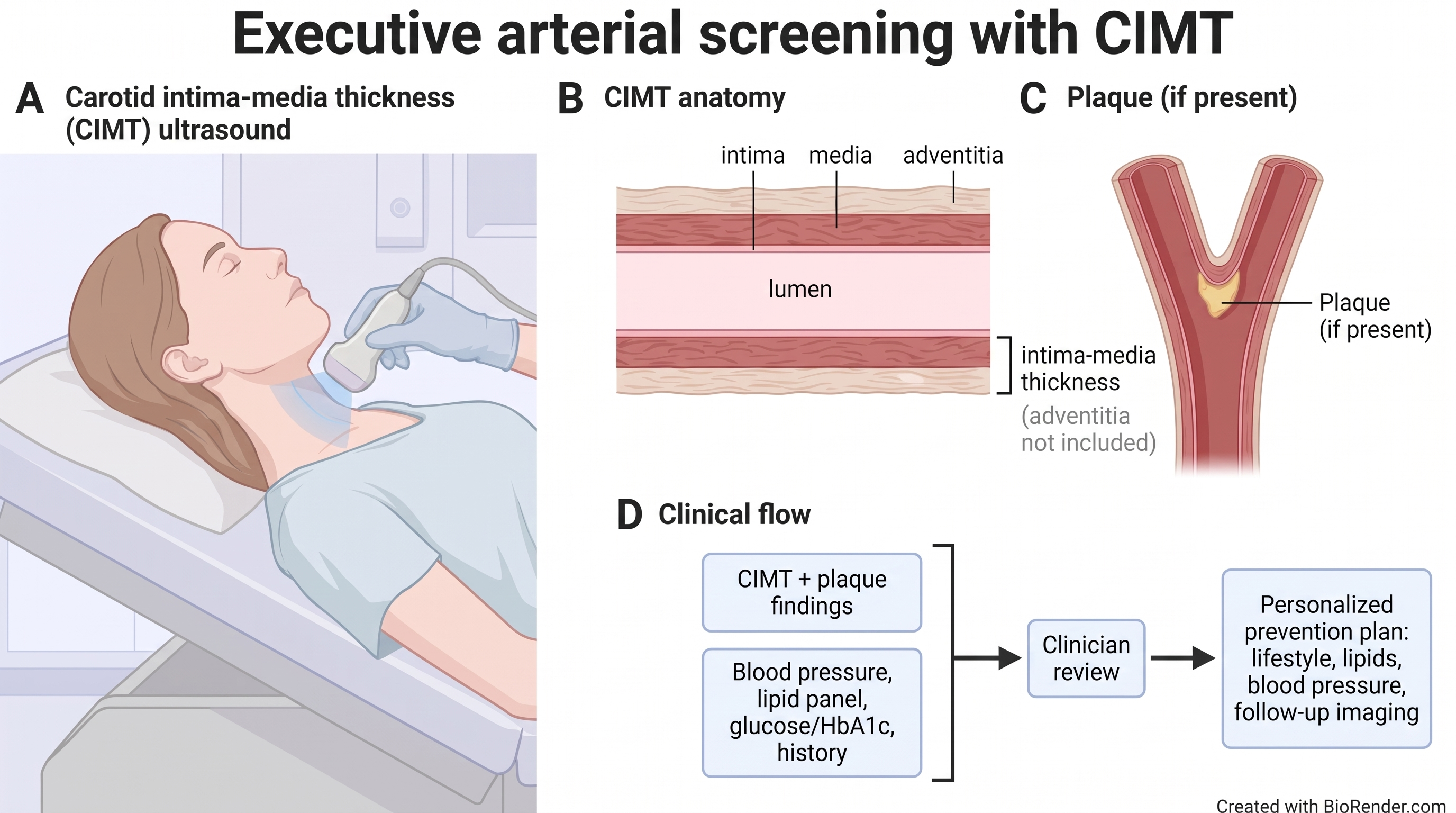
- Executive Physical With CIMT: What the Artery Scan Adds
Treat each hospital's list as that hospital's published options.
If the question is "which tests find arterial disease early," start with executive health screening and CIMT.
Cost and insurance coverage
Korenstein and colleagues, who collected prices from hospital websites for top-ranked hospitals on the 2018-2019 US News list, reported package costs ranging from $1,700 to $10,000 as of their September 2019 JAMA research letter (Korenstein et al., JAMA 2019). The same letter says flat fees generally include clinical assessments and specific laboratory and other diagnostic tests, with additional optional or personalized services, and that 3 hospitals offered multiple packages based on price (Korenstein et al., JAMA 2019). Those figures are hospital package prices from that study. They are a dated market range for comparison.
Cleveland Clinic's exam page says its corporate health consultant can help a company gather the information needed to add corporate health to its benefits portfolio (Cleveland Clinic executive health exams). No source on this page promises that a health plan pays the package fee. Ask your insurer in writing which line items it covers, and ask the program what you owe if the plan pays nothing. For cash quotes in more detail, see executive physical cost.
Full testing components
Cleveland Clinic publishes one public list. Its exam page says every appointment includes a thorough physical exam, nutrition consultation, exercise counseling, and a review of vaccinations, and may also include vision and hearing tests (Cleveland Clinic exam). Depending on your age and focus, the same page says tests might include:
- A variety of blood tests
- Electrocardiogram (EKG) and a cardiac stress test
- Calcium-score screening heart scan
- Spirometry, and a chest X-ray or CT scan
- Vascular screening tests
- Bone density test
For an extended stay, Cleveland Clinic adds total body MRI or total body CT, cognitive tests, neuropsychological testing, and cancer screening (Cleveland Clinic exam). Korenstein and colleagues sorted hospital package services into 6 domains: cardiovascular, otolaryngology and ophthalmology, cancer screening, lung disease screening, bone health, and total body computed tomography (Korenstein et al., JAMA 2019).
Cardiac, cancer, and metabolic markers in detail
Here is what the evidence says about common lab and screening items in those lists.
Cardiac markers. A cholesterol test reports LDL cholesterol, and a 2023 review in the Journal of the American Heart Association says low-density lipoprotein cholesterol is a major causal factor in the pathophysiology of atherosclerotic cardiovascular disease (Wilkinson et al., JAHA 2023). The 2019 ACC/AHA primary prevention guideline lists elevated high-sensitivity C-reactive protein among biomarkers associated with increased ASCVD risk, as risk-enhancing clinical factors that can be used to revise the 10-year ASCVD risk estimate (Arnett et al., Circulation 2019).
Metabolic markers. The American Diabetes Association notes that before symptoms appear, it is possible to demonstrate an abnormality in carbohydrate metabolism by measurement of plasma glucose in the fasting state, describes impaired fasting glucose (IFG) as a category of increased risk for diabetes, and defines fasting as no caloric intake for at least 8 h (ADA position statement, 2010).
Cancer screens. A 2023 CDC journal report on colorectal cancer screening notes that one project "initially offered screening to individuals aged 45 to 75 years, consistent with the most recent USPSTF guidelines" (Gupta et al., Prev Chronic Dis 2023). A 2016 guide to PSA screening guidelines notes "other possible influences on PSA levels, which include prostatitis, urinary tract infection" among other factors (Cabarkapa et al., Prostate Int 2016). On tumor markers, a 2013 review says it is the low prevalence of cancer in the general population that prohibits most biomarkers from being used in screening for cancer (Duffy, Med Princ Pract 2013).
Ask for the written list for your own itinerary, with each test marked as standard or optional.
Provider selection and facility requirements
These checks apply to a hospital itinerary, a longevity clinic, or a local practice.
Physician credentials. MedlinePlus says internists are doctors who have completed a residency in internal medicine and are board-certified or board-eligible in this specialty, and that family practitioners have completed a family practice residency and are board-certified or board-eligible (MedlinePlus: Choosing a primary care provider). A systematic review by Sharp and colleagues found that more than half of the screened studies supported an association between specialty board certification and positive clinical outcomes, and that few studies used research methods appropriate to the question (Sharp et al., Acad Med 2002).
Laboratory quality. Bennett and colleagues write that all US clinical laboratories must comply with the federal Clinical Laboratory Improvement Amendments (CLIA) or state equivalents, and that some laboratories choose additional accreditation (Bennett et al., J Immunol Methods 2025). MedlinePlus says lab tests don't provide a complete picture of your health, and that your provider reads your results along with other information about you (MedlinePlus: How to understand your lab results).
Imaging accreditation. Sloper and Katanick describe a federal Medicare law requiring nonhospital suppliers of the technical component of advanced diagnostic imaging, including MRI, CT, nuclear medicine, and PET, to obtain accreditation as a condition for reimbursement by the Centers for Medicare & Medicaid Services (Sloper and Katanick, J Med Pract Manage 2011).
Coordination, results follow-up, and handoff. A systematic review by Callen and colleagues found that the share of test results not followed up in ambulatory care ranged from 6.8% to 62% for laboratory tests and from 1.0% to 35.7% for radiology, with missed cancer diagnoses among the reported impacts (Callen et al., J Gen Intern Med 2012). The same review found few guidelines on who is responsible for notifying patients and following up (Callen et al., JGIM 2012). MedlinePlus says a primary care provider gives preventive care and makes referrals to medical or surgical specialists when necessary (MedlinePlus: Choosing a primary care provider).
Questions to ask a program:
- Who leads my visit, and which board certified that physician?
- Which tests are standard for my age, and which are optional add-ons?
- Which laboratory runs my blood work, and does it hold CLIA certification?
- Is each imaging site accredited for the scans on my itinerary?
- Will someone review results with me before I leave?
- Who calls me about an abnormal result after I go home?
- Will my primary care physician receive the full written report?
Who it is for, and how often programs say to return
- Executive Health Assessment: What It Checks, What Follows
- Mayo Clinic Executive Health vs Renew Health: Key Facts
Annual return is a scheduling habit those programs publish.
What an executive physical is not
A few limits keep the definition clear:
- Not a diagnosis by itself. Extra tests still need clinician interpretation and, when positive, confirmatory work.
- Not automatically insurance-covered. See executive physical cost.
- Not ongoing care by itself. Follow-up on results depends on your own clinician or a return visit.
Long-term health and productivity
Cleveland Clinic's exam page says that focusing on your health and wellness goals can mean many productive, active years ahead (Cleveland Clinic exam). A Cochrane review of general health checks found little or no effect on total mortality, cancer mortality, or fatal and non-fatal ischaemic heart disease (Krogsbøll et al., Cochrane 2019). Ask a program which of its tests change a treatment decision for someone your age.
Benefits for long-term health and productivity
Several studies measured gains that a mortality endpoint can miss.
Earlier detection and risk control. Liss and colleagues report that general health checks were linked to increased detection of chronic diseases such as depression and hypertension, moderate improvements in controlling blood pressure and cholesterol, and greater uptake of colorectal and cervical cancer screening (Liss et al., JAMA 2021).
Quality of life. The same review links general health checks to improvements in patient-reported outcomes, such as quality of life and self-rated health (Liss et al., JAMA 2021).
Productivity at work. In a health risk survey of 28,375 employees of a national company, Burton and colleagues found that each additional health risk factor was associated with a 2.4% excess productivity reduction, and that medium-risk and high-risk employees were 6.2% and 12.2% less productive than low-risk employees (Burton et al., J Occup Environ Med 2005).
Time away from work. In an earlier study of a worksite executive examination program, participants averaged 0.93 short-term disability days absent per year, compared with 1.34 for eligible executives who did not take part. The authors estimated a net return on investment of 2.3:1 (Burton et al., J Occup Environ Med 2002). Executives chose whether to participate, so the comparison is observational.
How Renew answers the same question
If you asked what is an executive physical because you want a thorough look and a plan that continues after the first visit, Renew's public answer is still the executive health program:
- Performance, $999/mo (primary)
- Executive, $5,000/mo (secondary, white-glove)
Renew's How It Works page maps a plan from "Month 1" to "End of Year," listing "Quarterly labs." with the note "Lab frequency depends on your plan" (How it works). Its CIMT page says, "We recommend a baseline scan followed by repeat imaging every 9-12 months" (CIMT).
Frequently asked questions
What is an executive physical in one sentence?
Cleveland Clinic's employer page calls its version a fully integrated, head-to-toe evaluation (Cleveland Clinic employer executive health).
How is an executive physical different from an annual physical?
Mayo Clinic's program page says its 1-to-3-day itinerary is tailored to your medical assessment (Mayo Clinic Executive Health).
What tests are included?
Cleveland Clinic's exam page says the tests might include a variety of blood tests, an electrocardiogram (EKG), and a cardiac stress test (Cleveland Clinic executive health exams). Mayo Clinic's experience page says the itinerary starts with a standard protocol, your physician may add recommended services, and you can select from a menu of optional services (Mayo Clinic Executive Health experience).
Who should get an executive physical?
Mayo Clinic's program page welcomes applications from working executives and business leaders (Mayo Clinic Executive Health).
How often should you get an executive physical?
Mayo Clinic's experience page says the visit is typically annual, while your connection to Mayo Clinic is year-round (Mayo Clinic Executive Health experience).
Does Renew offer an executive physical?
Renew's Executive Health page names Performance and Executive membership as Renew's executive-health path (Executive health). Performance at $999/mo is primary. Executive at $5,000/mo is secondary.
Sources
- Korenstein et al., JAMA 2019
- Mayo Clinic Executive Health Program
- Mayo Clinic Executive Health: Your Experience
- Cleveland Clinic About Your Executive Health Exam
- Evidence Brief: Role of the Annual Comprehensive Physical Examination in the Asymptomatic Adult (VA / NCBI Bookshelf)
- USPSTF A and B Recommendations
- MedlinePlus: Choosing a primary care provider
- MedlinePlus: How to understand your lab results
- Sharp et al., Acad Med 2002
- Bennett et al., J Immunol Methods 2025
- Sloper and Katanick, 2011
- Wilkinson et al., JAHA 2023
- Arnett et al., Circulation 2019
- ADA position statement, 2010
- Gupta et al., Prev Chronic Dis 2023
- Cabarkapa et al., Prostate Int 2016
- Duffy, Med Princ Pract 2013
- Callen et al., JGIM 2012
- Renew Health executive health program
Author and medical review
Written by Andrew Le, MD. Andrew Le, MD reviews patient-facing guidance for Renew Health with a focus on preventive cardiology and functional medicine clarity.
Medically reviewed by Clinical Review Team.
Next step
Read the definition against the commercial path on executive health. Primary CTA: Performance $999/mo. Secondary: Executive $5,000/mo. Full tiers on Pricing.
Ready to see your actual risk?
Advanced metabolic testing, arterial imaging, and a personalized prevention plan, built around your numbers.
View Memberships