Executive Checkup: What's Included and What Comes After
Andrew founded Renew Health to change how cardiovascular disease is detected and treated.
Direct answer: What is included in the executive check-up? An executive check-up (ECU) is “a comprehensive, bundled health screening designed to evaluate overall health, establish a health baseline, and detect hidden conditions early in a single, time-efficient visit”. Extended physical exam: A thorough head-to-toe physical evaluation and medical history review with an internal medicine specialist. Advanced diagnostics & labs: Complete blood counts, extensive metabolic and lipid panels, urinalysis, stool tests, and diabetes markers. Imaging & heart tests: Chest X-rays, electrocardiograms (ECGs/EKGs), stress tests, and ultrasounds (such as whole abdomen or prostate/pelvic scans). Specialized consults: Often includes evaluations by nutritionists, dietitians, optometrists, or audiologists. Personalized summaries: Provides a detailed, cohesive medical report and custom wellness plan.
The moment most people book
You run a company. You get a short visit with a clinician once a year, and the visit ends with "take a statin" and no explanation. Then a calcium score or a carotid scan comes back worse than expected, and you want the whole picture in one sitting. You also want your energy back, because the business runs on it.
An executive checkup compresses a year of separate appointments into one visit. It rarely covers month two, month six, and month twelve.
What an executive checkup includes
Published program menus follow a similar outline. Treat it as a checklist and confirm each line with the program you choose.
- Physical exam. A long exam and a detailed history review.
- Labs. Blood counts, metabolic and lipid panels, urine and stool tests, and diabetes markers.
- Imaging. A chest X-ray and ultrasound, and sometimes a body composition scan or a coronary calcium scan.
- Heart tests. A resting ECG and an exercise stress test.
- Consults. Nutritionists, dietitians, optometrists, or audiologists.
- A written report. A summary and a wellness plan at the end of the visit.
Renew's plan, next, picks up where that visit ends.
After the checkup: stop it, then reverse it
Most checkups end with the report and a hand-off to local care. If you want the follow-up run as ongoing care, Renew's Performance and Executive memberships start with CIMT imaging, a direct ultrasound of the carotid artery wall, and a workup for 33 known drivers of arterial damage across inflammation, metabolic, genetic, infectious, sleep, and oral pathogen groups. The care team then treats those drivers through the year.
First we stop it. Then we work to reverse it. Your 12-month rescan shows which. If the wall holds steady, that counts as the first win.
Whatever program you choose, ask who is on the team, who reads your results with you, and who you can reach after the visit.
Visits happen by video and messaging. Performance and Executive include in-home blood draws. On the Essentials and Reversal tiers, labs run through Quest. Five trained providers share the work on every Renew membership. Renew is cash-pay and works outside insurance.
Primary: Performance, $999/mo. Monthly physician visits, tune-up labs four times a year, and DEXA and VO2 Max testing twice a year.
Secondary: Executive, $5,000/mo. Performance plus weekly coaching and unlimited physician access. Other tiers are on Pricing. To compare one-time checkup fees and coverage, see executive physical cost and does insurance cover an executive physical.
Each part of the checkup, test by test
Physical exam
A long exam and a detailed history review. This is where family history, sleep, stress, and medications come up.
Labs
Blood counts, metabolic and lipid panels, urine and stool tests, and diabetes markers form the base. Many programs extend it with thyroid, vitamin, and inflammation markers. The three worth asking about by name are hs-CRP, Lp(a), and apoB. The 2018 cholesterol guideline treats each as a risk enhancer when measured, at hs-CRP of 2.0 mg/L or higher, Lp(a) of 50 mg/dL (125 nmol/L) or higher, and apoB of 130 mg/dL or higher (Grundy et al., Circulation 2019). It also names reasons to measure Lp(a) and apoB, such as a family history of premature heart disease or high triglycerides. Ask whether any of those reasons apply to you.
Advanced diagnostic imaging
Imaging on a checkup menu usually means a chest X-ray and ultrasound, and sometimes a body composition scan or a coronary calcium scan. Each answers a different question. Ask what each one is for on your itinerary.
Chest X-ray. A chest X-ray shows the lungs, the outline of the heart, and the large vessels. It is a weak tool for finding lung cancer early, which is why lung screening uses low-dose CT instead (see cancer screening below).
Ultrasound. Abdominal ultrasound looks at organs such as the liver, kidneys, and gallbladder. Pelvic or prostate ultrasound looks at those organs. A carotid ultrasound looks at the neck arteries and can measure the thickness of the artery wall. That wall measurement, CIMT, is where Renew starts. Ask which ultrasound is on your list and what finding would lead to a next step.
Body composition. A DEXA scan measures fat, lean mass, and bone, and can estimate visceral fat, the fat packed around the organs. Kaul and colleagues measured 124 adults with both DEXA and CT. DEXA visceral fat tracked the CT measurements closely, with an r² of about 0.96 (Kaul et al., Obesity 2012). The authors describe visceral fat as a stronger predictor of adverse events than fat under the skin.
Coronary calcium scan. A CT that scores calcified plaque in the heart arteries. What each score means for a statin decision is covered below.
Heart tests
Electrocardiogram (ECG). A resting ECG records the heart's electrical signal for a few seconds. It can show rhythm problems or signs of an earlier heart attack. A normal resting ECG says little about plaque in the artery wall.
Exercise stress test. A treadmill test shows how your heart rate, blood pressure, and ECG respond to effort, and it estimates your fitness. In a cohort of 122,007 patients who had treadmill testing, the least fit group had about five times the adjusted risk of death of the fittest group over a median of 8.4 years (Mandsager et al., JAMA Netw Open 2018). That gap was larger than the ones the study found for smoking, diabetes, or coronary artery disease. Ask for your fitness result in writing, because it is one of the few numbers from the day you can train to change. Renew's Performance tier repeats VO2 Max testing twice a year.
What a calcium score changes, and what it leaves open
A coronary artery calcium (CAC) score is one of the most useful heart tests to understand before you book, because the guidelines tie specific scores to specific decisions.
The 2018 AHA/ACC cholesterol guideline says that when a statin decision is uncertain in an intermediate-risk adult, measuring CAC can help (Grundy et al., Circulation 2019):
- A score of zero can support holding off on a statin, with exceptions for cigarette smokers, people with diabetes, and people with a strong family history of premature ASCVD.
- A score of 1 to 99 favors statin therapy, especially from age 55 on.
- A score of 100 or higher, or at or above the 75th percentile, points to statin therapy unless the clinician and patient decide otherwise.
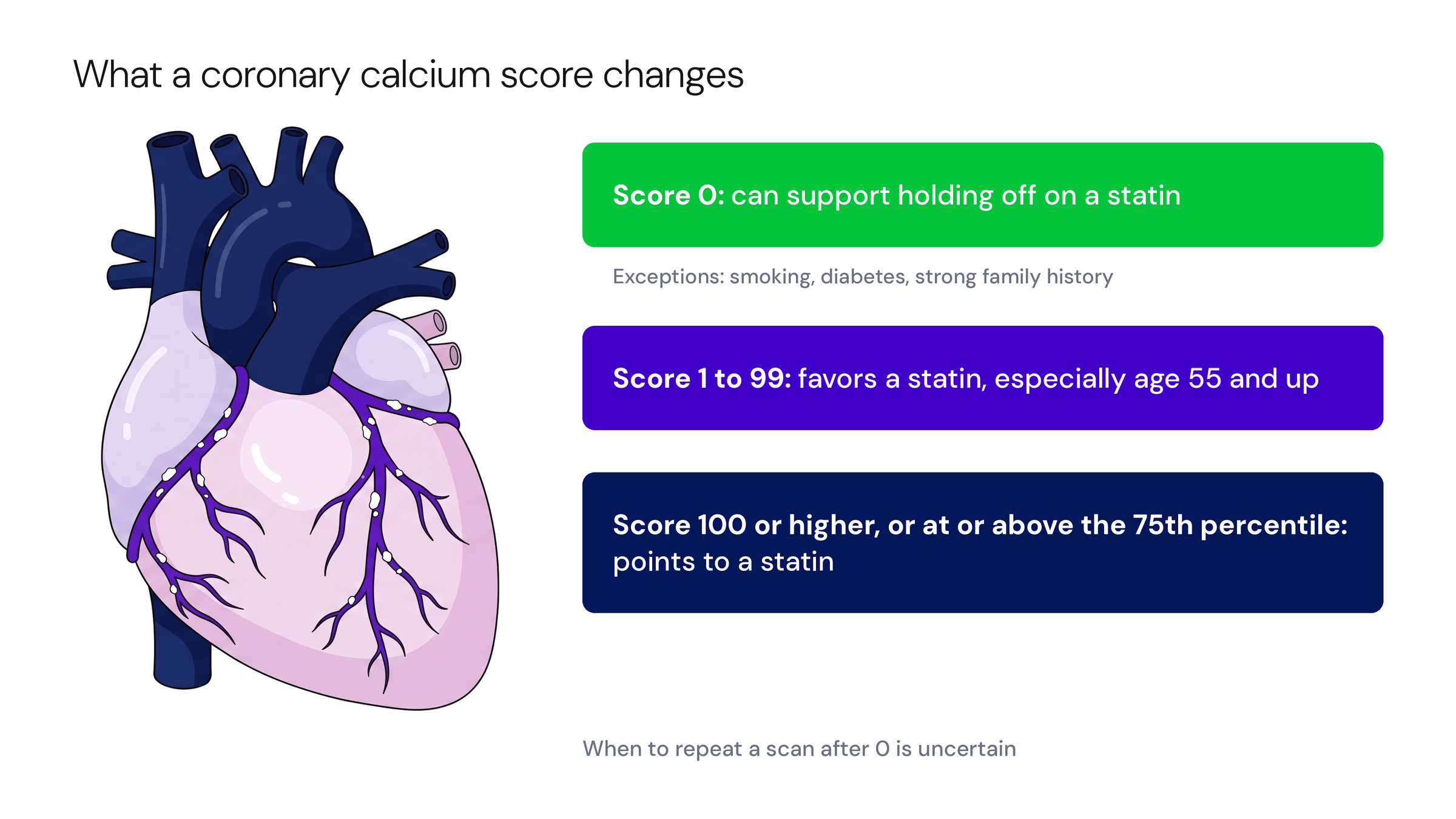
The same guideline is candid about gaps. It says it is currently uncertain when, or whether, a follow-up CAC scan should be done after a score of zero.
That gap matters. A calcium score is one snapshot. The question most people have next is "is it still growing?" A one-time checkup is built to answer a different question.
What to ask for in the report
Most programs close with a written summary and a wellness plan. A useful report lists each raw value next to its reference range. It says which results change a decision, such as a statin, a referral, or a repeat test. It also names who follows up, and when.
The cholesterol guideline gives one model for that follow-up. After a statin is started or its dose changes, it recommends a repeat lipid test in 4 to 12 weeks, then every 3 to 12 months as needed, and it judges the response by the percentage drop in LDL-C from baseline (Grundy et al., Circulation 2019). Ask your program who orders that repeat test, and who reads it with you.
Is an executive checkup worth the money?
A Cochrane review pooled 17 randomized trials of general health checks, covering 251,891 participants (Krogsbøll et al., Cochrane 2019). The people studied were adults picked without regard to disease or risk factors. Offering them health checks had little or no effect on total or cancer mortality. It probably had little or no effect on cardiovascular mortality.
The review's authors describe the major harms of health checks as overdiagnosis, psychological effects such as worry, complications from follow-up tests, and unnecessary treatment.
That evidence argues against buying a big panel by default. It says less about a person who already has a finding and wants a plan. For that person, the checkup is worth the money when a result leads to a decision, and the decision gets re-measured.
Other tests on the menu, and what Renew covers
Renew's plan centers on your arteries. Like the rest of a standard checkup, each test below is a one-time snapshot unless someone owns the follow-up.
Cancer screening
Cancer screening on a checkup is chosen by age, sex, and family history, so the test list differs from person to person on the same program. The common ones are:
- Colonoscopy or stool-based tests for colorectal cancer. A colonoscopy needs bowel preparation and sedation, so ask whether it fits the checkup day or needs its own appointment. Stool tests can be collected at home and sent in.
- Mammography for breast cancer, usually ordered as a referral.
- Pap smear and HPV testing for cervical cancer.
- PSA blood testing for prostate cancer, which is worth discussing with the clinician before the draw, since a high result often leads to more testing.
- Low-dose chest CT for lung cancer in people with a heavy smoking history.
Every screening test trades early detection against false alarms. In the National Lung Screening Trial, low-dose CT cut lung cancer deaths by 20% compared with chest radiography. In that same trial, 96.4% of positive CT results were false positives (National Lung Screening Trial Research Team, N Engl J Med 2011). Ask the program which guideline it follows for each test, and what happens after an abnormal result. Renew doesn't do cancer screening. Your primary care doctor does, and we'll coordinate with them.
Genetic testing
Offered by some programs. Ask which genes, why, and who explains the result. Ask how the result will change your plan before you consent. Ask whether the report goes into your medical record. Renew's 33-driver workup includes genetic drivers of arterial damage. Renew doesn't do broader genetic panels. Ask your primary care doctor about a genetic counselor.
MRI
The published program menus we reviewed do not list MRI as a standard item. If a program offers one, ask what question it answers for you and what happens if it finds something incidental. Renew doesn't do MRI. Your primary care doctor can refer you if you need one.
Vision, hearing, and nutrition consults
Nutritionists, dietitians, optometrists, and audiologists appear on many lists. Ask whether the nutrition advice gets a follow-up session, or ends with a handout on the day. Renew doesn't do vision or hearing testing. Your primary care doctor can order these or refer you.
Frequently asked questions
What is included in the executive check-up?
An executive check-up (ECU) is “a comprehensive, bundled health screening designed to evaluate overall health, establish a health baseline, and detect hidden conditions early in a single, time-efficient visit”. Extended physical exam: A thorough head-to-toe physical evaluation and medical history review with an internal medicine specialist. Advanced diagnostics & labs: Complete blood counts, extensive metabolic and lipid panels, urinalysis, stool tests, and diabetes markers. Imaging & heart tests: Chest X-rays, electrocardiograms (ECGs/EKGs), stress tests, and ultrasounds (such as whole abdomen or prostate/pelvic scans). Specialized consults: Often includes evaluations by nutritionists, dietitians, optometrists, or audiologists. Personalized summaries: Provides a detailed, cohesive medical report and custom wellness plan.
What is an executive checkup?
An executive check-up (ECU) is “a comprehensive, bundled health screening designed to evaluate overall health, establish a health baseline, and detect hidden conditions early in a single, time-efficient visit”.
Does an executive checkup include heart tests?
Imaging & heart tests: Chest X-rays, electrocardiograms (ECGs/EKGs), stress tests, and ultrasounds (such as whole abdomen or prostate/pelvic scans).
What do you get at the end of an executive checkup?
Personalized summaries: Provides a detailed, cohesive medical report and custom wellness plan.
Sources
- Krogsbøll LT, et al. General health checks in adults for reducing morbidity and mortality from disease. Cochrane Database Syst Rev. 2019. Main results and harms.
- Grundy SM, et al. 2018 AHA/ACC Guideline on the Management of Blood Cholesterol: Executive Summary. Circulation. 2019. CAC recommendations and evidence gaps.
- National Lung Screening Trial Research Team. Reduced Lung-Cancer Mortality with Low-Dose Computed Tomographic Screening. N Engl J Med. 2011. Low-dose CT against chest radiography.
- Kaul S, et al. Dual-energy X-ray absorptiometry for quantification of visceral fat. Obesity. 2012. DXA against CT in 124 adults.
- Mandsager K, et al. Association of Cardiorespiratory Fitness With Long-term Mortality Among Adults Undergoing Exercise Treadmill Testing. JAMA Netw Open. 2018. 122,007 patients, median follow-up 8.4 years.
- Executive health memberships.
- Pricing.
- How it works.
Author and medical review
Written by Andrew Le, MD. Andrew Le, MD reviews patient-facing guidance for Renew Health with a focus on preventive cardiology and functional medicine clarity.
Medically reviewed by Clinical Review Team.
Next step
If a checkup already gave you a number you want to change, start with Performance at $999/mo on executive health. Executive at $5,000/mo is listed on the same page.
Structured data
{
  "@context": "https://schema.org",
  "@type": "FAQPage",
  "mainEntity": [
    {
      "@type": "Question",
      "name": "What is included in the executive check-up?",
      "acceptedAnswer": {
        "@type": "Answer",
        "text": "An executive check-up (ECU) is “a comprehensive, bundled health screening designed to evaluate overall health, establish a health baseline, and detect hidden conditions early in a single, time-efficient visit”. Extended physical exam: A thorough head-to-toe physical evaluation and medical history review with an internal medicine specialist. Advanced diagnostics & labs: Complete blood counts, extensive metabolic and lipid panels, urinalysis, stool tests, and diabetes markers. Imaging & heart tests: Chest X-rays, electrocardiograms (ECGs/EKGs), stress tests, and ultrasounds (such as whole abdomen or prostate/pelvic scans). Specialized consults: Often includes evaluations by nutritionists, dietitians, optometrists, or audiologists. Personalized summaries: Provides a detailed, cohesive medical report and custom wellness plan."
      }
    },
    {
      "@type": "Question",
      "name": "What is an executive checkup?",
      "acceptedAnswer": {
        "@type": "Answer",
        "text": "An executive check-up (ECU) is “a comprehensive, bundled health screening designed to evaluate overall health, establish a health baseline, and detect hidden conditions early in a single, time-efficient visit”."
      }
    },
    {
      "@type": "Question",
      "name": "Does an executive checkup include heart tests?",
      "acceptedAnswer": {
        "@type": "Answer",
        "text": "Imaging & heart tests: Chest X-rays, electrocardiograms (ECGs/EKGs), stress tests, and ultrasounds (such as whole abdomen or prostate/pelvic scans)."
      }
    },
    {
      "@type": "Question",
      "name": "What do you get at the end of an executive checkup?",
      "acceptedAnswer": {
        "@type": "Answer",
        "text": "Personalized summaries: Provides a detailed, cohesive medical report and custom wellness plan."
      }
    }
  ]
}
{
  "@context": "https://schema.org",
  "@type": "Article",
  "headline": "Executive Checkup: What's Included and What Comes After",
  "description": "What an executive checkup includes: exam, labs, heart tests, and consults in one visit. What a calcium score changes, and how Renew keeps measuring after.",
  "image": [
    {
      "@type": "ImageObject",
      "contentUrl": "/images/blog/executive-checkup/executive-checkup-calcium-score-bands.png",
      "name": "What a coronary calcium score changes",
      "caption": "A heart with coronary arteries flecked with white calcium sits beside three color bands. A score of 0 can support holding off on a statin, a score of 1 to 99 favors a statin, and a score of 100 or higher or at or above the 75th percentile points to a statin.",
      "creditText": "Created with BioRender.com (Industry)."
    }
  ],
  "author": {
    "@type": "Person",
    "name": "Andrew Le, MD",
    "description": "Andrew Le, MD reviews patient-facing guidance for Renew Health with a focus on preventive cardiology and functional medicine clarity."
  },
  "reviewedBy": {
    "@type": "Person",
    "name": "Clinical Review Team"
  },
  "datePublished": "2026-09-28",
  "mainEntityOfPage": "/evidence/executive-checkup"
}
{
  "@context": "https://schema.org",
  "@type": "MedicalWebPage",
  "name": "Executive Checkup: What's Included and What Comes After",
  "description": "What an executive checkup includes: exam, labs, heart tests, and consults in one visit. What a calcium score changes, and how Renew keeps measuring after.",
  "medicalAudience": {
    "@type": "MedicalAudience",
    "audienceType": "Patients"
  },
  "reviewedBy": {
    "@type": "Person",
    "name": "Clinical Review Team"
  },
  "lastReviewed": "2026-09-28"
}
Ready to see your actual risk?
Advanced metabolic testing, arterial imaging, and a personalized prevention plan — built around your numbers.
View Memberships