Corporate Executive Physical: Employer vs Individual
Andrew founded Renew Health to change how cardiovascular disease is detected and treated.
Korenstein and colleagues' 2019 JAMA research letter says executive physicals are provided by employers as perks for corporate leaders but can also be purchased by individuals (Korenstein et al., JAMA 2019). Mayo Clinic's Executive Health FAQ offers a corporate enrollment option for companies with 25+ employees, in which the company determines eligible executives, Mayo Clinic campus options, preferred billing, and what they will and won't cover (Mayo Clinic Executive Health FAQ, MC1927-43). Mayo Clinic's Executive Health FAQ says the executive services fee is typically out-of-pocket unless covered by your company through corporate enrollment, and requires executive patients to have a local primary care provider for personal health needs, including medication refills, throughout the year (Mayo Clinic Executive Health FAQ, MC1927-43). Performance at $999/mo is primary. Executive at $5,000/mo is secondary.
Your company offers a physical day, but last year's ended with "just take a statin" and no plan for the next twelve months.
How a corporate executive physical differs from a standard annual exam
Korenstein and colleagues' 2019 JAMA research letter describes executive physicals as 1- to 2-day comprehensive evaluations offering putative preventive testing and screening, and says flat fees for packages generally include clinical assessments and specific laboratory and other diagnostic tests, with additional optional or personalized services (Korenstein et al., JAMA 2019). Korenstein and colleagues also write that executive physicals allow companies to reward valued executives and perhaps reassure investors of executives' health (Korenstein 2019). The same research letter found that the most commonly included package services were hearing examination (83%) and electrocardiogram (83%), both with I grades from the USPSTF (Korenstein 2019).
For routine preventive care, the USPSTF says its A and B grade recommendations are services that the Task Force most highly recommends implementing for preventive care (USPSTF A and B recommendations).
Employer package versus an individual booking
The medical day can look similar. The contract is a different document.
| Question | Individual booking | Corporate package |
|---|---|---|
| Who chooses eligibility? | You, if the program accepts you | The employer, often by title or leadership tier |
| Who is the payer of record? | You, then possibly insurance | The company for an agreed scope. Extras often stay with you |
| What should you read first? | The clinic itinerary and a benefits quote | The company's covered-services list and the clinic's corporate terms |
| What still needs a clinician? | Interpretation and follow-up | The clinician still owns interpretation and follow-up |
Scope, eligibility, and employer subsidy
Lead with the contract, then the clinic. These criteria are the ones Mayo Clinic publishes for its own corporate enrollment (Mayo Clinic FAQ).
| Criterion | What Mayo Clinic publishes (Mayo Clinic FAQ) | What to confirm on your agreement |
|---|---|---|
| Who is eligible | FAQ flyer: typically CEO, president, C-suite, the business leadership team, and/or VPs and above | The titles your company actually enrolled |
| Which employers qualify | FAQ flyer: corporate enrollment for companies with 25 or more employees | Whether your company meets that program's bar |
| What the employer subsidizes | FAQ flyer: the company determines eligible executives, campus options, billing preferences, and what it will and will not cover | The covered dates, campuses, and tests |
| What stays on your bill | The company decides the lines it pays and the lines left to you | Add-on imaging, specialty consults, and any line the agreement leaves to you |
| Who is the clinician the rest of the year | A local primary care clinician is required for day-to-day needs, including medication refills | The name of that clinician and whether the visit summary can be shared with them |
Take the same five rows to HR and to the clinic. Corporate discounts, where a program offers them, are a question for that program.
Target audience and eligibility criteria
Korenstein and colleagues write that, by their nature and price, executive physicals tend to be used by wealthy individuals and corporate leaders (Korenstein et al., JAMA 2019). The same letter says they may be offered by luxury spas, freestanding companies, or academic medical centers (Korenstein et al., JAMA 2019). Mayo Clinic's FAQ says that when a person applies for an appointment, they answer questions about their work status, business title, company, and company size before being invited to be part of its program (Mayo Clinic FAQ). The same Mayo Clinic FAQ says a patient not seen for an Executive Health appointment within three years is considered inactive and would have to requalify to be invited into the program (Mayo Clinic FAQ). Eligibility for an exam day is separate from routine preventive care. The USPSTF notes that its A and B grade recommendations are also relevant for implementing the Affordable Care Act (USPSTF A and B recommendations). Ask HR which titles qualify and whether eligibility lapses if you skip a year.
What HR and the executive should each confirm
If you are the person attending, ask HR and the clinic for four written answers:
- Covered scope. Which dates, campuses, and tests the company pays.
- Excluded scope. Add-on imaging, specialty consults, and anything billed as diagnostic.
- Your share. What hits you if you say yes to an optional test.
- The handoff. Who gets the clinical summary, and who is your physician the rest of the year.
If you are designing the benefit, take the clinical standard from the clinic's itinerary. Skip return-on-investment estimates and homemade savings percentages.
Privacy and scheduling
Privacy is a contract question. Ask, in writing:
- Does HR receive results, dates only, or nothing clinical?
- Can you decline release to the employer and still attend?
- Where does the medical record live, separate from the personnel file?
Do not assume a wellness vendor and a medical clinic follow the same rules. Confirm with the clinic's privacy notice and your benefits office.
Scheduling decides whether the benefit works in real life. Time details are on how long an executive physical takes.
Individual results belong to you and your clinician. They stay out of HR.
One individual membership option if the company package is a single exam day
Renew operates outside insurance (Pricing). Medicare does not cover the membership.
If an employer wants to reimburse you, that is between you and the employer. See does insurance cover an executive physical and executive physical HSA. Neither page promises payment.
For how to judge any program, corporate or not, see best executive physical. If your company is choosing a program for its whole leadership team, see how to choose a corporate executive health program.
Advanced imaging and diagnostic testing
Cleveland Clinic's services page says its tests might include a cardiac stress test, a calcium-score screening heart scan, a chest X-ray or CT scan, vascular screening tests, and a bone density test, and that an extended stay can add scans like a total body MRI or total body CT scan (Cleveland Clinic Executive Health). Atrium Health lists CT calcium scoring and a treadmill exercise stress test on its Healthy Heart exam, a CT coronary angiogram on Healthy Heart 2.0, and a diagnostic MRI of the brain on its Healthy Brain exam (Atrium Health Executive Physical). Sutter Health says full-body scans are not currently available to patients who are healthy and symptom free (Sutter Health Executive Health Program).
RadiologyInfo says CT images of internal organs, bones, soft tissue, and blood vessels provide greater detail than traditional x-rays (RadiologyInfo: Body CT). RadiologyInfo says MRI uses a powerful magnetic field, radiofrequency pulses, and a computer to produce detailed pictures of internal body structures, and that MRI does not use radiation (x-rays) (RadiologyInfo: Body MRI).
Comprehensive blood panel and biomarkers
Ask for the lab panel by name before the day, since programs publish different lists. Cleveland Clinic's exam page says its tests will be targeted to your specific situation and might include a variety of blood tests (Cleveland Clinic exam). Cleveland Clinic's 2024 Executive Health self-pay fee schedule lists a laboratory panel that includes a complete blood count (CBC) with differential, a lipid profile, a complete metabolic profile (CMP), thyroid-stimulating hormone (TSH), urinalysis, ultra-sensitive C-reactive protein (U-CRP), lipoprotein (a), hemoglobin A1C (HbA1C), apolipoprotein B (ApoB), and 25-hydroxy vitamin D (Cleveland Clinic self-pay fee schedule). National Jewish Health says its comprehensive laboratory panel includes lab testing such as CBC differential, comprehensive metabolic panel, hemoglobin A1C, thyroid function, vitamins B-12 and D, and urinalysis (National Jewish Health Executive Health). National Jewish Health says its advanced lipid screening measures proteins called lipoprotein (a), or Lp(a), and apolipoprotein B (ApoB), providing a more comprehensive view of cardiovascular risk than standard cholesterol tests (National Jewish Health Executive Health). MedlinePlus says nutrients and ingredients in food are absorbed in your bloodstream, might still be there when you have your test, and may change the results of certain blood tests (MedlinePlus). MedlinePlus adds that fasting can help to improve the accuracy of your test results, and that the length of time you need to fast can vary (MedlinePlus). No single value is a diagnosis, so ask who will explain each result and what would change your plan.
Cost, insurance, and what to expect on the day
How the bill splits. In Korenstein and colleagues' 2019 JAMA research letter, executive physical package costs at top-ranked US hospitals ranged from $1,700 to $10,000 (Korenstein et al., JAMA 2019). Cleveland Clinic's fee schedule lists the core visit block at $1,346, prices tests such as an exercise stress test ($860) and a coronary calcium score test ($45) as separate lines, and says those services have been discounted for self-payors and therefore cannot be billed to insurance (Cleveland Clinic self-pay fee schedule). Mayo Clinic's Executive Health FAQ says Mayo Clinic files claims with your carrier for the parts of your care that are typically covered by insurance, that the non-clinical executive services fee is usually paid by the patient or the company, and that select other tests and services may also not be covered by insurance (Mayo Clinic Executive Health FAQ, MC1927-43). More price examples are on executive physical cost.
How the day runs. Mayo Clinic's experience page says each visit begins and ends with time with the Executive Health physician (Mayo Clinic).
Long-term health risk: cancer screening, cognition, and the next year
Cancer screening. The USPSTF recommends colorectal cancer screening for adults 45 to 75 (grade A for ages 50 to 75, grade B for ages 45 to 49) and selective screening for ages 76 to 85 (USPSTF). It recommends annual lung cancer screening with low-dose CT for adults 50 to 80 who have a 20 pack-year smoking history and smoke now or quit within the past 15 years (USPSTF). Screening should be discontinued once a person has not smoked for 15 years or develops a health problem that substantially limits life expectancy or the ability or willingness to have curative lung surgery (USPSTF). The same task force recommends breast and cervical cancer screening in defined age and risk groups, as the best executive physical page already summarizes. National Jewish Health includes a lab-based colon cancer test for people at low risk, a PSA test for men, and a Pap test for women in its executive packages, and Galleri multi-cancer testing on the Premier and Performance packages (National Jewish Health). Cleveland Clinic's services page says an extended stay may include cancer screening (Cleveland Clinic). Atrium Health lists age-appropriate cancer screens on its Healthy Brain, Healthy Body, and Healthy Genome exams (Atrium Health).
Cognitive decline. The USPSTF concludes that evidence is insufficient to assess the balance of benefits and harms of screening for cognitive impairment in community-dwelling adults 65 and older who have no recognized signs or symptoms (I statement) (USPSTF). The USPSTF page says this topic is being updated (USPSTF). National Jewish Health includes cognitive screening for memory, recall, executive function, and processing time in all four packages, and an optional brain MRI on Core and Advanced (National Jewish Health). Cleveland Clinic also lists, for an extended stay, cognitive tests and neuropsychological testing (Cleveland Clinic). Atrium Health's Healthy Brain Exam includes a diagnostic MRI of the brain and a complete cognitive assessment (Atrium Health).
Multi-year trajectory. Duke Executive Health says you leave with a schedule for periodic health maintenance and that most people return annually to update the plan (Duke). Northwestern Medicine describes its executive physical as a comprehensive annual examination, with testing and a results review the same day (Northwestern Medicine). Cleveland Clinic's employer page says the physician prepares a written report with next steps, and that virtual and in-person follow-up visits are available (Cleveland Clinic employers).
Preparation instructions and what to expect
A typical day, in order:
- Before the day. Cleveland Clinic's employer page says pre-appointment consultations with a nurse ensure all needs are addressed (Cleveland Clinic Executive Health).
- Labs. Sutter Health's sample itinerary starts with a lab blood draw at 7:00 a.m., then a light breakfast in its executive lounge at 7:15 a.m. (Sutter Health).
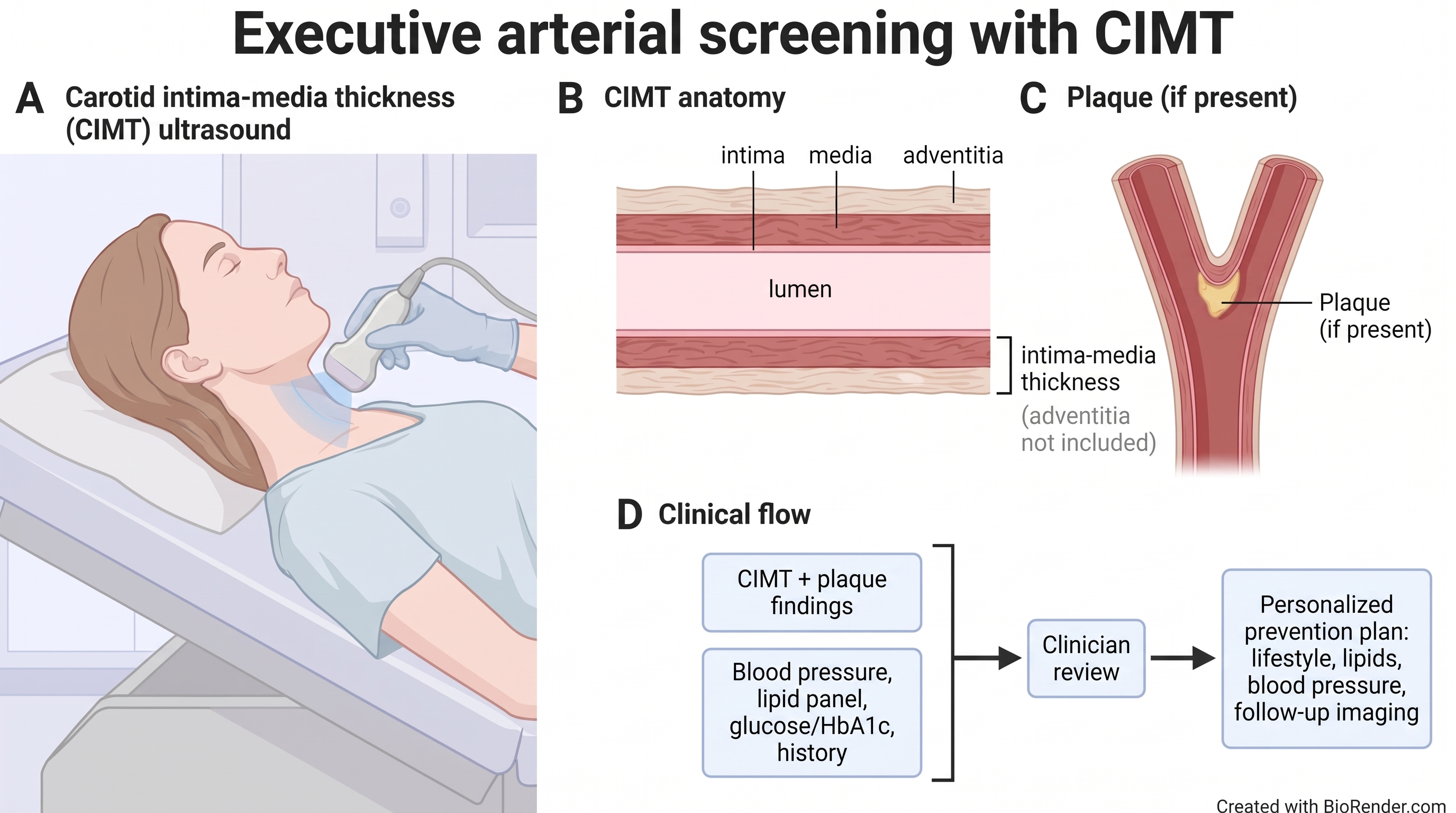
- Imaging and stress testing. From 8:00 to 11:30 a.m., Sutter's sample itinerary lists a carotid artery ultrasound, nutrition consultation, stress echocardiogram, and hearing evaluation (Sutter Health).
- Exam. Sutter's sample itinerary lists a physical examination with a physician from 11:30 a.m. to 12:30 p.m., an extended appointment that allows for a detailed discussion of lab results (Sutter Health).
- Specialist consults. Cleveland Clinic's employer page says that if specialty consultations are necessary, participants have priority access to more than 120 Cleveland Clinic medical and surgical experts (Cleveland Clinic Executive Health).
- Results and wrap-up. Cleveland Clinic's employer page says most test results are available the same day, and that a written report is prepared by the physician with patient results and clear next steps (Cleveland Clinic Executive Health).
What to bring and how to prep
- A written list of medicines, vitamins, and supplements, since MedlinePlus advises telling your provider about any medicines, vitamins, or supplements that you are taking (MedlinePlus).
- Your medical history, since Cleveland Clinic says your provider will ask questions about your medical history and any medications you take (Cleveland Clinic exam).
- Ask how long to fast, because MedlinePlus lists the blood glucose test and the cholesterol levels test among the most common lab tests that require fasting (MedlinePlus).
Frequently asked questions
Does Renew sell a corporate executive physical contract?
No. Renew's Pricing page lists memberships, with Executive at $5,000/mo and Performance at $999/mo (Pricing). Renew operates outside insurance (Pricing).
Is a corporate day the same as year-round care?
No. Renew's Pricing page says every membership measures your arterial disease and builds a plan to reverse it (Pricing). Pricing lists DEXA Body Composition Scan and VO2 Max Testing at 2x/year on Performance and 4x/year on Executive (Pricing).
Sources
- Mayo Clinic Executive Health Program (corporate enrollment and campus options vary by company agreement)
- Mayo Clinic Executive Health apply page (corporate enrollment criteria. local primary care required)
- Renew Health executive health program
- Renew Health pricing
- Mayo Clinic Executive Health: Your Experience (visits start and end with physician time)
- USPSTF colorectal cancer screening (May 18, 2021)
- USPSTF lung cancer screening (March 9, 2021)
- USPSTF cognitive impairment screening in older adults (I statement; page notes an update in progress)
- National Jewish Health Executive Health
- Cleveland Clinic Executive Health
- Cleveland Clinic Executive Health for employers
- Atrium Health Executive Physical
- Duke Executive Health
- Northwestern Medicine Executive Health
- Korenstein D, Mamoor M, Bach PB. Preventive services offered in executive physicals at top-ranked hospitals. JAMA. 2019
- Mayo Clinic Executive Health FAQ, MC1927-43
- USPSTF A and B recommendations
- Cleveland Clinic Executive Health self-pay fee schedule (2024)
- Sutter Health Executive Health Program
- RadiologyInfo: Body CT
- RadiologyInfo: Body MRI
Author and medical review
Written by Andrew Le, MD. Andrew Le, MD reviews patient-facing guidance for Renew Health with a focus on preventive cardiology and functional medicine clarity.
Medically reviewed by Clinical Review Team.
Next step
Performance at $999/mo is primary. Executive at $5,000/mo is secondary.
The program details are on Executive health.
Ready to see your actual risk?
Advanced metabolic testing, arterial imaging, and a personalized prevention plan, built around your numbers.
View Memberships