Blood Tests in an Executive Physical: The Panel, Explained
Andrew founded Renew Health to change how cardiovascular disease is detected and treated.
Direct answer: What is included in an executive physical? Complete Blood Count (CBC): Evaluates overall health and checks for conditions like anemia or infection. Comprehensive Metabolic Panel (CMP): Assesses blood sugar, fluid balance, electrolyte levels, and kidney/liver function. Standard & Advanced Lipid Panels: Goes beyond basic cholesterol to measure LDL, HDL, triglycerides, and often NMR lipoprotein subfractions or ApoB for a precise look at cardiovascular risk. Metabolic & Diabetes Indicators: Hemoglobin A1C and HOMA-IR insulin resistance scoring. Inflammatory Markers: High-sensitivity C-reactive protein (hs-CRP) to detect systemic inflammation linked to heart disease. Nutritional Status: Vitamin D levels and homocysteine.
When the numbers stop making sense
You eat well, you train, and your LDL or ApoB still went up two years running. The answer you got was that it looks fine for now, or that a statin will handle it. You want to know why the number is moving, whether your arteries are paying for it, and how to get back the energy the business has cost you.
The panel decides which questions your results can answer.
The foundational panels
Panel sizes vary by program, but almost every one starts with three panels.
- Complete blood count (CBC). Red cells, white cells, and platelets. It flags problems such as anemia or infection.
- Comprehensive metabolic panel (CMP). Blood sugar, electrolytes, fluid balance, and kidney and liver function.
- Lipid panel. LDL, HDL, triglycerides, and total cholesterol. Some programs extend it with lipoprotein subfractions or ApoB.
Most program pages treat these three panels as the base layer. The differences between programs show up in the next layer.
Advanced biomarkers and risk assessment
Published program menus list a second tier of markers:
- Metabolic markers. Hemoglobin A1C and HOMA-IR insulin resistance scoring.
- Inflammation. High-sensitivity C-reactive protein (hs-CRP).
- Hormones and thyroid. A full thyroid panel and other hormone levels.
- Nutrition. Vitamin D and homocysteine.
- Organ markers. Liver and kidney markers.
- Cancer markers. PSA where appropriate, and sometimes an optional multi-cancer early detection blood test. Details are below.
- Infectious disease screening. Tests such as hepatitis C or HIV, depending on the protocol.
How Renew measures and re-measures these markers
If you want these markers measured and re-measured as ongoing care, Renew pairs repeat labs with CIMT imaging of the carotid artery wall. The labs look for 33 known drivers of arterial damage, and tune-up labs repeat four times a year on Performance and Executive. First we stop it. Then we work to reverse it. Your 12-month rescan shows which. A steady rescan is the first win, because it means the disease stopped progressing.
Visits happen by video and messaging. Performance and Executive include in-home blood draws. On the Essentials and Reversal tiers, labs run through Quest. A team of five trained providers reads your results with you on every Renew membership. Renew is cash-pay and works outside insurance.
Performance at $999/mo (primary). Monthly physician visits, quarterly tune-up labs, and DEXA and VO2 Max testing twice a year.
Executive at $5,000/mo (secondary). Performance plus weekly coaching and unlimited physician access.
The full tier table is on Pricing. For the rest of the visit beyond the blood draw, see what does an executive physical include.
ApoB and NMR particle testing
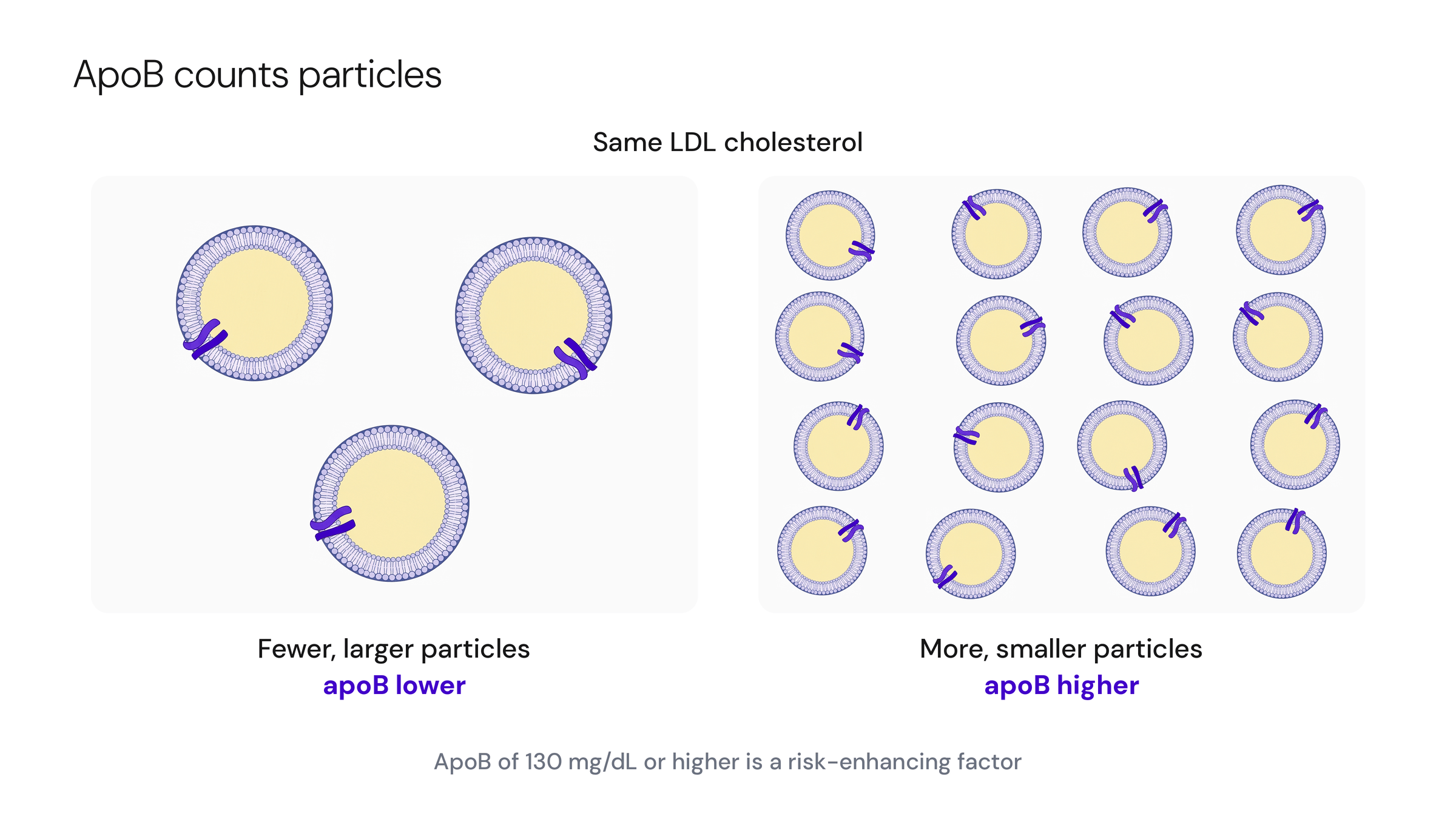
A standard lipid panel measures how much cholesterol the particles carry. ApoB and NMR testing count the particles themselves.
Every atherogenic lipoprotein particle, including LDL, carries one apolipoprotein B molecule, so the apoB level equals the number of those particles in the blood. The particles become trapped in the artery wall, and that trapping drives atherosclerosis. Cholesterol and triglyceride levels are not always accurate measures of particle number (Sniderman et al., JAMA Cardiol 2019).
NMR lipoprotein testing uses nuclear magnetic resonance to estimate particle number and size by lipoprotein class. The threshold to know is in the cholesterol guideline: apoB of 130 mg/dL or higher counts as a risk enhancer, and the guideline says that level corresponds to an LDL-C of 160 mg/dL or higher (Grundy et al., Circulation 2019).
What the guidelines say about the extra markers
The 2018 AHA/ACC cholesterol guideline and the 2019 ACC/AHA prevention guideline both treat hs-CRP, Lp(a), and apoB as risk enhancers "if measured" (Grundy et al., Circulation 2019 and Arnett et al., Circulation 2019). Each has a threshold and a reason to order it.
| Marker | Risk-enhancing level | When the guideline says to consider measuring it |
|---|---|---|
| hs-CRP | 2.0 mg/L or higher | No specific trigger named. It counts only if measured |
| Lp(a) | 50 mg/dL (125 nmol/L) or higher, more so at higher levels | Family history of premature ASCVD is a relative indication |
| ApoB | 130 mg/dL or higher | Triglycerides of 200 mg/dL or higher are a relative indication |
Two details from the same tables matter before your draw:
- Triglycerides count as a risk enhancer only when they stay high. The guideline sets the level at 175 mg/dL or higher and notes that three measurements are optimal.
- Fasting is optional for a lipid screen. The cholesterol guideline says screening can be done with fasting or nonfasting lipids. Other tests on the same draw, such as an oral glucose tolerance test, may come with their own instructions.
These markers matter because they can move a borderline or intermediate risk estimate. The guideline frames that as a discussion between you and your clinician. Bring the results to that conversation.
How this differs from a standard annual physical
The biggest difference is scope. Published program menus describe it this way:
| Standard annual physical | Executive physical panel | |
|---|---|---|
| Lipids | Standard lipid panel | Often adds NMR subfractions or ApoB |
| Blood sugar | Glucose on the metabolic panel | Adds hemoglobin A1C and HOMA-IR scoring |
| Inflammation | Ordered case by case | hs-CRP |
| Results | Reviewed at a later visit | Reviewed with a physician the same day |
A routine annual visit orders what your clinician thinks you need that year. The guideline's "if measured" wording is a clue: hs-CRP, Lp(a), and apoB are ordered for selected people, so they are easy to miss on a short visit.
If you want to know what your annual physical checked, ask for the order list. Compare it with the tables on this page.
Single-day diagnostic workflow
Most executive programs fit the blood draw into a single day. A typical order runs like this:
- Before the day. You get instructions on fasting, medications, and forms.
- Early draw. Blood and urine are collected first, so the lab can process them while the day goes on.
- Imaging and consults. Heart tests, body composition, and specialist visits fill the hours while results come back.
- Same-day review. A physician walks through the results that are ready and drafts a plan.
- Late results. Some specialty tests return days later and should come with a scheduled call.
Ask three questions before the day:
- Do I need to fast, and for which tests?
- Which results come back the same day, and which follow later?
- Who calls me about a result that arrives after I leave?
Clinician-led result interpretation
A result outside the reference range starts a conversation with your clinician, who decides what it means for you. An Lp(a) result, a borderline A1C, or a high hs-CRP means something different next to your blood pressure, family history, and imaging.
For heart risk, the guideline's approach runs in three steps. First, the clinician estimates your 10-year risk of heart attack and stroke from standard factors such as blood pressure, cholesterol, diabetes, and smoking. Second, risk enhancers such as Lp(a), apoB, and hs-CRP adjust that estimate. The cholesterol guideline says these factors may favor a statin at borderline risk (5% to 7.5%) and favor one at intermediate risk (7.5% to 19.9%) (Grundy et al., Circulation 2019). Third, imaging such as a calcium score can settle a decision that is still uncertain.
Don't grade yourself from a printout. Ask the ordering clinician what the result changes in your plan.
Tracking results over time
One blood draw tells you where you are. A second draw on the same markers tells you whether the plan is working.
The cholesterol guideline sets a schedule for this when treatment starts. It recommends a repeat lipid test 4 to 12 weeks after a statin is started or its dose changes, then every 3 to 12 months as needed, and it judges the response by the percentage drop in LDL-C from baseline (Grundy et al., Circulation 2019).
To keep comparisons fair, use the same lab when you can, match your fasting status between draws, and keep a copy of every report.
What a blood panel cannot show
Blood tests measure drivers and risk markers. Imaging looks at the artery itself.
Carotid intima-media thickness (CIMT) uses ultrasound to measure the carotid artery wall. In a UK Biobank cohort of 29,292 adults free of cardiovascular disease at baseline, higher CIMT was associated with later coronary heart disease and heart attack (Mitra et al., Am J Prev Cardiol 2025). The same team built a risk index from HbA1c, total cholesterol ratio, and blood pressure, and reported that it added predictive information for subclinical atherosclerosis and later events.
Those are research associations from a public cohort, and they support reading labs and imaging together. One wall measurement cannot grade your risk by itself.
Cancer markers, and what Renew covers
Renew's plan centers on your arteries. PSA and multi-cancer blood tests show up on some executive panels. Renew doesn't do cancer screening. Your primary care doctor does, and we'll coordinate with them. Like the rest of a standard checkup, a single cancer marker is a snapshot unless someone owns the follow-up.
Frequently asked questions
What is included in an executive physical?
Complete Blood Count (CBC): Evaluates overall health and checks for conditions like anemia or infection. Comprehensive Metabolic Panel (CMP): Assesses blood sugar, fluid balance, electrolyte levels, and kidney/liver function. Standard & Advanced Lipid Panels: Goes beyond basic cholesterol to measure LDL, HDL, triglycerides, and often NMR lipoprotein subfractions or ApoB for a precise look at cardiovascular risk. Metabolic & Diabetes Indicators: Hemoglobin A1C and HOMA-IR insulin resistance scoring. Inflammatory Markers: High-sensitivity C-reactive protein (hs-CRP) to detect systemic inflammation linked to heart disease. Nutritional Status: Vitamin D levels and homocysteine.
Which blood panels are standard in an executive physical?
Complete Blood Count (CBC): Evaluates overall health and checks for conditions like anemia or infection. Comprehensive Metabolic Panel (CMP): Assesses blood sugar, fluid balance, electrolyte levels, and kidney/liver function. Standard & Advanced Lipid Panels: Goes beyond basic cholesterol to measure LDL, HDL, triglycerides, and often NMR lipoprotein subfractions or ApoB for a precise look at cardiovascular risk.
Does an executive physical test for inflammation?
Inflammatory Markers: High-sensitivity C-reactive protein (hs-CRP) to detect systemic inflammation linked to heart disease.
Does an executive physical check blood sugar and insulin resistance?
Comprehensive Metabolic Panel (CMP): Assesses blood sugar, fluid balance, electrolyte levels, and kidney/liver function. Metabolic & Diabetes Indicators: Hemoglobin A1C and HOMA-IR insulin resistance scoring.
Sources
- Grundy SM, et al. 2018 AHA/ACC Guideline on the Management of Blood Cholesterol: Executive Summary. Circulation. 2019. Risk-enhancing factors, fasting or nonfasting lipids.
- Arnett DK, et al. 2019 ACC/AHA Guideline on the Primary Prevention of Cardiovascular Disease. Circulation. 2019. Risk-enhancing factors table.
- Mitra et al. Carotid intima-media thickness, cardiovascular disease, and risk factors in 29,000 UK Biobank adults. Research association, no Renew outcome rate.
- Sniderman AD, et al. Apolipoprotein B Particles and Cardiovascular Disease: A Narrative Review. JAMA Cardiol. 2019. ApoB as particle number.
- Executive health memberships.
- Pricing.
- How it works.
Author and medical review
Written by Andrew Le, MD. Andrew Le, MD reviews patient-facing guidance for Renew Health with a focus on preventive cardiology and functional medicine clarity.
Medically reviewed by Clinical Review Team.
Next step
If you want these markers measured and re-measured on a plan, start with Performance at $999/mo on executive health. Executive at $5,000/mo is the fully managed option on the same page.
Structured data
{
  "@context": "https://schema.org",
  "@type": "FAQPage",
  "mainEntity": [
    {
      "@type": "Question",
      "name": "What is included in an executive physical?",
      "acceptedAnswer": {
        "@type": "Answer",
        "text": "Complete Blood Count (CBC): Evaluates overall health and checks for conditions like anemia or infection. Comprehensive Metabolic Panel (CMP): Assesses blood sugar, fluid balance, electrolyte levels, and kidney/liver function. Standard & Advanced Lipid Panels: Goes beyond basic cholesterol to measure LDL, HDL, triglycerides, and often NMR lipoprotein subfractions or ApoB for a precise look at cardiovascular risk. Metabolic & Diabetes Indicators: Hemoglobin A1C and HOMA-IR insulin resistance scoring. Inflammatory Markers: High-sensitivity C-reactive protein (hs-CRP) to detect systemic inflammation linked to heart disease. Nutritional Status: Vitamin D levels and homocysteine."
      }
    },
    {
      "@type": "Question",
      "name": "Which blood panels are standard in an executive physical?",
      "acceptedAnswer": {
        "@type": "Answer",
        "text": "Complete Blood Count (CBC): Evaluates overall health and checks for conditions like anemia or infection. Comprehensive Metabolic Panel (CMP): Assesses blood sugar, fluid balance, electrolyte levels, and kidney/liver function. Standard & Advanced Lipid Panels: Goes beyond basic cholesterol to measure LDL, HDL, triglycerides, and often NMR lipoprotein subfractions or ApoB for a precise look at cardiovascular risk."
      }
    },
    {
      "@type": "Question",
      "name": "Does an executive physical test for inflammation?",
      "acceptedAnswer": {
        "@type": "Answer",
        "text": "Inflammatory Markers: High-sensitivity C-reactive protein (hs-CRP) to detect systemic inflammation linked to heart disease."
      }
    },
    {
      "@type": "Question",
      "name": "Does an executive physical check blood sugar and insulin resistance?",
      "acceptedAnswer": {
        "@type": "Answer",
        "text": "Comprehensive Metabolic Panel (CMP): Assesses blood sugar, fluid balance, electrolyte levels, and kidney/liver function. Metabolic & Diabetes Indicators: Hemoglobin A1C and HOMA-IR insulin resistance scoring."
      }
    }
  ]
}
{
  "@context": "https://schema.org",
  "@type": "Article",
  "headline": "Blood Tests in an Executive Physical: The Panel, Explained",
  "description": "Blood tests in an executive physical, panel by panel: CBC, CMP, lipids, A1C, hs-CRP, Lp(a), and apoB, plus when guidelines say the extra markers matter.",
  "image": [
    {
      "@type": "ImageObject",
      "contentUrl": "/images/blog/blood-tests-in-an-executive-physical/blood-tests-apob-counts-particles.png",
      "name": "ApoB counts particles",
      "caption": "Two panels with the same LDL cholesterol compare three large LDL particles with sixteen small ones, and each particle carries one purple apoB marker. More, smaller particles means a higher apoB.",
      "creditText": "Created with BioRender.com (Industry)."
    }
  ],
  "author": {
    "@type": "Person",
    "name": "Andrew Le, MD",
    "description": "Andrew Le, MD reviews patient-facing guidance for Renew Health with a focus on preventive cardiology and functional medicine clarity."
  },
  "reviewedBy": {
    "@type": "Person",
    "name": "Clinical Review Team"
  },
  "datePublished": "2026-09-28",
  "mainEntityOfPage": "/evidence/blood-tests-in-an-executive-physical"
}
{
  "@context": "https://schema.org",
  "@type": "MedicalWebPage",
  "name": "Blood Tests in an Executive Physical: The Panel, Explained",
  "description": "Blood tests in an executive physical, panel by panel: CBC, CMP, lipids, A1C, hs-CRP, Lp(a), and apoB, plus when guidelines say the extra markers matter.",
  "medicalAudience": {
    "@type": "MedicalAudience",
    "audienceType": "Patients"
  },
  "reviewedBy": {
    "@type": "Person",
    "name": "Clinical Review Team"
  },
  "lastReviewed": "2026-09-28"
}
Ready to see your actual risk?
Advanced metabolic testing, arterial imaging, and a personalized prevention plan — built around your numbers.
View Memberships