What Does an Executive Physical Include? Components
Andrew founded Renew Health to change how cardiovascular disease is detected and treated.
Cleveland Clinic's 2024 Executive Health self-pay fee schedule lists a laboratory panel that includes ultra-sensitive C-reactive protein (U-CRP), lipoprotein (a), and apolipoprotein B (ApoB) (Cleveland Clinic self-pay fee schedule). Korenstein and colleagues' 2019 study found 46 unique packages across the 29 top-ranked US hospitals that published package details, and the most commonly included services were hearing examination (83%) and electrocardiogram (83%) (Korenstein et al., 2019). Performance at $999/mo is primary. Executive at $5,000/mo is secondary. Medicare does not cover the membership. Renew operates outside insurance (Pricing).
Your last checkup was a seven-minute visit, one cholesterol number, and "see you next year." A full physical should measure much more than that.
There is no single included list
An executive physical is a way of booking the day. The name does not list the tests.
When someone asks what is included, they usually want one of two answers:
- The sequence of the day (history, exam, testing, results talk).
- One hospital's published options.
If you want the definition of the visit, see what is an executive physical.
Comprehensive blood panel and biomarkers
"Comprehensive labs" is a label until the panel names are written down. Cleveland Clinic's fee schedule for 2024 names a lab panel with a complete blood count (CBC) with differential, a lipid profile, a complete metabolic profile (CMP), thyroid-stimulating hormone (TSH), urinalysis, ultra-sensitive C-reactive protein (U-CRP), lipoprotein (a), hemoglobin A1C (HbA1C), apolipoprotein B (ApoB), and 25-hydroxy vitamin D (Cleveland Clinic self-pay fee schedule).
ApoB counts atherogenic particles (Sniderman et al., JAMA Cardiol 2019). Lp(a) is reported on its own line. The 2018 cholesterol guideline treats an apoB of 130 mg/dL or higher, and an Lp(a) of 50 mg/dL (125 nmol/L) or higher, as risk-enhancing when they are measured (Grundy et al., Circulation 2019). The same guideline says a lipid screen can be fasting or nonfasting (Grundy et al., Circulation 2019). An OGTT can come with its own instructions.
ApoE, KIF6, and 9p21 are variants associated with cardiovascular risk. A clinician reads them with the rest of the workup.
Cleveland Clinic's published exam contents
Cleveland Clinic's services page says every executive health appointment includes a physical exam, a nutrition consultation, exercise counseling, a review of vaccinations, and executive coaching (Cleveland Clinic). It may also include vision and hearing tests (Cleveland Clinic).
- Blood Tests in an Executive Physical: The Panel, Explained
- Executive Checkup: What's Included and What Comes After
- Executive Physical for Women: What It Covers, Heart First
- Executive Physical With Calcium Score: What It Decides
What Mayo Clinic says is in the visit
Mayo Clinic's experience page describes the itinerary in three parts (Mayo Clinic):
- A gender- and age-based standard protocol.
- Additional services the physician adds from your history and exam.
- Optional services you can select. The page names examples such as genetic testing, multi-cancer early detection screening, and stress management consultations.
Mayo Clinic's FAQ flyer says its Executive Health physician is not your primary care provider, and that you keep a local primary care provider for personal health needs, including medication refills (Mayo Clinic FAQ).
Advanced imaging: CT, MRI, and PET
CT, MRI, and PET are different tests. RadiologyInfo, the public site of the American College of Radiology and the Radiological Society of North America, describes each one (RadiologyInfo). A radiologist interprets the images and sends a report to the ordering physician.
CT. Body CT uses x-rays to make cross-sectional pictures of organs, bone, soft tissue, and blood vessels, with more detail than a plain x-ray. RadiologyInfo lists uses that include the chest, abdomen, and pelvis, and vascular disease such as aortic aneurysm (RadiologyInfo). The same page says soft-tissue detail in the brain is often better evaluated with MRI (RadiologyInfo). CT uses ionizing radiation. The USPSTF recommends annual low-dose CT for lung cancer screening only in adults 50 to 80 with a 20 pack-year smoking history who smoke now or quit within the past 15 years (USPSTF).
MRI. Body MRI uses a magnetic field and radio waves. It does not use ionizing radiation. RadiologyInfo says doctors use it for organs in the chest, abdomen, and pelvis, and that a radiologist reviews the images (RadiologyInfo).
PET. PET uses a small amount of a radioactive tracer, most often FDG, to show metabolic activity. RadiologyInfo says combined PET/CT is how most PET scans are done today (RadiologyInfo). The same page says the tracer typically takes about 30 to 60 minutes to be absorbed, and total scanning time is usually about 30 minutes (RadiologyInfo). A radiologist or nuclear medicine physician interprets the scan.
Program pages name CT and MRI in different places.
- Cleveland Clinic's services page lists chest X-ray or CT among tests that may be included, and says an extended stay may add a total body MRI or a total body CT (Cleveland Clinic).
- National Jewish Health includes a chest CT with a coronary calcium score in its cardiovascular assessment, a full body MRI on the Premier and Performance packages, and an optional brain MRI on Core and Advanced (National Jewish Health).
- Atrium Health lists CT calcium scoring on the Healthy Heart exam, a CT coronary angiogram on Healthy Heart 2.0, a brain MRI on the Healthy Brain exam, and an abdominal MRI on the Healthy Gut exam (Atrium Health).
- Sutter Health says its hospital can perform full-body scans, and that this service is not currently offered to healthy people without symptoms (Sutter Health). The page cites the American Cancer Society, the Food and Drug Administration, and the American College of Radiology on that point (Sutter Health).
Genetic and lifestyle risk analysis
A JAMA meta-analysis found a statistically significant link between 9p21 variants and heart disease, with a small magnitude of association (Palomaki et al., JAMA 2010). A large replication study found the KIF6 Trp719Arg polymorphism was not associated with the risk of clinical coronary artery disease (Assimes et al., JACC 2010). For ApoE, a JAMA meta-analysis found that, compared with the epsilon3/epsilon3 genotype, epsilon2 carriers had a 20% lower risk of coronary heart disease and epsilon4 carriers a slightly higher risk (Bennet et al., JAMA 2007). The lifestyle half can be scored directly: the AHA's Life's Essential 8 rates diet, physical activity, nicotine exposure, sleep health, body mass index, blood lipids, blood glucose, and blood pressure from 0 to 100 points each (Lloyd-Jones et al., Circulation 2022). Ask how any gene result would change a plan built on those measured scores.
Cancer screening: what hospital programs and Renew include
Cancer screening in an executive physical follows the program's protocol and your own age, sex, and history. USPSTF A and B recommendations cover screening for colorectal, breast, cervical, and lung cancer in defined risk groups (USPSTF). Each program applies them differently.
Named program pages describe cancer screening this way:
- Mayo Clinic's experience page names multi-cancer early detection screening as an optional service (Mayo Clinic).
- Cleveland Clinic's services page says an extended stay may include cancer screening (Cleveland Clinic).
Renew's Pricing page does not list cancer screening tests. Keep your age-appropriate cancer screening with your primary care clinician, and ask the Renew team before you assume membership covers it.
Screening items versus a method
A stacked day can include guideline-based services and extra tests outside the USPSTF A/B list. Adding tests does not create a method by itself.
A method names:
- What disease or risk you are trying to see
- Who interprets the flag
- What treatment follows
- How you will know whether anything changed
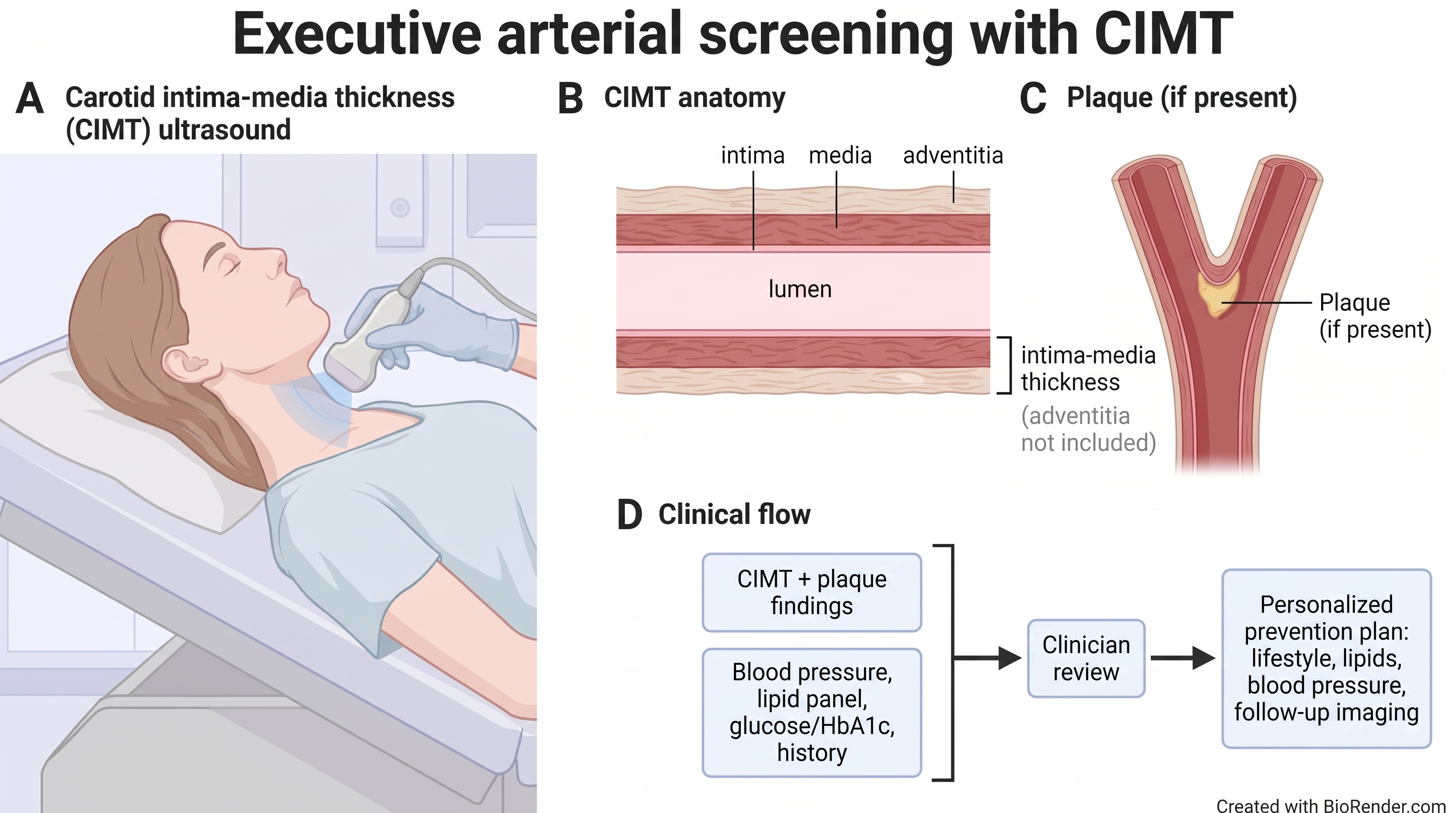
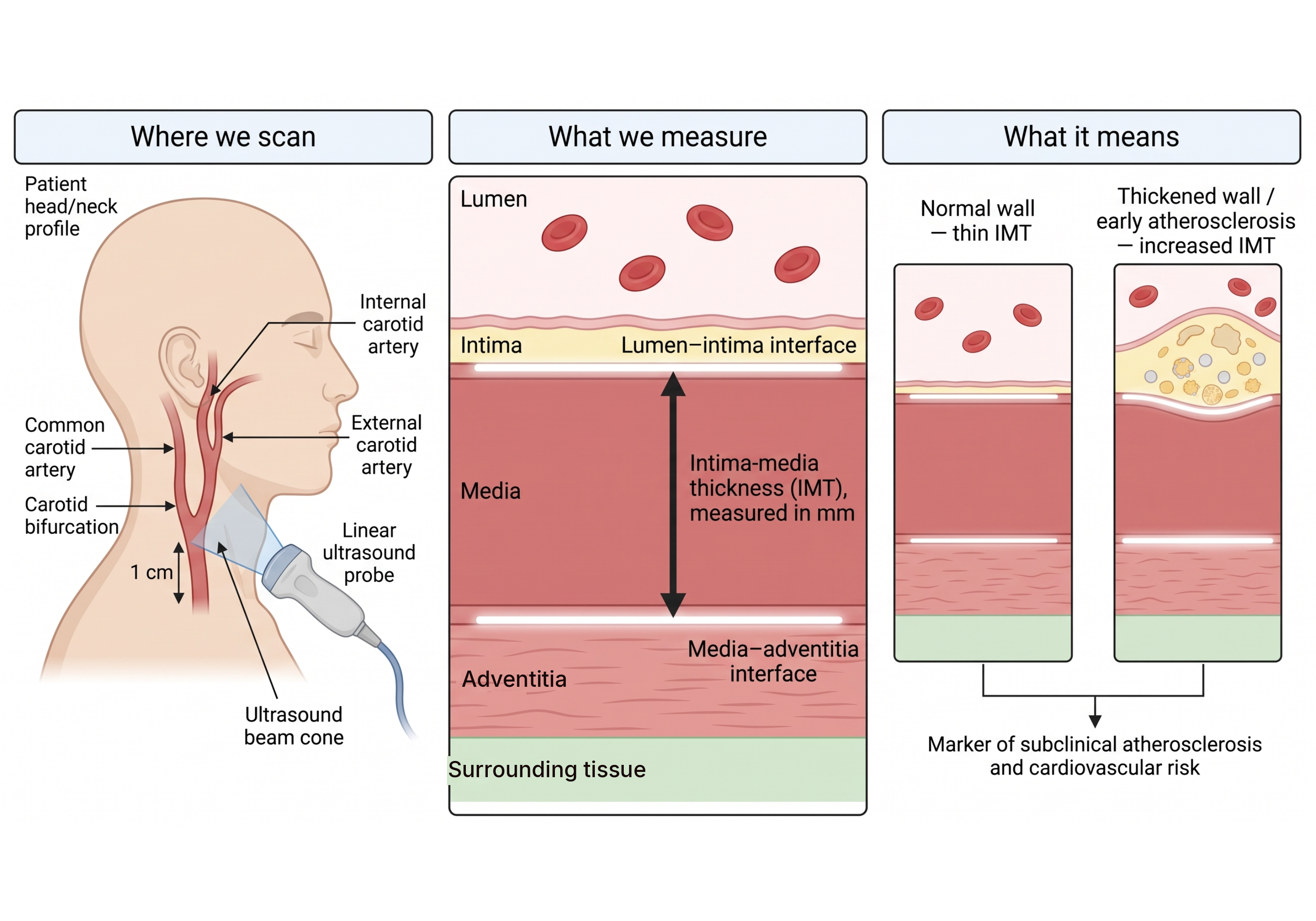
Carotid intima-media thickness is one research marker of subclinical atherosclerosis. A UK Biobank cohort of adults free of cardiovascular disease at baseline describes it that way and reports an association with later coronary events. Do not diagnose yourself from a millimeter.
Do not turn a letter on a lipid report, a color on a dashboard, or a single thickness number into a self-diagnosis.
Where Renew fits
CIMT is the anchor of the arterial story: ultrasound of the carotid arteries so a Renew expert PA can read wall thickness and plaque.
Every membership includes CIMT arterial imaging, advanced lab panels (lipoprotein panel with Lp(a) and ApoB, insulin resistance panel with OGTT, inflammation panel, vitamin and metabolic panel, and genetic testing for ApoE, KIF6, and 9p21), a dedicated physician and care coordinator, the root cause workup (OralDNA, sleep, genetics) once a year, and a dental liaison (Pricing). Performance and Executive add DEXA body composition scans and VO2 Max testing (Pricing).
Cardiovascular risk assessment versus a lab printout
The 2019 ACC/AHA prevention guideline by Arnett and colleagues says adults who are 40 to 75 years of age and are being evaluated for cardiovascular disease prevention should undergo 10-year atherosclerotic cardiovascular disease (ASCVD) risk estimation and have a clinician-patient risk discussion before starting on pharmacological therapy, such as antihypertensive therapy, a statin, or aspirin (Arnett et al., Circulation 2019). The Arnett guideline sorts 10-year risk into low (under 5%), borderline (5% to under 7.5%), intermediate (7.5% to under 20%), and high (20% or more), and says that in adults at borderline or intermediate risk, it is reasonable to use additional risk-enhancing factors to guide decisions about preventive interventions such as statin therapy (Arnett 2019).
The 2018 AHA/ACC cholesterol guideline by Grundy and colleagues lists risk-enhancing factors that include family history of premature ASCVD, persistently elevated LDL-C of 160 mg/dL or higher, metabolic syndrome, chronic kidney disease, and chronic inflammatory disorders (Grundy et al., Circulation 2019). Grundy and colleagues advise that if risk status is uncertain, clinicians consider using coronary artery calcium to improve specificity. For adults 20 to 39 years of age, the Arnett guideline says it is reasonable to assess traditional ASCVD risk factors at least every 4 to 6 years (Arnett 2019).
Do not self-grade a millimeter or a letter on a report.
How it compares with a standard annual physical
Korenstein and colleagues' 2019 JAMA research letter describes executive physicals as 1- to 2-day comprehensive evaluations offering putative preventive testing and screening, with flat fees that generally include clinical assessments and specific laboratory and other diagnostic tests (Korenstein et al., JAMA 2019). For routine preventive care, the USPSTF says its A and B grade recommendations are services that the Task Force most highly recommends implementing for preventive care (USPSTF A and B recommendations). The USPSTF recommends screening for hypertension in adults 18 years or older with office blood pressure measurement (USPSTF hypertension screening). In the same letter, Korenstein and colleagues noted that the two most common package items, a hearing exam and an EKG, both carry I grades from the USPSTF, and that four grade D services were included (Korenstein et al., JAMA 2019). The 2019 Cochrane review by Krogsbøll and colleagues included 17 trials, 15 of which reported outcome data, and found that health checks have little or no effect on total mortality or cancer mortality, and probably have little or no effect on cardiovascular mortality (Krogsbøll et al., Cochrane 2019).
| Standard annual physical | Executive physical | |
|---|---|---|
| How tests are chosen | USPSTF A and B services for your age and risk (USPSTF) | A package of clinical assessments and diagnostic tests, plus optional services |
| Length | One clinic visit | 1- to 2-day evaluations (Korenstein 2019) |
| Who follows up | Your primary care clinician | The program's report, then your own clinician or a return visit |
Physician consultation and follow-up
A test list with nobody named to interpret it is incomplete. For a side-by-side with a shorter checkup, see executive physical vs annual physical.
One-on-one physician consultation
Mayo Clinic says each Executive Health visit begins and ends with unhurried time with your Executive Health physician (Mayo Clinic Executive Health: Your Experience). Mayo Clinic says your itinerary starts with its standard protocol, and your Executive Health physician may then add recommended services based on your health profile, visit priorities, and medical exam findings (Mayo Clinic Executive Health: Your Experience). Cleveland Clinic says your provider will ask about your medical history, any medications you take, what you eat and drink, your exercise habits, and your overall lifestyle (Cleveland Clinic exam). Cleveland Clinic's employer page says a written report is prepared by the physician with patient results and clear next steps (Cleveland Clinic Executive Health). Mayo Clinic says the visit ends with an Executive Summary and defined Action Plan, and that results are accessible to your primary care provider at home (Mayo Clinic Executive Health: Your Experience). Some decisions belong in that conversation by design: the USPSTF says that before deciding whether to be screened with PSA, men aged 55 to 69 should have an opportunity to discuss the potential benefits and harms of screening with their clinician (USPSTF prostate cancer screening). Ask who your consulting physician is and how much time is set aside with them.
Preventive planning after the visit
The written plan you leave with decides what the tests are worth. A plan has these parts:
- Findings ranked by priority, with the numbers that need action first.
- Targets with dates, such as a blood pressure, LDL cholesterol or ApoB, or A1c goal and when it will be rechecked.
- Lifestyle steps for activity, nutrition, sleep, alcohol, and tobacco, written as specific changes.
- Medication decisions, including what was started, stopped, or deferred and why.
- Referrals to specialists, with the name of whoever schedules them.
- A re-test schedule for each lab or scan that showed a problem.
- A named owner for each item, whether that is the program's doctor or your local clinician.
Questions to ask
- Ask the ordering clinician before you turn a letter, a color, or a thickness number into a self-diagnosis.
- Ask who reviews results with you on the visit day, and who owns treatment after you leave.
Frequently asked questions
What tests are always included in an executive physical?
Cleveland Clinic's exam page says the tests might include a variety of blood tests, an electrocardiogram (EKG), a cardiac stress test, a calcium-score screening heart scan, spirometry, a chest X-ray or CT scan, vascular screening tests, and a bone density test (Cleveland Clinic exam). Korenstein and colleagues found information about included services for 29 hospitals, which offered 46 unique packages (Korenstein et al., JAMA 2019).
Does an executive physical include heart imaging?
Cleveland Clinic's exam page lists vascular screening tests, a calcium-score screening heart scan, and a cardiac stress test among the tests that might be included (Cleveland Clinic).
What does Renew's executive health program include?
Performance at $999/mo is primary. Renew's Pricing FAQ lists CIMT arterial imaging and advanced lab panels testing for 33 known drivers of arterial damage in every membership (Pricing). Pricing lists DEXA Body Composition Scan and VO2 Max Testing at 2x/year on Performance and 4x/year on Executive (Pricing). Executive at $5,000/mo is secondary.
Sources
- Cleveland Clinic About Your Executive Health Exam (published "may include" list. about six to eight hours)
- Mayo Clinic Executive Health: Your Experience (age- and gender-based protocol plus physician-added and optional services)
- Mayo Clinic Executive Health Program
- Evidence Brief: Role of the Annual Comprehensive Physical Examination in the Asymptomatic Adult (VA / NCBI Bookshelf)
- Mitra et al., carotid intima-media thickness in UK Biobank adults (research marker. not a Renew outcome rate)
- Grundy SM, et al. 2018 AHA/ACC Guideline on the Management of Blood Cholesterol. Circulation. 2019 (apoB and Lp(a) risk-enhancing levels when measured. fasting or nonfasting lipids)
- Sniderman AD, et al. Apolipoprotein B Particles and Cardiovascular Disease. JAMA Cardiol. 2019 (ApoB as particle number)
- Renew Health executive health program
- Renew Health pricing
- Renew Health how it works
- Mayo Clinic Executive Health FAQ flyer (MC1927-43) (program physician is not your primary care clinician)
- RadiologyInfo: Body CT
- RadiologyInfo: Body MRI
- RadiologyInfo: PET/CT
- USPSTF lung cancer screening
- Cleveland Clinic Executive Health
- National Jewish Health Executive Health
- Atrium Health Executive Physical
- Sutter Health Executive Health Program
- Korenstein D, Mamoor M, Bach PB. Preventive services offered in executive physicals at top-ranked hospitals. JAMA. 2019
- Arnett et al., Circulation 2019
- USPSTF A and B recommendations
- USPSTF hypertension screening
- Krogsbøll et al., Cochrane 2019
- Cleveland Clinic Executive Health self-pay fee schedule (2024)
Author and medical review
Written by Andrew Le, MD. Andrew Le, MD reviews patient-facing guidance for Renew Health with a focus on preventive cardiology and functional medicine clarity.
Medically reviewed by Clinical Review Team.
Next step
Performance at $999/mo is primary. Executive at $5,000/mo is secondary.
If you want that full physical kept on a membership, compare Performance at $999/mo and Executive at $5,000/mo on executive health.
Ready to see your actual risk?
Advanced metabolic testing, arterial imaging, and a personalized prevention plan, built around your numbers.
View Memberships