Executive Physical for Women: What It Covers, Heart First
Andrew founded Renew Health to change how cardiovascular disease is detected and treated.
Are executive physicals worth it? An executive physical for women is an extended, comprehensive health assessment that includes a thorough general medical exam specifically tailored to women’s long-term health and wellness. Advanced Diagnostics: Extensive blood panels (including thyroid, vitamins, inflammation markers, and metabolic panels), electrocardiograms (EKGs), and cardiovascular risk evaluations like cardiac calcium scoring. Women’s Health Screenings: Pelvic exams, Pap smears, cervical HPV testing, breast exams, and referrals or orders for mammograms based on age. Lifestyle & Wellness Consults: One-on-one time with registered dietitians for nutrition/body composition analysis, stress management counseling, and executive coaching for work-life balance. Performance at $999/mo is primary. Executive at $5,000/mo is secondary. Medicare does not cover the membership. Renew operates outside insurance (Pricing).
The part of the visit that gets rushed
You built the company, and it has cost you sleep and energy you want back. Your last visit covered the Pap smear and the mammogram order, and your arteries barely came up. Now a calcium score or a carotid scan says your arteries are older than you are. The plan on the table is a statin and "see you next year."
An executive physical for women can put the heart back at the front of the day.
Are executive physicals worth it?
Worth it if you have a risk signal and want a year-long plan. Not worth it as a once-a-year test menu.
An executive physical for women bundles a long exam and history review, extended blood panels, an EKG, heart risk tests such as a calcium score, women's health screenings, and lifestyle consults into one or two days. For how that format compares with year-round care, see Renew's executive physical.
A Cochrane review of 17 randomized trials, with 251,891 participants, tested general health checks offered to adults not chosen for any disease or risk factor (Krogsbøll et al., Cochrane 2019). The checks had little or no effect on total mortality or cancer mortality. Cardiovascular mortality probably showed little or no effect. So a bigger menu is no guarantee of a better outcome. The case is stronger when you already have a finding, such as a high calcium score or a thick carotid wall, and the program has a plan to treat it and measure it again.
A one-time exam fits when you want a baseline and a written plan to carry back to your own doctor. Ongoing care fits better when there is already a finding to treat and measure again.
If you want ongoing care after the day
Ask any program who will read your imaging and labs, what training they have in preventive cardiology, and who you can reach after the day.
Renew is one option for that follow-up. Its Performance and Executive memberships start with CIMT imaging, an ultrasound of the carotid artery wall, and a 33-driver workup covering inflammation, metabolic, genetic, infectious, sleep, and oral pathogen drivers of arterial damage. The care team then treats those drivers through the year. First we stop it. Then we work to reverse it. Your 12-month rescan shows which. When that rescan holds steady, count it as the first win.
Care is remote, by video and messaging. Performance and Executive include in-home blood draws. Every Renew membership puts five trained providers on your care. Renew is cash-pay and operates outside insurance.
Performance is the primary option. Executive is the secondary option. Lighter tiers are on Pricing.
What an executive physical for women includes
Published program menus group their services in similar ways. Confirm each item with the program you choose.
- Health assessment. A long general exam and history review.
- Advanced diagnostic testing. Extended blood panels, an EKG, and heart risk tests such as a calcium score.
- Women's health screenings. Pelvic exam, Pap smear, HPV testing, breast exam, and mammogram orders by age. Details are below.
- Lifestyle and wellness consults. Dietitian time, body composition, stress counseling, and coaching.
- Optional add-ons. Bone density, skin checks, eye exams, and genetic or longevity testing, depending on the program. Details are below.
The day should end with a written plan that says what gets repeated and when.
Heart disease in women
Garcia et al. describe heart conditions that are more common in women, including heart attack without blocked arteries (MINOCA), spontaneous coronary artery dissection (SCAD), stress-induced cardiomyopathy, and heart failure with preserved ejection fraction (Garcia et al., Circ Res 2016).
That is a reason to ask how the program assesses your heart beyond a resting EKG. Ask who you call if symptoms show up after the day.
Risk factors a women's visit should ask about
The 2021 American Heart Association scientific statement on adverse pregnancy outcomes lists hypertensive disorders of pregnancy, preterm delivery, gestational diabetes, small-for-gestational-age delivery, placental abruption, and pregnancy loss. The statement says these outcomes increase a woman's risk of developing cardiovascular disease risk factors and of developing later cardiovascular disease, including fatal and nonfatal coronary heart disease, stroke, peripheral vascular disease, and heart failure (Parikh et al., Circulation 2021). It says recognizing these outcomes matters when cardiovascular disease risk is evaluated in women, and that their value in reclassifying risk may not be established. A history of these outcomes is a prompt for more vigorous primordial prevention of cardiovascular disease risk factors and primary prevention of cardiovascular disease.
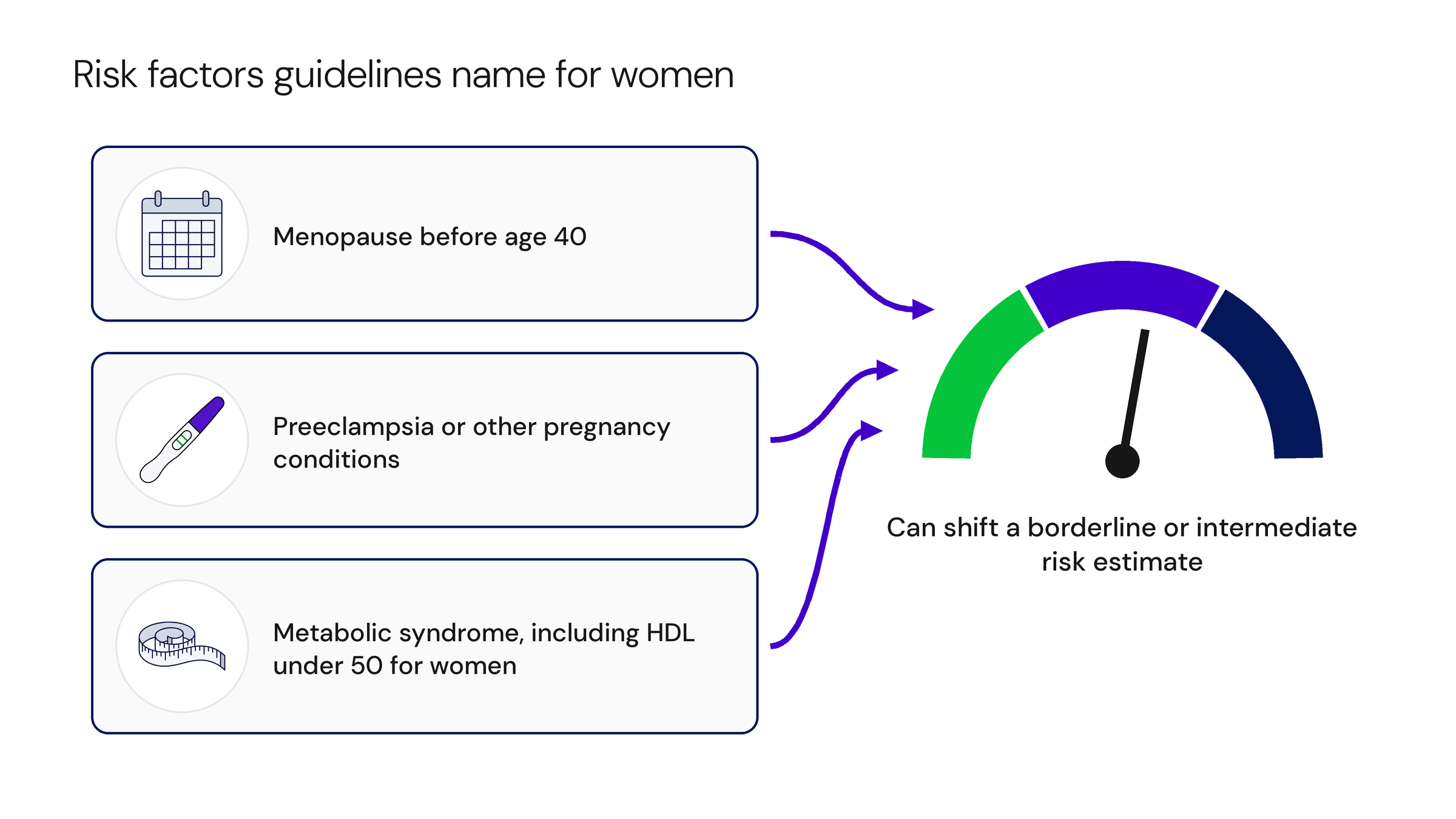
The 2019 ACC/AHA primary prevention guideline lists risk-enhancing factors that can shift a borderline or intermediate heart risk estimate (Arnett et al., Circulation 2019). Several apply to women specifically, or use a separate cutoff for women:
- Premature menopause, meaning menopause before age 40.
- Pregnancy-associated conditions that raise later ASCVD risk, such as preeclampsia.
- Metabolic syndrome, where the low HDL cutoff for women is under 50 mg/dL.
The same table lists markers that apply to everyone, if measured: hs-CRP of 2.0 mg/L or higher, Lp(a) of 50 mg/dL (125 nmol/L) or higher, and apoB of 130 mg/dL or higher. Family history of premature ASCVD counts too.
Advanced diagnostic testing, explained
- Extended blood panels. Thyroid, vitamins, inflammation markers, and metabolic panels. Ask whether hs-CRP, Lp(a), and apoB are included, since the prevention guideline counts each as a risk enhancer when measured.
- Electrocardiogram (EKG). Records the heart's electrical signal for a few seconds and can show rhythm problems. A normal resting EKG says little about plaque in the artery wall.
- Calcium scoring. A CT scan that scores calcified plaque in the heart arteries. The cholesterol guideline suggests it when a statin decision is uncertain at intermediate risk, and a score of zero can support holding off on a statin in many adults (Grundy et al., Circulation 2019).
- Body composition and bone density. DEXA measures fat, lean mass, and bone, and it can estimate visceral fat. A study of 124 adults compared DEXA with CT. Visceral fat on DEXA tracked the CT result closely, with an r² of about 0.96 (Kaul et al., Obesity 2012).
For each test, ask what result would change your plan.
Executive Health Program Benefits
Korenstein et al. examined executive physical packages at 50 top-ranked hospitals and reported that package costs ranged from $1,700 to $10,000 (Korenstein et al., JAMA 2019). The paper says executive physicals allow companies to reward valued executives.
For how a quote is built, see executive physical cost. For coverage and tax-advantaged accounts, see does insurance cover an executive physical and executive physical HSA.
Provider Expertise and Credentials
ABMS describes board certification as an independent evaluation of a physician's knowledge and skills in a specialty, and as a credential patients can rely on when selecting a provider.
Certification Matters is the public ABMS lookup. A search needs at least the first two letters of the last name, and the specialty filter includes Internal Medicine and Family Medicine.
The ABMS member-board list names the American Board of Internal Medicine and the American Board of Family Medicine among the 24 boards.
ABFM's verification system checks whether a physician is certified by the American Board of Family Medicine. ABFM says the form has to match its record exactly.
The Menopause Society awards the Menopause Society Certified Practitioner (MSCP) credential to licensed healthcare professionals who pass its competency exam. The credential is valid for 3 years and can be maintained by passing a new exam or by continuing education credits in midlife women's health. The Society's about page says patients can search its database of credentialed menopause professionals.
Check the name of the physician who reviews the results in Certification Matters, the public ABMS lookup for patients selecting a provider (ABMS).
What the personalized plan after the exam should include
The 2019 ACC/AHA primary prevention guideline lists this risk-enhancing factor: "History of premature menopause (before age 40 y) and history of pregnancy-associated conditions that increase later ASCVD risk, such as preeclampsia" (Arnett et al., Circulation 2019). In adults at borderline risk (5% to <7.5% 10-year ASCVD risk) or intermediate risk (≥7.5% to <20% 10-year ASCVD risk), it is reasonable to use additional risk-enhancing factors to guide decisions about preventive interventions (eg, statin therapy). In intermediate-risk adults (≥7.5% to <20% 10-year ASCVD risk), risk-enhancing factors favor initiation or intensification of statin therapy. In patients at borderline risk (5% to <7.5% 10-year ASCVD risk), the presence of risk-enhancing factors may justify initiation of moderate-intensity statin therapy.
The 2021 AHA scientific statement says adverse pregnancy outcomes, including gestational diabetes, preterm delivery, small-for-gestational-age delivery, placental abruption, and pregnancy loss, increase a woman's risk of developing cardiovascular disease risk factors and of developing later cardiovascular disease, and that recognizing them matters when that risk is evaluated (Parikh et al., Circulation 2021).
A woman's plan should record premature menopause before age 40 and a history of preeclampsia or other pregnancy-associated conditions. The guideline uses those factors in the statin discussion at borderline and intermediate 10-year risk.
Screenings and add-ons, and what Renew covers
Renew's plan centers on your arteries. A standard visit already spends its time on the screenings below. The heart is the part that gets rushed.
- Pap smear, HPV testing, pelvic and breast exams, and mammograms. Renew doesn't do these screenings. Your primary care doctor or gynecologist does, and we'll coordinate with them.
- Bone density. DEXA measures fat, lean mass, and bone. Renew's Performance tier includes DEXA twice a year.
- Genetic or longevity testing. Renew's 33-driver workup includes genetic drivers of arterial damage. Renew doesn't do broader genetic or longevity panels. Ask your primary care doctor about a genetic counselor.
- Skin checks and eye exams. Renew doesn't do skin checks or eye exams. Your primary care doctor or a dermatologist or eye doctor handles these.
Booking and scheduling
Start at executive health, which describes Renew's Performance and Executive memberships as year-round care that keeps measuring and treating all year. The full tier comparison is on Pricing. Renew's How it works page lays out the first year: month 1 is a full intake with CIMT imaging and the 33-driver lab panel, and in month 2 your physician builds a targeted protocol. Pricing lists in-home phlebotomy on the Performance and Executive memberships, and priority scheduling on Executive. How it works notes that lab frequency depends on your plan.
Before you book any program, ask what the fee includes, how long each appointment runs, and whether you need to fast before labs.
Frequently asked questions
What is a full physical exam for females?
An executive physical for women is an extended, comprehensive health assessment that includes a thorough general medical exam specifically tailored to women’s long-term health and wellness. Women’s Health Screenings: Pelvic exams, Pap smears, cervical HPV testing, breast exams, and referrals or orders for mammograms based on age.
Are executive physicals worth it?
Yes, once a calcium score or a carotid scan shows her arteries are older than she is. Her last checkup covered the Pap smear and the mammogram order, and her arteries barely came up.
What's included in an executive physical?
Advanced Diagnostics: Extensive blood panels (including thyroid, vitamins, inflammation markers, and metabolic panels), electrocardiograms (EKGs), and cardiovascular risk evaluations like cardiac calcium scoring. Women’s Health Screenings: Pelvic exams, Pap smears, cervical HPV testing, breast exams, and referrals or orders for mammograms based on age. Lifestyle & Wellness Consults: One-on-one time with registered dietitians for nutrition/body composition analysis, stress management counseling, and executive coaching for work-life balance.
Does an executive physical for women check the heart?
Advanced Diagnostics: Extensive blood panels (including thyroid, vitamins, inflammation markers, and metabolic panels), electrocardiograms (EKGs), and cardiovascular risk evaluations like cardiac calcium scoring.
Sources
- Arnett DK, et al. 2019 ACC/AHA Guideline on the Primary Prevention of Cardiovascular Disease. Circulation. 2019. Risk-enhancing factors table.
- Krogsbøll LT, et al. General health checks in adults for reducing morbidity and mortality from disease. Cochrane Database Syst Rev. 2019. Seventeen trials.
- Garcia M, et al. Cardiovascular disease in women: clinical perspectives. Circ Res. 2016. Conditions more common in women.
- Kaul S, et al. Dual-energy X-ray absorptiometry for quantification of visceral fat. Obesity. 2012. DXA against CT in 124 adults.
- Grundy SM, et al. 2018 AHA/ACC Guideline on the Management of Blood Cholesterol: Executive Summary. Circulation. 2019. CAC recommendations.
- Parikh NI, et al. Adverse Pregnancy Outcomes and Cardiovascular Disease Risk: Unique Opportunities for Cardiovascular Disease Prevention in Women. A Scientific Statement From the American Heart Association. Circulation. 2021. Gestational diabetes and other adverse pregnancy outcomes.
- Korenstein D, Mamoor M, Bach PB. Preventive Services Offered in Executive Physicals at Top-Ranked Hospitals. JAMA. 2019. Package costs and employer use.
- ABMS, What is board certification?.
- ABMS Certification Matters. Public certification lookup.
- ABMS member boards. American Board of Internal Medicine and American Board of Family Medicine.
- ABFM online verification.
- The Menopause Society, choosing a practitioner. MSCP credential.
- The Menopause Society, about. Searchable database of credentialed professionals.
- Pricing.
- How it works.
Author and medical review
Written by Andrew Le, MD. Andrew Le, MD reviews patient-facing guidance for Renew Health with a focus on preventive cardiology and functional medicine clarity.
Medically reviewed by Clinical Review Team.
Next step
Performance is $999/mo. Executive is $5,000/mo. See executive health.
Ready to see your actual risk?
Advanced metabolic testing, arterial imaging, and a personalized prevention plan, built around your numbers.
View Memberships