Does Insurance Cover Executive Physical? How to Verify
Andrew founded Renew Health to change how cardiovascular disease is detected and treated.
HealthCare.gov says most health plans must cover a set of preventive services, like screening tests, at no cost to you (HealthCare.gov preventive care). HealthCare.gov adds that, generally, these services are covered at no cost to you when provided by an in-network medical provider, that coverage may vary, and that $0 cost isn't guaranteed in all cases (HealthCare.gov preventive care). Korenstein and colleagues' 2019 JAMA research letter found that the most commonly included services in executive physical packages were hearing examination (83%) and electrocardiogram (83%), and that both have I grades from the USPSTF (Korenstein et al., JAMA 2019). Renew operates outside insurance (Pricing). Medicare does not cover the membership. Renew operates outside insurance, so Performance and Executive are cash-pay and Medicare does not cover the membership (Executive Health). Performance at $999/mo is primary. Executive at $5,000/mo is secondary.
Your doctor said it's fine, your plan paid for a basic physical, and you still want to see the numbers on your own arteries.
Why one yes-or-no answer does not exist
An executive physical is a bundle. Insurers pay for items, under a plan's rules, when the item is a covered benefit and the claim is coded that way.
Inside one stay you may have:
- A history and physical
- Labs and imaging that look like ordinary preventive or diagnostic services
- Extra tests that are optional
- Non-clinical fees for coordination, a lounge, or other amenities
A plan can cover each of those lines differently.
Treat the executive package as elective in your budget. If a clinical line item is later paid, that is a credit. Do not spend the credit before the explanation of benefits arrives.
Price ranges and the danger of fake hospital stickers are on executive physical cost.
What the hospital pages actually say
Mayo Clinic. Its FAQ flyer says the executive services fee, covering non-clinical services and amenities, is typically out-of-pocket unless covered by your company through corporate enrollment, and that select other tests and services may also not be covered by insurance (Mayo Clinic FAQ).
Neither page is a guarantee for a different clinic. Your plan can decline a local executive desk even when it covers your usual internist.
What counts as preventive for coverage
HealthCare.gov's glossary defines preventive services as routine health care that includes screenings, check-ups, and patient counseling to prevent illnesses, disease, or other health problems (HealthCare.gov glossary: preventive services). HealthCare.gov's preventive care page for adults lists blood pressure screening, cholesterol screening for adults of certain ages or at higher risk, and colorectal cancer screening for adults 45 to 75 years (HealthCare.gov preventive care for adults). The USPSTF says A and B grade recommendations are services that the Task Force most highly recommends implementing for preventive care and that are also relevant for implementing the Affordable Care Act (USPSTF A and B recommendations).
A test ordered for a reason is judged differently. HealthCare.gov's glossary defines medically necessary as health care services or supplies needed to diagnose or treat an illness, injury, condition, disease or its symptoms and that meet accepted standards of medicine (HealthCare.gov glossary: medically necessary). HealthCare.gov also says you have the right to an easy-to-understand summary about a health plan's benefits and coverage, and that you can get a Summary of Benefits and Coverage for all individual and job-based health plans (HealthCare.gov Summary of Benefits and Coverage).
Employer payment works separately from insurance
A company can pay for an agreed physical and still leave diagnostics to you. That payment is sponsorship. It does not show that your health plan covers the day. Read both:
- The employer's covered-services list
- The clinic's estimate of patient responsibility
Details of that split are on corporate executive physical.
How to verify before you travel
Do this before you book nonrefundable travel. These steps help you ask. They do not promise payment.
- Ask the clinic for a written estimate that separates clinical services from executive or amenity fees.
- Ask which services they will submit to insurance and which they will bill to you.
- Call the plan with the estimate. Ask about preventive visit benefits, diagnostic imaging, and out-of-network rules. Write down the reference number.
- Ask about prior authorization for any advanced imaging.
- Budget the uncovered total as the real price until an explanation of benefits says otherwise.
- If you hope to use an HSA, read executive physical HSA. HSA rules are separate from insurance coverage.
Renew and insurance
Renew's live Pricing FAQ says the practice operates outside insurance so your physician can spend real time with you. Renew is cash-pay, and Medicare does not cover the membership. See what Medicare still pays for alongside a concierge membership.
That means:
- Do not expect a Renew membership to be billed to insurance as an executive physical.
CIMT coverage is its own topic. See is CIMT covered by insurance.
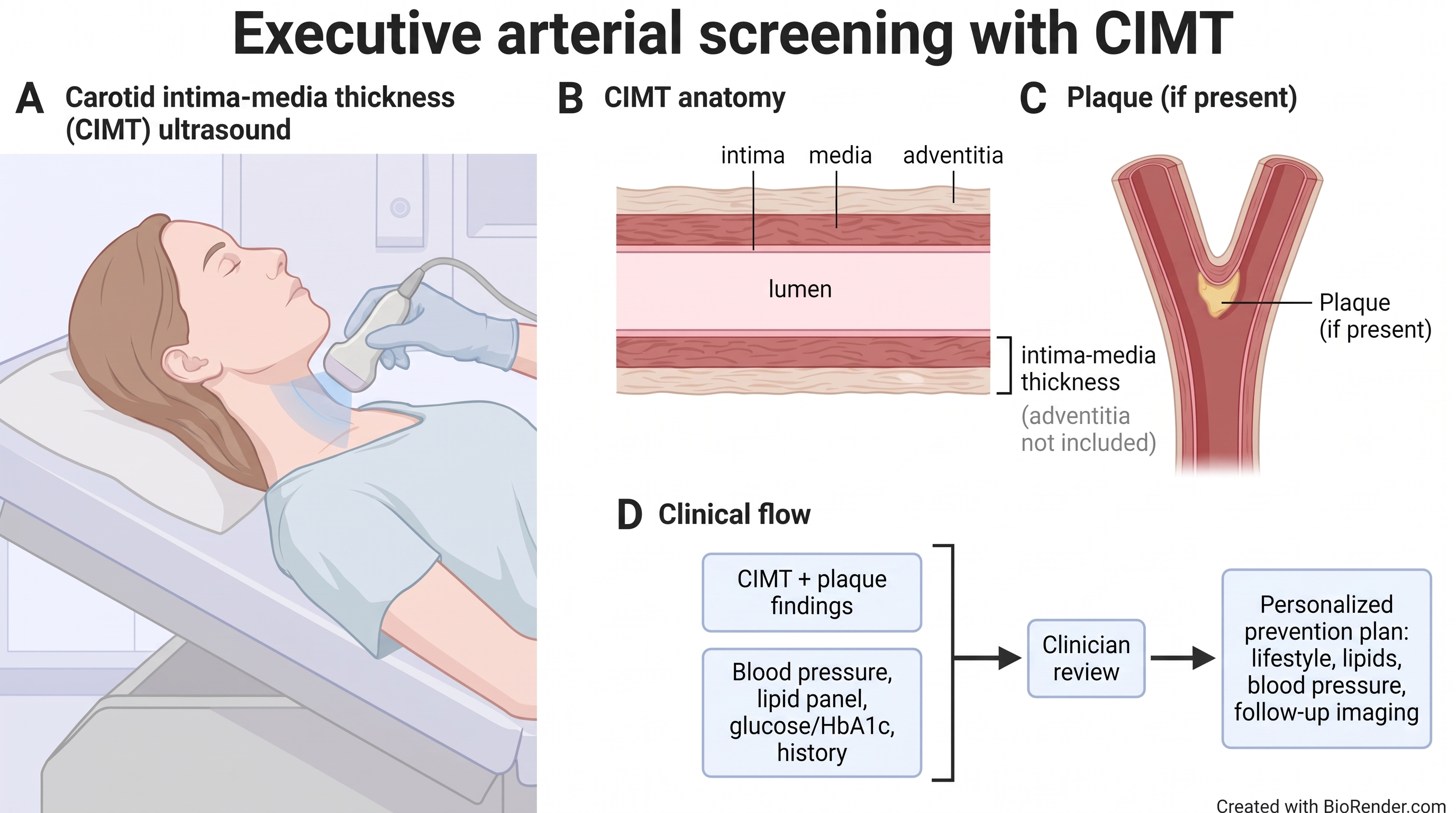
What you pay for is the membership on executive health. Performance at $999/mo is primary and includes CIMT arterial imaging, advanced lab panels testing for 33 known drivers of arterial damage, DEXA body composition scans (2x/year), VO2 Max testing (2x/year), tune-up labs (4x/year), and monthly physician visits. Executive at $5,000/mo is secondary and adds unlimited physician access, priority scheduling, and DEXA and VO2 Max at 4x/year.
Pre-authorization and network status
HealthCare.gov's glossary defines preauthorization as a decision by your health insurer or plan that a health care service, treatment plan, prescription drug or durable medical equipment is medically necessary, and says preauthorization isn't a promise your health insurance or plan will cover the cost (HealthCare.gov glossary: preauthorization). HealthCare.gov's glossary ties in-network coinsurance to providers who contract with your health insurance or plan, and says in-network coinsurance usually costs you less than out-of-network coinsurance (HealthCare.gov glossary: in-network coinsurance).
Questions to ask
- Ask your plan whether any advanced imaging on the itinerary needs preauthorization before you receive it.
- Ask whether your plan contracts with the clinic and with the physicians who interpret your tests.
- Ask the clinic which billing codes it expects to use, so you can check each one with your plan.
Out-of-pocket cost estimates
Get the clinical and amenity charges split out in writing before you book. Employer sponsorship and insurance payment are separate questions.
What plans commonly leave out
No national out-of-pocket figure exists, because each program quotes its own price and each plan pays its own share. The lines that most often stay with you are the ones the hospital pages name:
- Executive or amenity fees. At Mayo Clinic this fee is typically out-of-pocket unless corporate enrollment covers it (Mayo Clinic FAQ).
- Optional add-ons. Extra scans or tests you choose can fall outside what your plan covers.
- Out-of-network charges. A campus or interpreting physician outside your network can change what the plan pays.
- Your own cost share. Covered clinical lines can still carry a deductible, copay, or coinsurance under your plan.
Published third-party price ranges
These figures are published by each program. Renew's own prices are on Pricing.
Korenstein and colleagues reported in JAMA that executive physical package costs at top-ranked US hospitals ranged from $1,700 to $10,000, as of their September 2019 publication (Korenstein et al., JAMA 2019). Ask any program for its current written quote, since these figures can change.
For Renew, the out-of-pocket cost is the membership itself. Pricing states the practice operates outside insurance, so Renew is cash-pay and Medicare does not cover the membership. Performance at $999/mo is primary and Executive at $5,000/mo is secondary.
Common plan exclusions, with examples
Your plan's exclusions list decides most of the uncovered total. Look for these five:
- Screening without symptoms. Many plans pay for a test when there is a medical reason and decline the same test as a screen. Coronary calcium scoring, full-body imaging, and expanded genetic panels are common examples, so ask how your plan treats each one.
- Frequency limits. Plans often cover one preventive visit per year. An executive physical in the same year as your annual checkup may be denied.
- Age and risk rules. USPSTF A and B services carry age and risk limits (USPSTF A and B recommendations). Low-dose CT for lung cancer, for example, is recommended only for adults 50 to 80 with a qualifying smoking history (USPSTF).
- Campuses your plan does not contract with. Those claims may be paid at a lower rate or not at all.
To check, read your Summary of Benefits and Coverage and your plan's exclusions list. Then ask the clinic for the billing codes it expects to use, and call your insurer with those codes before you book.
Frequently asked questions
Is Performance or Executive paid through insurance?
Renew operates outside insurance (Pricing). Medicare does not cover the membership.
Does Renew bill insurance for Performance or Executive?
Renew operates outside insurance (Pricing). Medicare does not cover the membership.
Sources
- Mayo Clinic Executive Health Program
- Mayo Clinic Executive Health FAQ flyer (MC1927-43) (executive services fee typically out of pocket)
- Mayo Clinic Executive Health Program FAQs
- Renew Health pricing
- Renew Health executive health program
- HealthCare.gov: preventive health services covered without cost sharing under the Affordable Care Act
- USPSTF recommendation on lung cancer screening with low-dose CT
- Korenstein D, Mamoor M, Bach PB. Preventive services offered in executive physicals at top-ranked hospitals. JAMA. 2019
- USPSTF A and B recommendations
- HealthCare.gov glossary: preventive services
- HealthCare.gov preventive care for adults
- HealthCare.gov glossary: medically necessary
- HealthCare.gov Summary of Benefits and Coverage
- HealthCare.gov glossary: preauthorization
- HealthCare.gov glossary: in-network coinsurance
Author and medical review
Written by Andrew Le, MD. Andrew Le, MD reviews patient-facing guidance for Renew Health with a focus on preventive cardiology and functional medicine clarity.
Medically reviewed by Clinical Review Team.
Next step
Budget the executive visit as self-pay until a written benefit says otherwise. For year-round care, compare Performance at $999/mo and Executive at $5,000/mo on executive health.
Ready to see your actual risk?
Advanced metabolic testing, arterial imaging, and a personalized prevention plan, built around your numbers.
View Memberships