Is CIMT Covered by Insurance? Self-Pay and Medicare
Andrew founded Renew Health to change how cardiovascular disease is detected and treated.
Insurance companies and Medicare typically do not cover Carotid Intima-Media Thickness (CIMT) testing because it is classified as a preventive screening rather than an acute diagnostic procedure! Most clinics require self-pay or payment at the time of service, with costs about $250 on average nationally (typically $200–$500) per scan! Many patients use Health Savings Accounts (HSA) or Flexible Spending Accounts (FSA) to pay for the test! Some providers supply an itemized receipt or medical documentation that you can submit to your insurance company to request partial or full reimbursement yourself, though approval is rare!
Renew Health treats CIMT as a direct-book preventive ultrasound and publishes location-based cash pricing, including membership inclusion on some tiers. Confirm the quote for your location. This page does not promise insurance coverage.
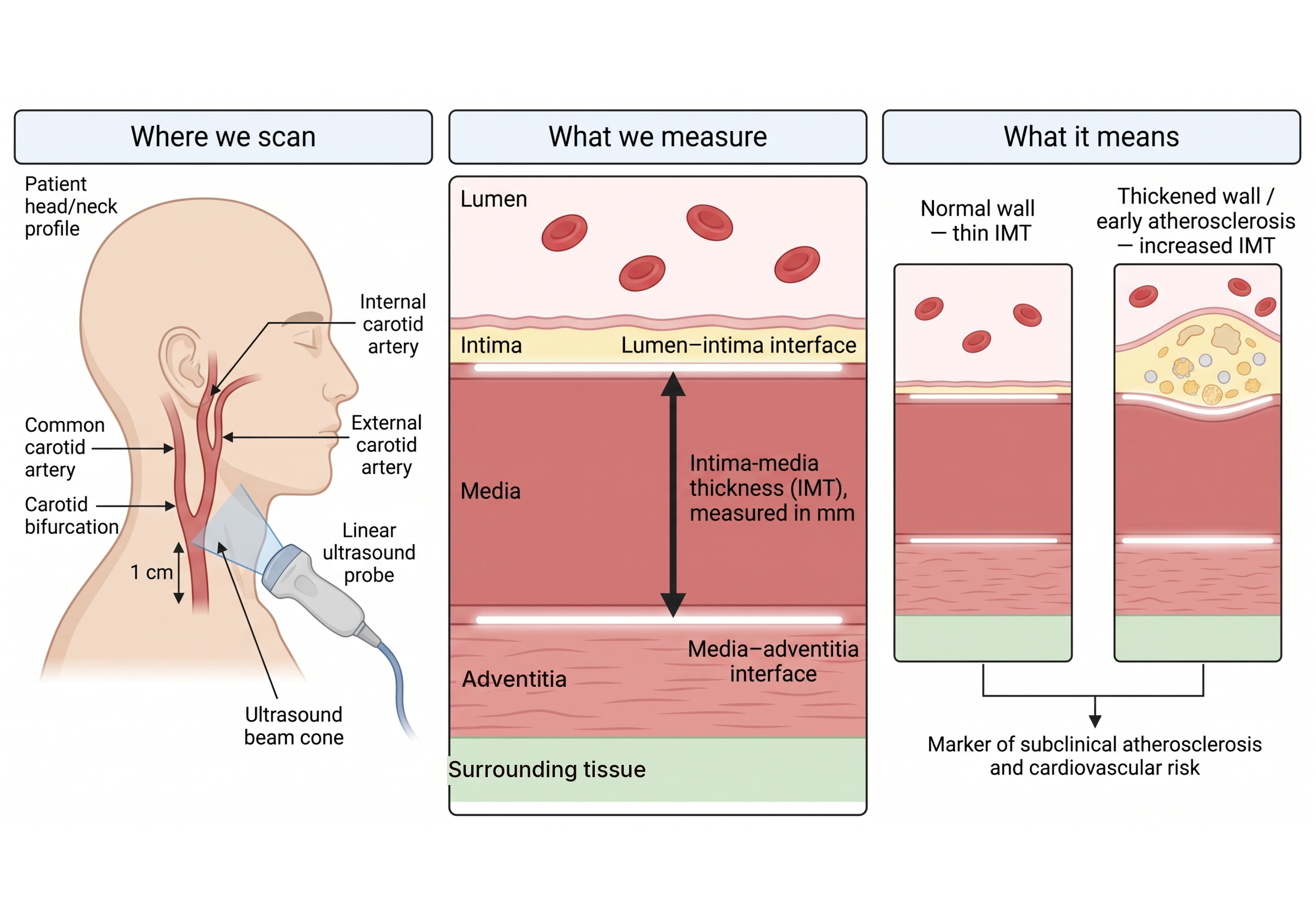
Medicare coverage for CIMT / IMT
Medicare's public cardiovascular screening materials focus on covered services such as certain blood pressure and cholesterol-related screenings. They do not present CIMT as a routine covered preventive benefit in the same way. Clinic pages likewise state that Medicare usually declines CIMT when the reason for testing is wellness or early atherosclerosis detection without an acute indication.
What that means in practice:
- Don't assume a Medicare card removes the cash fee for a screening CIMT.
- If a clinician orders imaging for a different covered indication, that's a separate clinical and billing decision. Screening CIMT should still be planned as self-pay unless your specific Medicare Advantage plan states otherwise in writing.
- Always ask the scheduling site whether they will bill Medicare for your exact order, or whether they only offer cash screening.
Fail-closed rule for patients: no written payer confirmation means no coverage expectation.
Private insurance reimbursement policies
Commercial plans follow the same pattern. CIMT is frequently labeled elective preventive imaging. Insurers may cover other carotid duplex studies when there are neurologic symptoms, bruits, or other medical-necessity criteria. They can still exclude asymptomatic screening CIMT.
Common private-plan outcomes reported by clinics:
- Denial as not medically necessary for asymptomatic screening.
- Out-of-network submission after cash payment, with low odds of payment.
- No network rate, because the service isn't contracted as a covered preventive code at that site.
Before your visit, ask your insurer three precise questions and save the answers:
- Is carotid intima-media thickness screening a covered benefit under my plan?
- If yes, what diagnosis and documentation are required?
- If no, can any portion apply to deductible as an uncovered medical expense?
Get the representative's name, date, and reference number. Verbal optimism isn't a guarantee.
Out-of-pocket cost estimates
Because coverage is uncommon, cash price is the planning number that matters.
Clinic and FAQ pages put the average self-pay CIMT scan at about $250 nationally, with most between $200 and $500. Adjacent marketplace and specialty clinic sources for CIMT test cost often cluster nearer $150 to $300, with prepaid listings starting around $150 and private clinics often quoting about $199 to $300 when a consult or arterial-age report is included.
| Payment path | What to expect |
|---|---|
| Cash / card at visit | Most common |
| HSA / FSA | Frequently used when plan rules allow |
| Insurance billed by clinic | Uncommon for screening CIMT |
| Patient-submitted claim after cash pay | Possible paperwork. Approval rare |
| Clinic membership inclusion | Some Renew membership tiers include imaging |
Wide spreads usually reflect packaging (scan alone vs scan + physician review + prevention consult). They don't reflect a single national fee. Confirm the quote for your location.
Medical necessity criteria
Payers that ever consider carotid imaging look for medical necessity language tied to symptoms or established disease. Screening language ("I want to know my arterial age") rarely meets those criteria.
Examples of contexts that aren't the same as preventive CIMT marketing:
- Focal neurologic symptoms that trigger a diagnostic carotid duplex workup
- Known vascular disease follow-up ordered under a treating clinician's plan
- Pre-operative vascular assessment when a surgeon documents a covered indication
Even then, the study ordered may be a diagnostic carotid duplex, not a wellness CIMT product. Don't equate those visits. If you're asymptomatic and seeking prevention insight, plan for self-pay CIMT and a clinician who will interpret wall thickness and plaque in context. If an earlier scan already showed plaque, see what plaque in a carotid artery means before you decide.
Renew Health's public CIMT materials say you can book a screening visit without a referral and without insurance authorization. That matches the self-pay reality described across clinics.
CPT code 93306 details (coding caveats)
Search results and clinic forums sometimes mention CPT 93306 near cardiac imaging conversations. 93306 is a transthoracic echocardiography code (complete echo with spectral and color Doppler), not a universal "CIMT screening" code. CIMT and carotid duplex billing practices vary by payer, place of service, and whether the study is diagnostic or screening.
Patient-safe takeaways:
- A CPT number on an invoice does not create coverage.
- Do not instruct a clinic to use 93306 (or any other code) to force payment. Coding must match the service performed and payer rules.
- If you need coding detail for a reimbursement attempt, ask the clinic's billing team for the codes they actually use for your CIMT product, then ask your insurer whether that exact code/diagnosis pair is payable for screening.
- Treat any online claim that "93306 means CIMT is covered" as unreliable.
This page will not invent a billing recipe. Coverage remains uncommon for preventive CIMT regardless of which form you submit.
Renew Health pricing and payment options
Renew Health offers CIMT as a short preventive ultrasound at partner locations across many states. Public Renew materials state:
- No referral required for screening booking
- No insurance authorization required to schedule the screening visit
- Standalone pricing varies by location. Contact the site for the current cash quote
- For Renew members, CIMT imaging is described as included in membership tiers
- Results are reviewed with a Renew expert PA, with an option to connect findings to a broader prevention plan
Payment planning tips if you choose Renew:
- Decide whether you want a standalone scan or a membership that includes imaging and follow-up structure.
- Ask the location for today's cash price and whether expert PA review is included.
- If using HSA/FSA, request an itemized receipt with the service description.
- If you still want to attempt insurance reimbursement, ask for documentation that matches what your insurer requested on your coverage call. Expect a possible denial.
Renew's model is built for clarity: look at the arteries, understand vascular age and plaque, then decide on next steps with a clinician. It isn't built around waiting for a payer to redefine screening as a covered benefit.
How to decide whether to pay cash
Use a simple decision check:
- Do you want arterial wall and plaque information now, even if insurance declines?
- Is the cash quote within your planning band of about $250 on average nationally (typically $200–$500) (or your local confirmed quote)?
- Will a clinician explain the result and help you act on it?
- Are you prepared for a possible claim denial if you submit paperwork later?
If the answer to the first three is yes, self-pay CIMT is a straightforward prevention purchase. If you only want the test when a payer pre-authorizes it, you may wait a long time. Clinic sources don't show routine pre-authorization for asymptomatic CIMT screening.
Frequently asked questions
Is CIMT covered by insurance and Medicare?
Insurance companies and Medicare typically do not cover Carotid Intima-Media Thickness (CIMT) testing because it is classified as a preventive screening rather than an acute diagnostic procedure.
How much does a CIMT test cost if I self-pay?
Most clinics require self-pay or payment at the time of service, with costs about $250 on average nationally (typically $200–$500) per scan.
Can I use an HSA or FSA for a CIMT test?
Many patients use Health Savings Accounts (HSA) or Flexible Spending Accounts (FSA) to pay for the test.
Can I submit a CIMT receipt to insurance for reimbursement?
Some providers supply an itemized receipt or medical documentation that you can submit to your insurance company to request partial or full reimbursement yourself, though approval is rare.
Sources
- JAHA review of carotid IMT and cardiovascular risk
- Atherosclerosis Screening with Carotid IMT - COR Medical Group
- CIMT Scan Near Me - Renew Health
- CIMT (carotid ultrasound) - Health Suite 110
- CIMT - Trinity Medical Associates
- Why You Should Have the CIMT Test - Nexus HealthSpan
- Nexus HealthSpan clinic coverage notes
- CIMT Screening FAQ - CardioRisk
- CIMT Testing - Pappas Health
- CIMT Testing - Van Zant Medical Group
- Medicare cardiovascular disease screenings materials
- CIMT test overview - Healthline
- CIMT Screening - Pacific Vascular
Primary coverage sources: COR Medical Group carotid IMT page and Renew Health CIMT.
Author and medical review
Written by Andrew Le, MD. Andrew Le, MD reviews patient-facing guidance for Renew Health with a focus on preventive cardiology and functional medicine clarity.
Medically reviewed by Clinical Review Team.
Next step
See Renew Health CIMT locations and payment options if you want a direct-pay scan with expert PA review rather than waiting on unlikely screening coverage.
Ready to see your actual risk?
Advanced metabolic testing, arterial imaging, and a personalized prevention plan, built around your numbers.
View Memberships