CIMT Test Cost: Scan-Only Ranges vs Clinician Review
Andrew founded Renew Health to change how cardiovascular disease is detected and treated.
CIMT test cost is usually a cash price, because most major private insurance plans and Medicare do not cover CIMT testing as preventive screening. In the ARIC study (Nambi et al., J Am Coll Cardiol 2010), adding CIMT and plaque to traditional risk factors moved about 23% of participants into a different risk group (Nambi et al., J Am Coll Cardiol 2010).
The national average is about $250. Typical market pricing runs from $200 to $500. Compare packages by what is included.
Maybe a calcium score came back high, and the plan on the table is a statin and "see you next year." You are pricing a CIMT because you want to see the numbers on your own arteries.
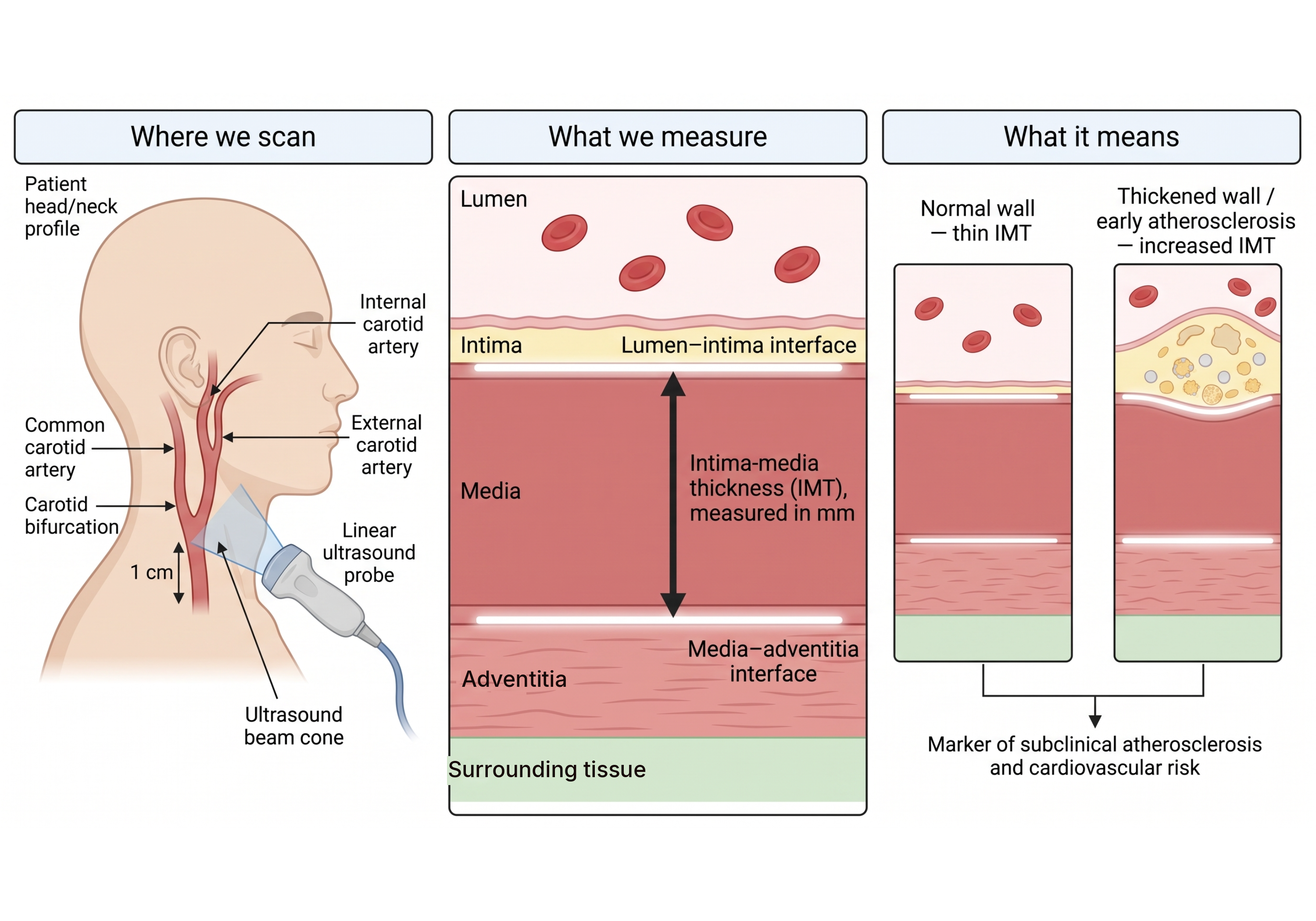
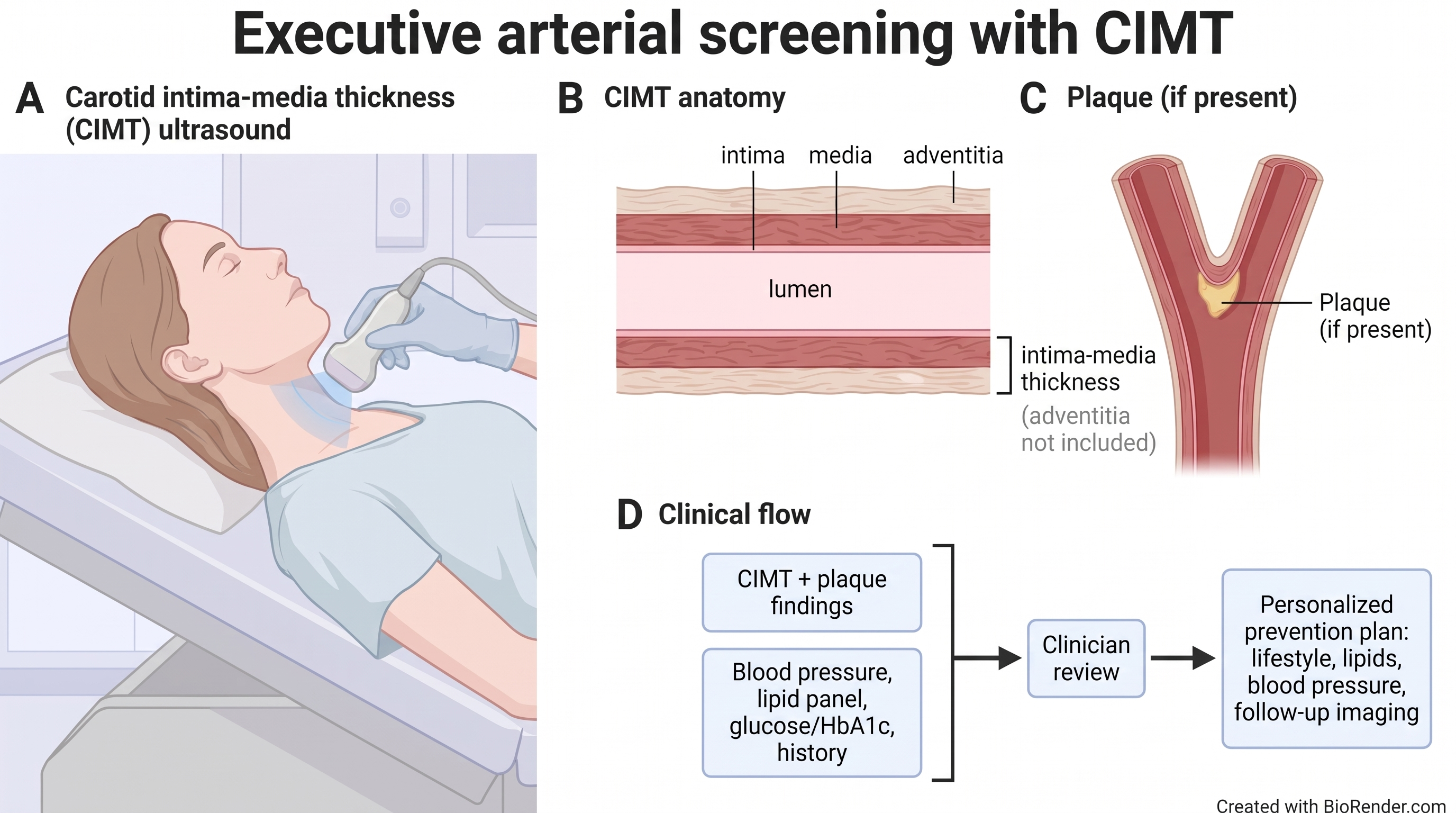
CIMT test price and cost breakdown
Clinic pages usually publish a cash range for the visit. Use the national average and the typical market band below when you budget.
| Package | What the cash figure usually means |
|---|---|
| Market CIMT | National average about $250. Typical market pricing $200 to $500. |
| Renew Health standalone CIMT | Scan plus clinician review of your images and what they mean for risk. Price in the booking section below. |
Fees inside that $200 to $500 band still differ by what you receive. Ask whether the fee buys an image file or an image file plus clinician review.
Renew's standalone fee pays for the scan and clinician review. Some Renew membership tiers include imaging in a broader care plan. Confirm the current fee at booking.
If a quote sits far above $500, ask which extras are bundled (labs, a longer consult, imaging at more than one site). If a quote sits far below $200, confirm operator training, bilateral carotid imaging, and who interprets the study.
Factors influencing pricing (location, provider type)
Price differences usually come from how the visit is packaged. Clinics set their own cash fees.
Location. Facility overhead and local wages show up in the cash rate even when the ultrasound protocol is similar.
Provider type. A vascular screening vendor may price the scan alone. A preventive clinic may price the scan plus clinician review, vascular-age reporting, and a written plan. Direct primary care practices sometimes include CIMT in a membership instead of a one-off charge.
What is measured and reported. A basic wall-thickness measurement is one deliverable. A report that also flags plaque, discusses plaque type, and compares later scans is another. More reporting work tends to raise the cash fee.
Follow-up intensity. Some sites hand you a PDF. Others schedule clinician review. Clinic pages toward the top of the typical market band often include that review step.
Ask for a written list of deliverables: bilateral carotid imaging, measurement method, plaque commentary, arterial-age estimate, and who signs the report.
Insurance coverage and out-of-pocket expenses
Most major private insurance plans and Medicare do not cover CIMT testing. They classify it as elective preventive screening rather than an established medical necessity.
What that means for your budget:
- Payment is typically due in full at the time of service.
- Some clinics provide an itemized receipt if you submit paperwork. Budget the cash price as the price you will pay.
- Treat a reimbursement attempt as paperwork, not a lower fee.
For a deeper coverage walkthrough, see whether CIMT is covered by insurance. This page stays focused on what you should budget.
What is a CIMT test (Carotid Intima-Media Thickness)
Test procedure and duration
A CIMT visit is a short neck ultrasound. Clinic pages describe a pain-free, no-radiation study that usually takes about 15 minutes. A sonographer places gel and a probe on the neck to image the inner layers of the carotid arteries.
A complete package typically includes:
- Bilateral carotid imaging of the intima-media complex.
- Wall-thickness measurements used for risk context and, at many clinics, an arterial (vascular) age estimate.
- Plaque comments when plaque is seen. Soft and calcified plaque can both matter. Soft plaque often gets extra attention in prevention conversations because it may not show on calcium-only tests. See plaque in carotid artery.
- Clinician review of what the findings mean in the setting of age and risk factors.
Clinician review places wall thickness on the lab reference method and notes plaque when it is seen. This page keeps letter grades and millimeter bands out of home use. Companion page: CIMT normal range.
Prep is usually none: no fasting, no needles, no contrast. Renew Health includes clinician review at participating sites. If findings need a broader prevention plan, the clinician connects the scan to that next conversation.
Report interpretation and radiologist review
Interpretation happens after the images are acquired. A trained reader places wall thickness on the lab's reference method, notes plaque when it is seen, and may report an arterial (vascular) age. The person who signs the report owns that reading. On some reports the signer is a radiologist. On others the signer is a clinician trained in that lab's protocol. Ask who signs yours.
Patients should not self-score with millimeter bands or letter grades at home. Thickness only means something on the lab's reference method. See CIMT normal range.
Clinics package the handoff in two common ways. A scan-only visit may end with a PDF of images and measurements. A clinician review is a conversation about what those findings mean. Renew Health's standalone CIMT is one packaging choice: the scan plus clinician review. The reading steps above are the general process either way.
Book a CIMT with clinician review
National average CIMT test cost is about $250 with typical market pricing from $200 to $500 and Renew Health standalone CIMT is $389 with clinician review.
If you want the scan and a clinician walking through the result, book CIMT with Renew Health. Standalone price is $389.
Comparison with other cardiac risk markers
CIMT is one tool. Cost is easier to judge when you know what each test can show.
| Test | What it shows | Typical patient experience | Cost framing vs CIMT |
|---|---|---|---|
| CIMT ultrasound | Wall thickness, soft and calcified plaque in carotids, serial tracking | ~15 minutes, no radiation | Typical market pricing $200 to $500 (national average about $250). |
| CT angiogram | Lumen map of the open vessel channel. Coronary or other beds, depending on the order | CT with ionizing radiation. Often uses IV contrast | Diagnostic CT bill with facility and contrast charges. A different purchase from a CIMT screening |
| Coronary artery calcium (CAC) CT | Calcified coronary plaque burden | Low-dose CT radiation | Often a separate cash or facility fee. Misses soft plaque |
| Standard lipid panel | Blood cholesterol markers | Blood draw | Usually insurance-covered. Does not image arteries |
| Stress testing | Exertional ischemia signals | Longer visit, sometimes nuclear imaging | Useful later in care. Often normal until advanced obstruction |
| Invasive angiography | Luminal blockages | Catheter procedure | Far higher cost and risk. A different clinical question from screening CIMT |
Lipids estimate risk from blood chemistry. CAC shows hardened plaque and uses CT. CIMT looks at arterial wall biology and can be repeated without radiation. See CIMT vs calcium score for that comparison. That's why many prevention clinics use CIMT as a baseline and tracking tool even when insurance does not pay.
Cardiovascular risk assessment and atherosclerosis detection
CIMT contributes a wall picture to cardiovascular risk assessment. The ultrasound measures carotid intima-media thickness. It can also comment on plaque in that wall, including soft plaque and calcified plaque. See plaque in carotid artery.
In the ARIC study (Nambi et al., J Am Coll Cardiol 2010), adding CIMT and plaque to traditional risk factors moved about 23% of participants into a different risk group (Nambi et al., J Am Coll Cardiol 2010). The ARIC authors reported that more individuals were reclassified to a lower risk group than to a higher risk group, and concluded that C-IMT measurement and identification of plaque presence or absence improves CHD risk prediction and should be considered in the intermediate risk group (Nambi et al., J Am Coll Cardiol 2010). For risk assessment, that means a CIMT and plaque result can move an estimate down as well as up, so ask the reviewing clinician how your findings change the estimate built from your traditional risk factors.
Clinics repeat the study to track wall thickness and plaque over time. Ultrasound adds no ionizing radiation on those later visits.
CIMT is used alongside lipids, a coronary calcium score, and stress testing. It does not replace them. Lipids describe blood markers. A calcium score shows calcified coronary plaque on CT. Stress testing looks for exertional ischemia. Soft plaque can matter in a prevention visit because a calcium-only score may not show it. The comparison table above is the side-by-side view. See CIMT vs calcium score.
CT angiogram vs CIMT
A CT angiogram and a CIMT test answer different questions. They are not interchangeable.
Radiation. A CT angiogram uses computed tomography, so the exam involves ionizing radiation. CIMT is a neck ultrasound. The picture comes from sound waves. CIMT uses no ionizing radiation.
Contrast. A CT angiogram often uses intravenous contrast to outline the channel inside the artery. CIMT uses gel on the skin and a probe. CIMT uses no contrast and no intravenous line.
What the picture shows. A CT angiogram maps the lumen, the open channel where blood flows, in the bed named on the order. CIMT measures carotid wall thickness (intima plus media) and can comment on plaque in that wall, including soft plaque. Soft plaque can matter in a prevention visit because a calcium-only score may not show it.
Cost framing. A CT angiogram is usually ordered as a diagnostic CT. The bill reflects facility imaging and, when contrast is used, the contrast charge. Typical market CIMT pricing runs from $200 to $500, with a national average about $250. Use each price for the study it actually buys.
How to book a CIMT test
You can usually book without a referral when the site offers direct-pay screening.
Steps that keep cost surprises low:
- Confirm the cash price and what's included (scan only vs scan plus clinician review).
- Ask whether membership pricing changes the fee if you already receive care at that clinic.
- Verify operator and interpretation credentials.
- Request an itemized receipt if you may submit paperwork to an insurer or need HSA/FSA documentation.
- Schedule a time you can stay for result review when that's part of the package.
Renew Health's CIMT page lists Cardiorisk Laboratories partner sites at 50+ locations across 28 states (CIMT). Members may have imaging included in membership tiers. No referral is required to start. Book CIMT.
Frequently asked questions
What does a CIMT test typically cost?
National average CIMT test cost is about $250 with typical market pricing from $200 to $500 and Renew Health standalone CIMT is $389 with clinician review.
Does health insurance typically cover a CIMT test?
Most major private insurance plans and Medicare do not cover CIMT testing. They classify it as an elective preventive screening rather than an established medical necessity. Payment is typically due in full at the time of service.
What is the difference between a CT angiogram and a CIMT test?
A 2010 Insights into Imaging review of cardiac CT angiography says it necessitates injection of intravenous contrast material as well as exposure to ionizing radiation (Clinical applications of cardiac CT angiography). A CIMT test is a neck ultrasound of wall thickness and plaque, including soft plaque, with no ionizing radiation.
What CIMT score is considered normal?
A Journal of the American Heart Association cohort notes that the American Society of Echocardiography consensus statement recommends the use of CIMT above the 75th percentile for age, race, and sex as being abnormal (JAHA.123.029656).
How do I book a CIMT test?
Renew Health's CIMT page says to pick a location near you and choose an available date, with no referral needed and no insurance required (CIMT). The same page lists "Expert PA review within 10 days" under Results (CIMT).
Sources
-
Carotid Intima-Media Thickness (CIMT) Evaluation - MDsave
-
CIMT Screening - Pacific Vascular
-
CIMT Test - Whole Heart Family Medicine
-
CIMT Testing - Van Zant Medical Group
-
CIMT (carotid ultrasound) - Health Suite 110
-
Atlanta Ultrasound CIMT
-
Nexus HealthSpan CIMT screening cost notes
-
CardioRisk
-
Nambi V, et al. Carotid intima-media thickness and presence or absence of plaque improves prediction of coronary heart disease risk: the ARIC study. J Am Coll Cardiol 2010 (PMC). Primary sources for pricing ranges: MDsave CIMT evaluation and the clinic pages named above.
Author and medical review
Written by Andrew Le, MD. Andrew Le, MD reviews patient-facing guidance for Renew Health with a focus on preventive cardiology and functional medicine clarity.
Medically reviewed by Clinical Review Team.
Next step
Book your CIMT scan with Renew Health for $389 with clinician review of results.
Ready to see your actual risk?
Advanced metabolic testing, arterial imaging, and a personalized prevention plan, built around your numbers.
View Memberships