Executive Health Assessment: What It Checks, What Follows
Andrew founded Renew Health to change how cardiovascular disease is detected and treated.
Direct answer: Are executive physicals worth it? An executive health assessment is “a comprehensive, single-day preventive health exam designed for busy professionals to evaluate overall health and detect hidden risks early”. Extended physical exam: A thorough head-to-toe examination and detailed medical history review with an internal medicine physician. Specialized screenings: Customized tests based on age and risk factors, which can include cardiac imaging (like calcium scoring), fitness assessments (VO2 max), and nutritional or stress evaluations. Same-day review: A final wrap-up consultation with the physician to review findings and map out a personalized health and wellness plan.
Why people book one
Many people look up an executive health assessment after a number surprised them. A CIMT report put arterial age well past real age. A calcium score came back high, and the plan offered was a statin and "see you next year." A peer the same age had a heart attack.
If that is you, one day of tests still leaves the next twelve months open. Building a company already costs sleep and energy. You want both back. You want to know whether the disease is still growing. You want to know what happens over the next twelve months.
An assessment day can answer the first half.
Are executive physicals worth it?
Worth it if you have a risk signal and want a year-long plan. Not worth it as a once-a-year test menu.
An assessment packs a head-to-toe exam, a detailed history review, a large blood panel, heart tests such as an ECG or a calcium score, a fitness test, and a same-day review with a written plan into one day.
The strongest evidence on broad check-ups is a Cochrane review of 17 randomized trials with 251,891 participants (Krogsbøll et al., Cochrane 2019). The trials compared invitations to general health checks with no invitation, in adults who were not selected for disease or risk factors. Health checks had little or no effect on total mortality or cancer mortality. They probably had little or no effect on cardiovascular mortality.
Those trials tested broad screening for people with no known problem. A focused workup for someone who already has a finding, such as a thick carotid wall or a high calcium score, with a plan to treat it and measure again, was outside their scope.
What Renew does after the day
Hospital programs usually close the day with a same-day review and a written plan. After that, you go back to local care or book a return visit. The next measurement is often a year away.
If you want that follow-up run as ongoing care, Renew's Performance and Executive memberships start with CIMT imaging and a workup for 33 known drivers of arterial damage, then treat and re-measure those drivers through the year. First we stop it. Then we work to reverse it. Your 12-month rescan shows which. A rescan that holds steady is the first win.
Care is remote, by video and messaging. Performance and Executive include in-home blood draws. On the Essentials and Reversal tiers, labs run through Quest. Five trained providers share your care on every Renew membership. Renew is cash-pay and operates outside insurance.
Performance at $999/mo is the primary path. It includes monthly physician visits, tune-up labs four times a year, and DEXA and VO2 Max testing twice a year.
Executive at $5,000/mo is the secondary path. It adds weekly coaching and unlimited physician access. Full tier details are on Pricing.
What an executive health assessment usually includes
Published program menus look much alike. The exact list belongs to each program. Use it as a checklist of questions.
- Physical examination. A head-to-toe exam and a detailed history review.
- Advanced diagnostic imaging. Some programs add cardiac imaging such as calcium scoring, body composition scans, or ultrasound.
- Cardiovascular risk assessment. Blood pressure, a lipid panel, an electrocardiogram, and sometimes imaging.
- Cancer screening protocols. Screening chosen by age and risk. Details are below.
- Genetic testing. Offered by some programs, often as an add-on. Details are below.
- Mental health and cognitive assessment. Questions or screens on mood, sleep, stress, and memory. Details are below.
- Executive lifestyle and stress management. Nutrition review, a fitness test such as VO2 max, and a stress evaluation.
- Written roadmap. The same-day review and a written plan.
- Preventive care strategy. A list of what to repeat and when.
Day length and fees vary by program. Ask for both in writing. For fee ranges and what drives them, see executive physical cost. For coverage questions, see does insurance cover an executive physical.
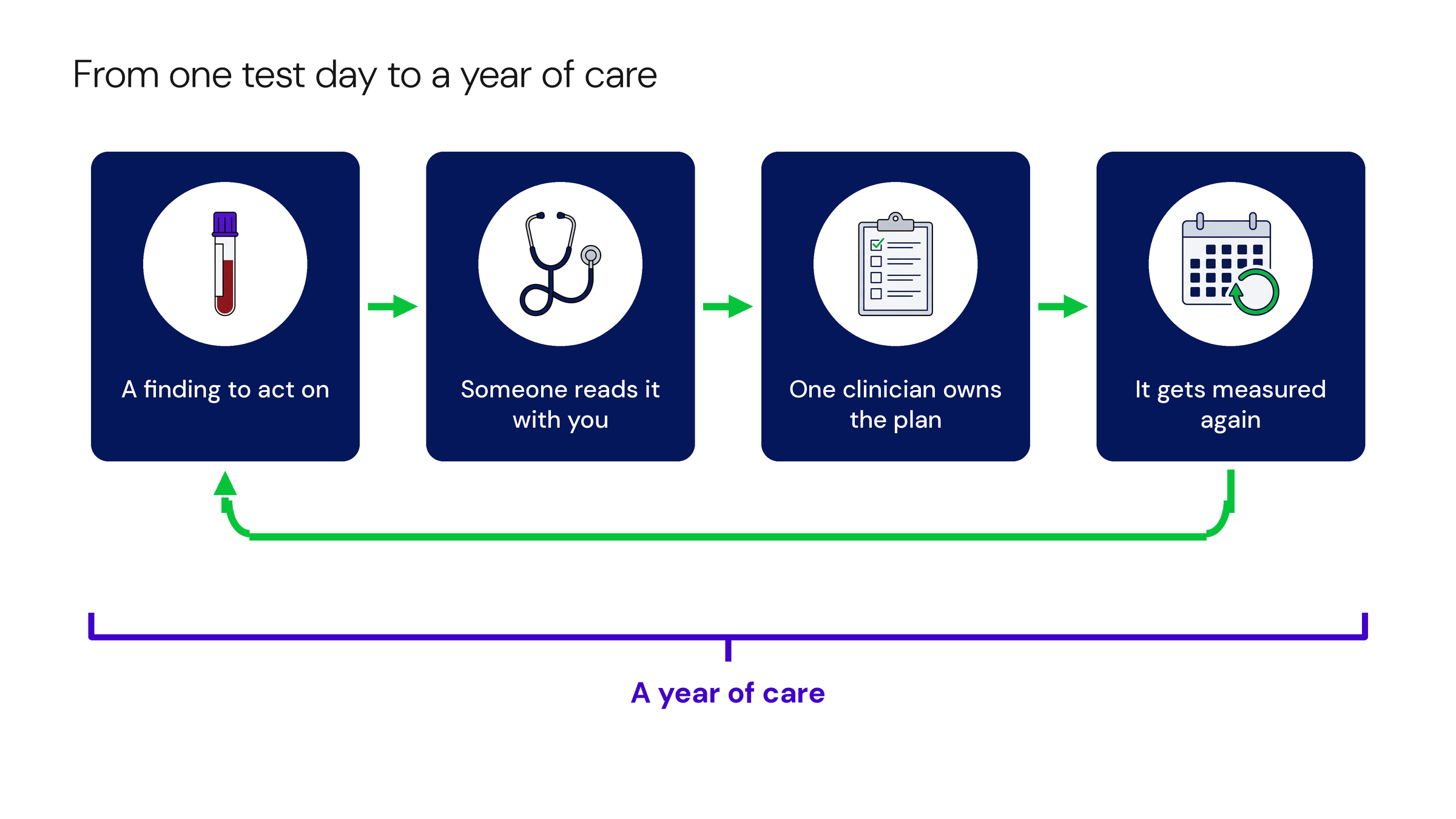
Four questions for any program
The Cochrane review's key message is that systematic offers of health checks are unlikely to be beneficial and may lead to unnecessary tests and treatments. So the useful test for any program is short:
- What finding are you trying to act on?
- Who reads the results with you?
- Who owns the treatment plan after the day?
- When does anyone measure the same thing again?
If a program can answer all four, you are buying a year of care. If it can answer only the first two, you are buying one day of tests.
Advanced diagnostics, test by test
The diagnostic part of the day is where programs differ most. Published program menus often list a large blood panel, an ECG, body composition scans such as DEXA, a fitness test, and heart imaging.
Blood panel
A large panel usually covers blood counts, a metabolic panel, lipids, blood sugar markers, thyroid, vitamins, and inflammation. The size of the panel tells you little on its own. Ask whether it includes hs-CRP, Lp(a), and apoB, the three markers the prevention guideline treats as risk enhancers when measured. Their thresholds are in the artery section below.
Electrocardiogram (ECG)
A resting ECG records the heart's electrical signal for a few seconds. It can pick up rhythm problems and signs of an earlier heart attack. A normal tracing says little about plaque in the artery wall, which is why programs add imaging.
Fitness testing and VO2 max
A treadmill or bike test measures how much work your heart and lungs can support. Mandsager and colleagues followed 122,007 patients after treadmill testing. Over a median of 8.4 years, the least fit group had about five times the adjusted risk of death of the fittest group (Mandsager et al., JAMA Netw Open 2018). That gap was larger than the gaps this study reported for smoking, diabetes, or coronary artery disease. Fitness is also one of the few results on the day you can train to change. Renew's Performance tier repeats VO2 Max testing twice a year.
Heart and body imaging
Imaging is where an assessment looks at the body itself. Each scan answers a narrow question. Ask which question each one on your itinerary is meant to answer.
Coronary artery calcium (CAC) scan. A non-contrast CT of the heart that scores calcified plaque in the coronary arteries. The cholesterol guideline uses it when a statin decision is uncertain in an adult at intermediate risk (Grundy et al., Circulation 2019). A score of zero can support holding off on a statin, with exceptions for cigarette smokers, people with diabetes, and people with a strong family history of premature ASCVD. A score of 1 to 99 favors a statin. A score of 100 or higher, or at or above the 75th percentile for age and sex, points to one unless you and your clinician decide otherwise. The guideline also says it is uncertain when, or whether, to repeat the scan after a score of zero.
Carotid ultrasound and CIMT. Carotid intima-media thickness (CIMT) uses ultrasound to measure the inner layers of the carotid artery wall, with no radiation. It reads the wall itself, which makes it useful for tracking change over time. Renew starts every Performance and Executive membership with it.
DEXA. A low-dose X-ray scan that measures fat, lean mass, and bone. It can also estimate visceral fat, the fat packed around the organs. Among 124 adults scanned with both methods, DEXA visceral fat stayed close to the CT measurement, with an r² of about 0.96 (Kaul et al., Obesity 2012). The authors note that visceral fat predicts adverse events better than fat under the skin.
What a good assessment asks about your arteries
The 2019 ACC/AHA primary prevention guideline lists risk-enhancing factors that can move a borderline or intermediate risk estimate toward treatment (Arnett et al., Circulation 2019). The list includes:
- Family history of premature ASCVD
- Primary hypercholesterolemia, with LDL-C of 160 to 189 mg/dL
- Metabolic syndrome and chronic kidney disease
- Chronic inflammatory conditions such as psoriasis, rheumatoid arthritis, lupus, or HIV
- A history of premature menopause (before age 40) or preeclampsia
- If measured: hs-CRP of 2.0 mg/L or higher, Lp(a) of 50 mg/dL (125 nmol/L) or higher, and apoB of 130 mg/dL or higher
The guideline labels the last three markers "if measured." Ask whether the program you are considering measures hs-CRP, Lp(a), and apoB, and who will explain the results.
Imaging adds a second layer. In a UK Biobank cohort of 29,292 adults free of cardiovascular disease at baseline, higher CIMT was associated with later coronary heart disease (Mitra et al., Am J Prev Cardiol 2025). That is a research association from a public cohort. One reading cannot grade your risk by itself. A clinician reads it with the rest of your history.
Other tests on the menu, and what Renew covers
These tests show up on many assessment menus. Renew's plan centers on your arteries. Like the rest of a standard checkup, each test below is a snapshot unless someone owns the follow-up.
Cancer screening
Programs choose cancer screening by age and risk. If a colonoscopy matters to you, ask whether it happens on the assessment day or is booked separately. Renew doesn't do cancer screening. Your primary care doctor does, and we'll coordinate with them.
Low-dose chest CT. Some programs offer it to people with a heavy smoking history. In the National Lung Screening Trial, low-dose CT led to 20% fewer lung cancer deaths than chest radiography. Of the positive CT results in that trial, 96.4% were false positives (National Lung Screening Trial Research Team, N Engl J Med 2011). Expect follow-up scans if something shows up.
MRI
Some programs sell whole-body MRI as an add-on. The published program menus we reviewed leave it off the standard list. Before you agree to one, ask what question it answers. Ask what happens if it finds something incidental. Renew doesn't do MRI. Your primary care doctor can refer you if you need one.
Vision, hearing, and lung function
Vision and hearing checks look for changes that are easy to miss at work. Pulmonary function testing, usually spirometry, measures how much air you move and how fast. Ask for the numbers themselves, since a baseline makes later changes easier to spot. Renew doesn't do vision, hearing, or lung function testing. Your primary care doctor can order these or refer you. The closest Renew measure is VO2 Max on Performance, which tracks how much work your heart and lungs can support.
Genetic testing
Genetic testing on an assessment usually means a panel chosen for heart and metabolic risk, or a broader longevity panel. Some results are fixed for life and need testing once, such as inherited variants. Others describe risk that your plan can respond to. Before you consent, ask which genes are on the panel, who explains the report, whether a genetic counselor is available, and whether the result goes into your medical record. Renew's 33-driver workup includes genetic drivers of arterial damage. Renew doesn't do broader genetic or longevity panels. Ask your primary care doctor about a genetic counselor.
Mental health and cognitive assessment
Most programs use short questionnaires to screen mood, anxiety, stress, and sleep, and some add a brief memory or attention test. A screen starts a conversation, and a clinician decides whether a diagnosis follows. Ask who reviews your answers, and what referral or follow-up happens if a score is high. Renew's 33-driver workup includes sleep. Renew doesn't do mental health screening. Your primary care doctor can screen you and refer you on.
Frequently asked questions
Are executive physicals worth it?
Yes, when the results lead to treatment and repeat measurement: Renew's Performance membership is $999/mo and includes carotid artery imaging, advanced lab panels testing for 33 known drivers of arterial damage, and a dedicated care team. If you have a heart attack, stroke, or other cardiovascular event while actively enrolled and following your protocol, Renew refunds your membership fees. An executive health assessment is “a comprehensive, single-day preventive health exam designed for busy professionals to evaluate overall health and detect hidden risks early”. Same-day review: A final wrap-up consultation with the physician to review findings and map out a personalized health and wellness plan.
What is an executive health assessment?
An executive health assessment is “a comprehensive, single-day preventive health exam designed for busy professionals to evaluate overall health and detect hidden risks early”.
What happens during an executive health assessment?
Extended physical exam: A thorough head-to-toe examination and detailed medical history review with an internal medicine physician. Specialized screenings: Customized tests based on age and risk factors, which can include cardiac imaging (like calcium scoring), fitness assessments (VO2 max), and nutritional or stress evaluations. Same-day review: A final wrap-up consultation with the physician to review findings and map out a personalized health and wellness plan.
Does an executive health assessment include heart imaging?
Specialized screenings: Customized tests based on age and risk factors, which can include cardiac imaging (like calcium scoring), fitness assessments (VO2 max), and nutritional or stress evaluations.
Sources
- Krogsbøll LT, et al. General health checks in adults for reducing morbidity and mortality from disease. Cochrane Database Syst Rev. 2019. Seventeen trials, 251,891 participants.
- Arnett DK, et al. 2019 ACC/AHA Guideline on the Primary Prevention of Cardiovascular Disease. Circulation. 2019. Risk-enhancing factors table.
- Mitra et al. Carotid intima-media thickness, cardiovascular disease, and risk factors in 29,000 UK Biobank adults. Research association, no Renew outcome rate.
- Grundy SM, et al. 2018 AHA/ACC Guideline on the Management of Blood Cholesterol: Executive Summary. Circulation. 2019. Risk-enhancing factors, CAC, and follow-up lipid testing.
- Kaul S, et al. Dual-energy X-ray absorptiometry for quantification of visceral fat. Obesity. 2012. DXA against CT in 124 adults.
- Mandsager K, et al. Association of Cardiorespiratory Fitness With Long-term Mortality Among Adults Undergoing Exercise Treadmill Testing. JAMA Netw Open. 2018. 122,007 patients, median follow-up 8.4 years.
- National Lung Screening Trial Research Team. Reduced Lung-Cancer Mortality with Low-Dose Computed Tomographic Screening. N Engl J Med. 2011. Low-dose CT against chest radiography.
- Executive health memberships.
- Pricing.
- How it works.
Author and medical review
Written by Andrew Le, MD. Andrew Le, MD reviews patient-facing guidance for Renew Health with a focus on preventive cardiology and functional medicine clarity.
Medically reviewed by Clinical Review Team.
Next step
If you already have a result and want a year-long plan around it, start with Performance at $999/mo on executive health. Executive at $5,000/mo is on the same page if you want it fully managed.
Structured data
{
  "@context": "https://schema.org",
  "@type": "FAQPage",
  "mainEntity": [
    {
      "@type": "Question",
      "name": "Are executive physicals worth it?",
      "acceptedAnswer": {
        "@type": "Answer",
        "text": "Yes, when the results lead to treatment and repeat measurement: Renew's Performance membership is $999/mo and includes carotid artery imaging, advanced lab panels testing for 33 known drivers of arterial damage, and a dedicated care team. If you have a heart attack, stroke, or other cardiovascular event while actively enrolled and following your protocol, Renew refunds your membership fees. An executive health assessment is “a comprehensive, single-day preventive health exam designed for busy professionals to evaluate overall health and detect hidden risks early”. Same-day review: A final wrap-up consultation with the physician to review findings and map out a personalized health and wellness plan."
      }
    },
    {
      "@type": "Question",
      "name": "What is an executive health assessment?",
      "acceptedAnswer": {
        "@type": "Answer",
        "text": "An executive health assessment is “a comprehensive, single-day preventive health exam designed for busy professionals to evaluate overall health and detect hidden risks early”."
      }
    },
    {
      "@type": "Question",
      "name": "What happens during an executive health assessment?",
      "acceptedAnswer": {
        "@type": "Answer",
        "text": "Extended physical exam: A thorough head-to-toe examination and detailed medical history review with an internal medicine physician. Specialized screenings: Customized tests based on age and risk factors, which can include cardiac imaging (like calcium scoring), fitness assessments (VO2 max), and nutritional or stress evaluations. Same-day review: A final wrap-up consultation with the physician to review findings and map out a personalized health and wellness plan."
      }
    },
    {
      "@type": "Question",
      "name": "Does an executive health assessment include heart imaging?",
      "acceptedAnswer": {
        "@type": "Answer",
        "text": "Specialized screenings: Customized tests based on age and risk factors, which can include cardiac imaging (like calcium scoring), fitness assessments (VO2 max), and nutritional or stress evaluations."
      }
    }
  ]
}
{
  "@context": "https://schema.org",
  "@type": "Article",
  "headline": "Executive Health Assessment: What It Checks, What Follows",
  "description": "An executive health assessment packs an exam, labs, and screenings into one day. See what the trials say about value, and what Renew does after the day.",
  "image": [
    {
      "@type": "ImageObject",
      "contentUrl": "/images/blog/executive-health-assessment/executive-health-assessment-year-of-care-loop.png",
      "name": "From one test day to a year of care",
      "caption": "Four cards joined by a green loop arrow show a finding to act on, someone reading it with you, one clinician owning the plan, and the result being measured again. A purple bracket groups the loop as a year of care.",
      "creditText": "Created with BioRender.com (Industry)."
    }
  ],
  "author": {
    "@type": "Person",
    "name": "Andrew Le, MD",
    "description": "Andrew Le, MD reviews patient-facing guidance for Renew Health with a focus on preventive cardiology and functional medicine clarity."
  },
  "reviewedBy": {
    "@type": "Person",
    "name": "Clinical Review Team"
  },
  "datePublished": "2026-09-28",
  "mainEntityOfPage": "/evidence/executive-health-assessment"
}
{
  "@context": "https://schema.org",
  "@type": "MedicalWebPage",
  "name": "Executive Health Assessment: What It Checks, What Follows",
  "description": "An executive health assessment packs an exam, labs, and screenings into one day. See what the trials say about value, and what Renew does after the day.",
  "medicalAudience": {
    "@type": "MedicalAudience",
    "audienceType": "Patients"
  },
  "reviewedBy": {
    "@type": "Person",
    "name": "Clinical Review Team"
  },
  "lastReviewed": "2026-09-28"
}
Ready to see your actual risk?
Advanced metabolic testing, arterial imaging, and a personalized prevention plan — built around your numbers.
View Memberships