Executive Physical Near Me: How to Judge Local Care
Andrew founded Renew Health to change how cardiovascular disease is detected and treated.
Korenstein and colleagues' 2019 study identified 50 top-ranked US hospitals in 43 states, and 32 of them (64%) offered executive physical packages (Korenstein et al., 2019). Performance at $999/mo is primary. Executive at $5,000/mo is secondary.
Your doctor said it's fine and to come back next year. You want a real look at your arteries without clearing a week from your calendar.
What this search is asking
"Near me" feels like a map query. For an executive physical, the map is the easy part. The hard part is whether the nearby visit is a real preventive workup or a short checkup with a premium name.
Sort the options you actually have into three groups:
- A local clinic or hospital that will put an itinerary in writing.
- A travel-to-center program you fly to for one stay.
- Year-round membership that does not depend on a single campus day, such as Renew's, which keeps measuring and treating all year (Executive health).
Distance matters for your calendar. If you want the definition of the visit itself, read what is an executive physical. If you want a method for the word "best," read best executive physical.
How to evaluate a local option
Call or email before you book. Five questions separate a useful local visit from a branded annual exam.
- Written itinerary. Which exams and tests are in the base visit, and which are add-ons? If the answer is "a comprehensive panel," ask for the list.
- Clinician of record. Who reviews results with you, and is that person available after the day?
- Handoff. If this clinic is not your ongoing physician, who receives the report?
- Time block. Is this a 30-minute checkup, a full day, or a multi-day stay? Length tells you about logistics. If the time does not match the work, you are looking at a different product.
- Aftercare. What is scheduled in the next 90 days if something is abnormal?
Do not self-diagnose from a millimeter of wall thickness or a letter on a printout. Take the report to the clinician who will own the next step.
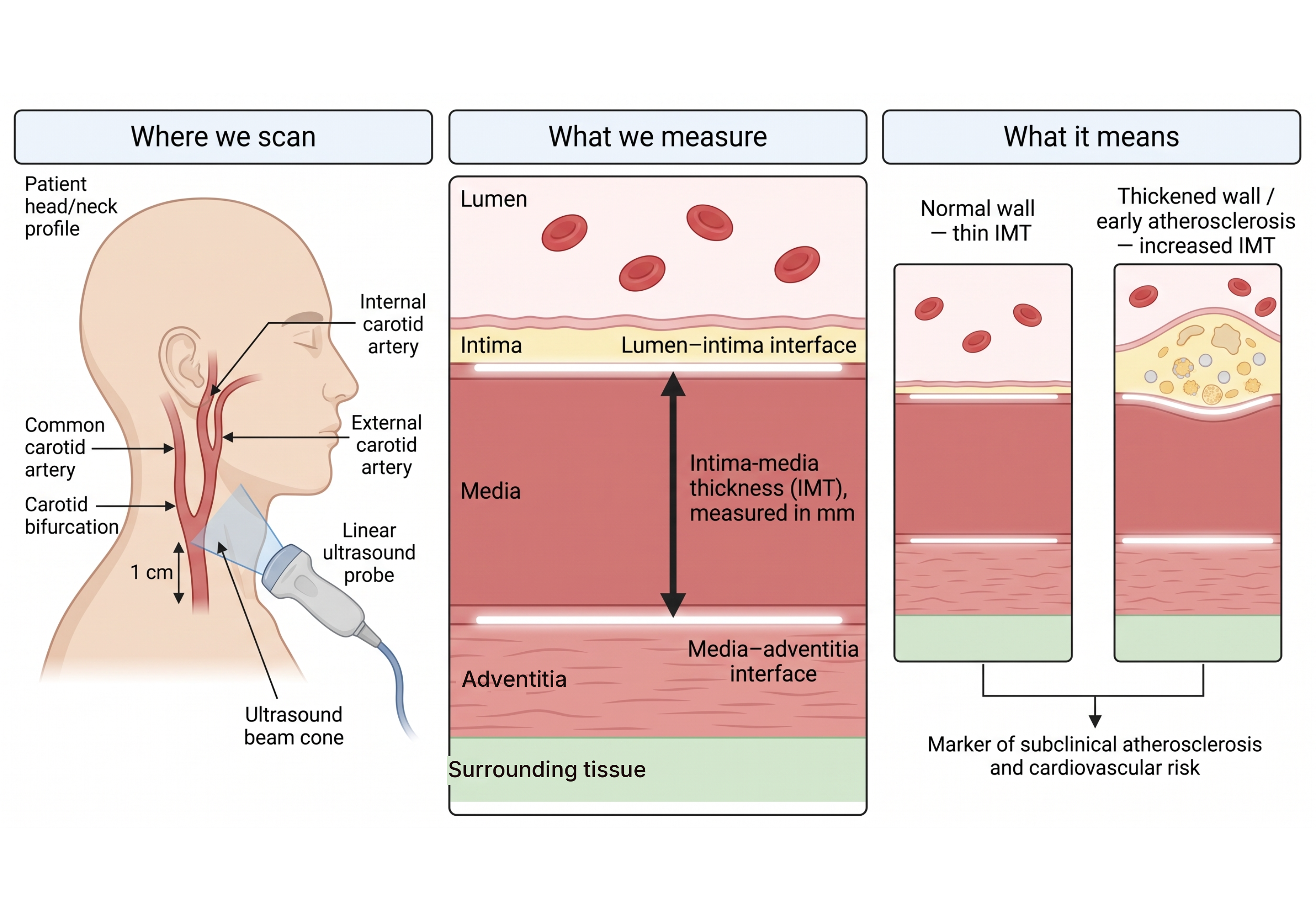
Where to get a carotid ultrasound is a different search. Renew's CIMT page covers the scan itself.
When travel to a center is reasonable
Travel fits when you want many services coordinated in one stay and you already know who will manage you at home.
A center can be worth the trip when its written itinerary matches your questions and a local clinician will use the summary.
Employer-paid travel is a benefits question. See corporate executive physical.
Concierge and private practice benefits
Mayo Clinic's FAQ flyer says its Executive Health Program is not a medical concierge program, is not a membership program, and does not provide 24/7/365 provider access (Mayo Clinic FAQ). The flyer says Mayo requires a local primary care provider for personal health needs, including medication refills (Mayo Clinic FAQ).
Where Renew fits
Choose membership when follow-through is the problem you care about. The membership includes CIMT arterial imaging, advanced lab panels testing for 33 known drivers of arterial damage, and tune-up labs. Performance and Executive add DEXA body composition scans and VO2 Max testing (Pricing).
Provider credentials to check
- Board certification. Each certifying board offers a public lookup. Use that lookup to confirm the certificate. A brochure title stays a claim until the lookup confirms it.
- Who interprets the imaging. A technologist performs a carotid ultrasound or a DEXA scan. A clinician interprets the scan.
- Who interprets the advanced labs. Lp(a), ApoB, and hs-CRP need a clinician to put them in context.
Standard and advanced tests to compare across local options
Put each local option's written list next to this table. A program that cannot fill in most rows is selling a shorter visit.
| Test | What it checks | What to ask |
|---|---|---|
| History and physical exam | Symptoms, family history, medications, blood pressure, and a hands-on exam | How long the physician visit lasts |
| Standard blood work | Cholesterol, blood sugar, kidney and liver function, and blood counts | Whether ApoB or Lp(a) is included or extra |
| Resting ECG | Heart rhythm and signs of past strain on the heart | Why it is ordered, since the USPSTF advises against screening ECGs for adults at low risk (USPSTF) |
| Exercise stress test | How the heart responds to effort | Who supervises it and whether it is included |
| Coronary calcium score | Calcified plaque in the heart arteries, measured by CT | Whether it costs extra and how the score would change your plan |
| Carotid ultrasound | Wall thickness and plaque in the neck arteries | Who reads it and whether it is repeated |
| Cancer screening | Colorectal, breast, cervical, and lung screening by age and risk | Which screenings happen that day and which are referred out |
The USPSTF recommends lung cancer screening with low-dose CT only for adults 50 to 80 with a 20 pack-year smoking history who smoke now or quit within the past 15 years (USPSTF). If a clinic offers that scan to everyone, ask why.
- Blood Tests in an Executive Physical: The Panel, Explained
- Executive Physical for Women: What It Covers, Heart First
- Executive Physical With Calcium Score: What It Decides
- Executive Physical With CIMT: What the Artery Scan Adds
Preventive health and longevity focus
"Near me" starts as a location search. The health question inside it is preventive: look for risk while you still feel well, then keep measuring it.
Longevity, on this page, means the plan continues after one campus day. Arterial risk is the piece to ask about by name. Carotid intima-media thickness is a research marker of subclinical atherosclerosis. In a UK Biobank cohort of adults free of cardiovascular disease at baseline, higher thickness was associated with later coronary disease (Mitra et al., Am J Prev Cardiol 2025). That association describes the measurement in a research cohort. It stands apart from any clinic's outcome rate.
A resting ECG answers a rhythm question. The USPSTF recommends against screening ECGs in adults at low risk (USPSTF).
Cancer screening stays part of preventive care for the age and risk groups the USPSTF names, including colorectal screening and breast, cervical, and lung screening where the recommendation applies (USPSTF).
Comprehensive exam components
Cleveland Clinic's exam page says every executive health appointment includes a thorough physical exam, nutrition consultation, exercise counseling and a review of vaccinations, and that your provider will ask questions about your medical history, any medications you take, what you eat and drink, your exercise habits and your overall lifestyle (Cleveland Clinic exam).
Advanced diagnostic testing
Cleveland Clinic's exam page says tests might include a variety of blood tests, an electrocardiogram (EKG), a cardiac stress test, a calcium-score screening heart scan, spirometry, a chest X-ray or CT scan, vascular screening tests, and a bone density test (Cleveland Clinic exam).
MDVIP-affiliated practices
MDVIP's employer FAQ says MDVIP-affiliated physicians limit their practice to MDVIP members only, offer 24/7 doctor availability by phone and same- or next-day appointments, and that the annual fee for individual memberships is generally between $2,500 and $5,000, based on location (MDVIP employers FAQ).
Who leads the exam
Atlantic Health says a board-certified internal medicine doctor leads the exam and brings in specialists chosen for your specific health needs (Atlantic Health Executive Health).
Scheduling and location
Mayo Clinic's Executive Health FAQ recommends scheduling your appointment several months in advance, and charges cancellation fees to patients who cancel or reschedule within 30 days of a scheduled on site exam (Mayo Clinic Executive Health FAQ, MC1927-43).
Lifestyle prevention in the guideline
The 2019 ACC/AHA prevention guideline says the most important way to prevent atherosclerotic vascular disease, heart failure, and atrial fibrillation is to promote a healthy lifestyle throughout life (Arnett et al., Circulation 2019).
Questions to ask
- Ask the clinic for its written itinerary, who reads your results, and who owns follow-up.
- Ask who will read your results before you book.
- Ask which specialty board certifies the clinician of record, such as internal medicine, family medicine, cardiology, or preventive medicine.
- Ask who signs the imaging report and whether that person will walk you through it.
- Ask whether the clinician who reviews Lp(a), ApoB, and hs-CRP has specific training in cardiovascular prevention.
- Ask whether the same clinician will see you across visits.
- Ask the team for each provider's board certification and training before you join.
- Ask whether the written itinerary includes blood pressure, lipids, and the markers a deeper prevention visit adds past a standard cholesterol line: Lp(a), ApoB, and hs-CRP.
- Ask who reads those results next to any vascular imaging on the day.
- Ask why a resting ECG is included for a low-risk adult.
Frequently asked questions
Is a nearby annual checkup the same product?
Korenstein and colleagues' 2019 JAMA research letter describes executive physicals as 1- to 2-day comprehensive evaluations offering putative preventive testing and screening (Korenstein et al., JAMA 2019). Cleveland Clinic's employer page says a thorough preventive exam is delivered in an efficient 6-to 8-hour, single-day experience (Cleveland Clinic Executive Health).
Does Renew have an executive physical office near me?
Renew's Executive Health page says the commercial answer is membership (Executive health).
Sources
-
Mayo Clinic Executive Health: Our Expertise
-
Mayo Clinic Executive Health apply page (local primary care required. calendars may be full for the next three months)
-
Mayo Clinic Executive Health FAQ flyer (MC1927-43)
-
Mitra et al., carotid intima-media thickness in UK Biobank adults (research marker of subclinical atherosclerosis. separate from any clinic outcome rate)
-
USPSTF recommendation on screening for cardiovascular disease risk with electrocardiography
-
USPSTF recommendation on lung cancer screening with low-dose CT
-
US Preventive Services Task Force (USPSTF) recommendations on colorectal, breast, cervical, lung, prostate, and ovarian cancer screening
Author and medical review
Written by Andrew Le, MD. Andrew Le, MD reviews patient-facing guidance for Renew Health with a focus on preventive cardiology and functional medicine clarity.
Medically reviewed by Clinical Review Team.
Next step
If local follow-through is the gap, see executive health.
Performance at $999/mo is primary. Executive at $5,000/mo is secondary.
Primary: Performance, $999/mo. The membership includes CIMT arterial imaging, advanced lab panels testing for 33 known drivers of arterial damage, DEXA body composition scans (2x/year), VO2 Max testing (2x/year), and tune-up labs (4x/year).
Secondary: Executive, $5,000/mo. Executive adds unlimited physician access and priority scheduling on all appointments, with DEXA and VO2 Max at 4x/year.
If local follow-through is the gap, compare Performance at $999/mo and Executive at $5,000/mo on executive health.
Ready to see your actual risk?
Advanced metabolic testing, arterial imaging, and a personalized prevention plan, built around your numbers.
View Memberships