CIMT Test by Age: Screening Windows and How to Read
Andrew founded Renew Health to change how cardiovascular disease is detected and treated.
Direct answer: A Carotid Intima-Media Thickness (CIMT) test is a safe, 15-to-20-minute ultrasound of the neck that measures the inner layers of the carotid artery to find early plaque and determine arterial age! It is most useful for adults age 45 or older, or younger adults with cardiovascular risk factors!
Under 45, it adds the most when multiple risks are present. From 45 to 54, clinics often use it as a prevention screen in apparently healthy or intermediate-risk people. At 55 and older, thickening is more common with age, yet serial CIMT still helps track plaque burden and treatment response. Retest timing usually ranges from yearly (abnormal/plaque) to every 3 to 5 years (normal, low risk). Arterial age is the figure the clinic reports. Do not invent a home cutoff.
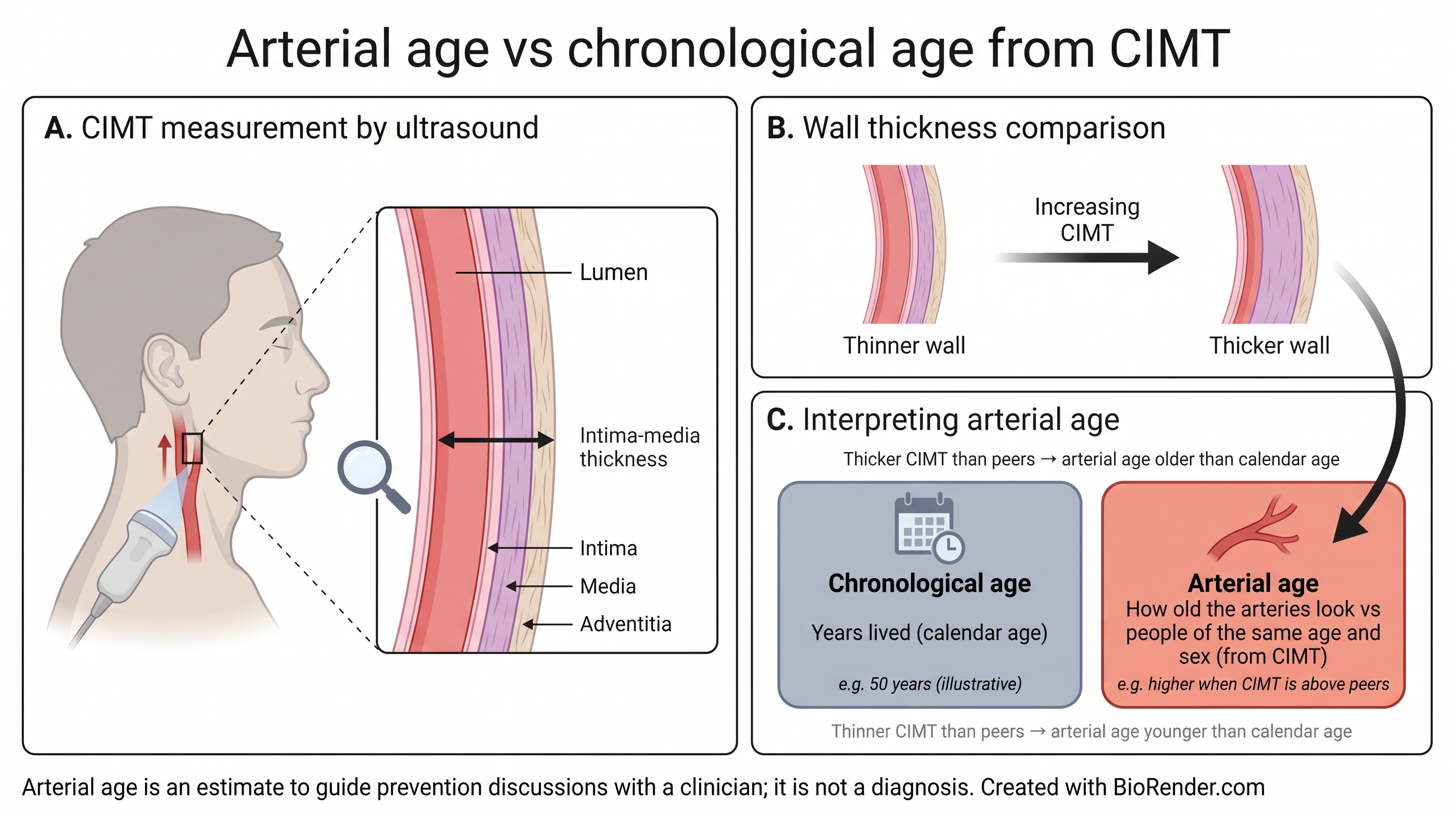
CIMT test definition and mechanism
CIMT measures the combined thickness of the intima and media layers of the carotid artery using high-resolution ultrasound. A sonographer places gel and a probe on your neck. Sound waves create images of the wall. There's no ionizing radiation. You usually don't need needles, dye, or fasting.
Cedars-Sinai and prevention clinics describe the clinical goal clearly: detect subclinical atherosclerosis years before chest pain, stroke symptoms, or an abnormal stress test. Many programs also report an arterial age derived from wall thickness relative to reference populations.
What the images can show:
- Wall thickness compared with age- and sex-based peers
- Presence or absence of plaque
- Soft versus more calcified plaque features, depending on protocol and reporting style
- A baseline for later comparison
Renew Health's patient materials frame the visit as about 15 minutes, with expert PA review of wall thickness, vascular age, and plaque findings.
Age-specific reference ranges and normal values
There isn't a single "normal millimeter number" that fits every adult. Thickness tends to increase with chronological age, and labs use reference curves by age and sex. That's why two people with the same raw measurement can receive different clinical messages. CIMT normal range is the dedicated walkthrough.
How to read a report without over-interpreting it:
- Ask which segment was measured. Common carotid far wall is a frequent research standard. Protocols differ.
- Ask for your value versus the reference percentile for your age and sex.
- Ask whether plaque was seen, even if average thickness looks modest.
- Ask for arterial age only if the clinic reports it. Use the clinic figure rather than calculating one yourself.
A JAHA paper on age-related predictive value is one of the sources behind this page. CIMT's ability to add prediction isn't identical at every age. Younger adults with risk factors can gain more relative insight from an abnormal wall finding than older adults, in whom some thickening is expected.
Never self-assign a disease label from an internet cutoff chart. Bring the report to a clinician who understands prevention imaging.
Interpreting arterial age vs. chronological age
Chronological age is your birthday age. Arterial age (also called vascular age in many clinics) estimates how old your arteries appear based on CIMT and reference data.
Useful interpretation patterns clinics discuss:
- Arterial age close to chronological age: wall findings align with peers.
- Arterial age older than chronological age: wall thickening or plaque burden suggests higher cumulative vascular injury than age alone would predict.
- Arterial age younger than chronological age: reassuring on imaging, still not a free pass if blood pressure, glucose, smoking, or inflammation drivers remain untreated.
Renew Health explains vascular age as a communication tool. A 50-year-old with arteries that look like a 65-year-old needs a different prevention intensity than a peer whose arteries match their age. Pair arterial age with plaque comments and your full risk profile. Imaging without a plan is incomplete.
Risk stratification by age group
Clinics usually group age guidance like this.
Under age 45
CIMT isn't automatic for every young adult. It's more often considered when multiple risk factors are present, such as:
- High blood pressure
- Diabetes or marked insulin resistance
- Current or recent smoking
- Strong family history of early heart attack or stroke
The JAHA paper notes meaningful predictive value in younger adults when findings are abnormal. Coastal CIMT and other prevention sites also describe selective use under 45.
Ages 45 to 54
This band is where many clinics use CIMT as a standard prevention screen for apparently healthy adults or those at intermediate risk. Cedars-Sinai's CIMT program materials and multiple screening vendors describe catching subclinical disease before symptoms. Soft plaque detection matters here because calcium scoring can miss non-calcified disease.
Age 55 and older
Wall thickening becomes more common with age, so a single thickness number is less uniquely predictive on its own. CIMT remains useful for:
- Documenting plaque burden
- Establishing a baseline before intensifying therapy
- Monitoring response after lifestyle and medical changes
COR Medical Group makes this age nuance explicit. The test is still helpful. Thickness needs a different interpretive weight at this age.
Practical age table
| Age band | How clinics usually use it |
|---|---|
| Under 45 | Selective: multiple risk factors or strong family history |
| 45 to 54 | Common prevention screen in intermediate-risk or prevention-focused adults |
| 55+ | Useful for plaque tracking and treatment monitoring. Interpret thickness with age context |
Frequency of testing recommendations
CardioRisk and clinic FAQs commonly cite these retest intervals. How often to get a CIMT test covers the retest timeline in more depth:
| Result pattern | Common retest interval cited |
|---|---|
| Normal, few risk factors | Every 3 to 5 years |
| Borderline / mild thickening | Every 2 to 3 years |
| Abnormal / plaque detected | About every 12 months |
Renew Health's public CIMT FAQ also discusses serial imaging on the order of every 9 to 12 months when you're actively working a reversal or prevention plan. Annualized tracking is about proving change, not collecting novelty scans.
Choose frequency with the clinician who owns your plan. More frequent scans make sense when therapy changes or plaque is present. Less frequent scans make sense when results are normal and risks are stable.
Clinical utility and limitations
What the test is useful for:
- Detects early wall change and plaque without radiation
- Supports arterial-age counseling
- Helps reclassify prevention intensity when standard calculators feel incomplete
- Lets you track change after interventions
Limits you should expect:
- Not a coronary angiogram and not a substitute for emergency care if you have acute chest pain, neurologic deficits, or other urgent symptoms
- Operator and protocol dependence: poor technique weakens comparisons
- Age confounding: older adults need plaque-aware interpretation, not thickness alone
- Incomplete if nobody addresses drivers such as blood pressure, apoB-carrying lipoproteins, glucose handling, smoking, sleep apnea, or periodontal inflammation
CIMT answers "what do the carotid walls show?" It doesn't by itself answer every longevity or treatment question. Pair it with clinician judgment and appropriate labs.
Preparation for the ultrasound
Preparation is simple in nearly all clinic and Renew materials:
- No fasting required for standard CIMT
- No needles or contrast
- Wear clothing that allows easy access to the neck
- Arrive able to lie still for about 15 to 20 minutes
- Bring a list of medications and prior vascular imaging if you have it
After the scan, wipe off the gel and return to normal activity. Ask when and how you'll receive the interpreted report. At Renew, an expert PA reviews thickness, vascular age, and plaque, and the report arrives within 10 days.
Frequently asked questions
What is a CIMT test?
A Carotid Intima-Media Thickness (CIMT) test is a safe, 15-to-20-minute ultrasound of the neck that measures the inner layers of the carotid artery to find early plaque and determine arterial age.
What age is a CIMT test most useful?
It is most useful for adults age 45 or older, or younger adults with cardiovascular risk factors.
Can younger adults get a CIMT test?
It is most useful for adults age 45 or older, or younger adults with cardiovascular risk factors.
How is arterial age determined on a CIMT test?
A Carotid Intima-Media Thickness (CIMT) test is a safe, 15-to-20-minute ultrasound of the neck that measures the inner layers of the carotid artery to find early plaque and determine arterial age.
Sources
- Age-Related Trends in the Predictive Value of Carotid Intima-Media Thickness - JAHA / AHA
- Carotid Intima-Media Thickness Test (CIMT) - Cedars-Sinai
- PMC article on CIMT methods and use
- Coastal CIMT overview
- What Is a CIMT Test - CardioRisk
- How Often Should You Get a CIMT Scan - CardioRisk
- Atherosclerosis Screening - Carotid IMT - COR Medical Group
- CIMT Screening - Pacific Vascular
- CIMT (carotid ultrasound) - Health Suite 110
- CIMT Scan Near Me - Renew Health
Primary age-guidance sources: JAHA age-related CIMT trends and Cedars-Sinai CIMT.
Author and medical review
Written by Andrew Le, MD. Andrew Le, MD reviews patient-facing guidance for Renew Health with a focus on preventive cardiology and functional medicine clarity.
Medically reviewed by Clinical Review Team.
Next step
Schedule a CIMT scan with Renew Health to measure wall thickness and arterial age, then review what the result means for your age and risk factors.
Ready to see your actual risk?
Advanced metabolic testing, arterial imaging, and a personalized prevention plan, built around your numbers.
View Memberships