CIMT Testing Explained: The Heart Test That Could Save Your Life Before You Even Feel Sick
Andrew founded Renew Health to change how cardiovascular disease is detected and treated.
Here's something unsettling: You can have perfectly normal cholesterol numbers, feel great, exercise regularly — and still have soft plaque building up in your arteries right now. The kind of plaque that causes the majority of heart attacks. The kind that won't show up on a standard CT scan until it's too late.
This is why CIMT testing exists. And honestly, it's one of the most important heart health tools most people have never heard of.
Why Does Traditional Cardiology Miss the Early Stuff?
Here's how most healthcare works: you get your annual physical, your cholesterol comes back "borderline," your blood pressure is fine, and your doctor tells you you're healthy. Maybe she recommends watching what you eat or getting more exercise.
But here's what she probably isn't telling you: standard risk calculators like the Framingham Risk Score can't see what's actually happening inside your arteries. They estimate your risk based on numbers — but they can't see if plaque is building.
The uncomfortable truth is that heart disease is often silent until it isn't. A heart attack doesn't usually announce itself years in advance with obvious warning signs. It shows up suddenly, sometimes in people who "had nothing wrong on their tests."
That's where CIMT comes in.
What Is CIMT Testing?
CIMT stands for Carotid Intima-Media Thickness. It's a non-invasive ultrasound test that measures the thickness of the inner layers of your carotid arteries — the blood vessels in your neck that carry oxygen-rich blood to your brain.
Think of it like this: your artery walls have two main layers — the intima (the innermost lining) and the media (the middle muscle layer). When these layers thicken, it's often a sign that plaque is accumulating. That's atherosclerosis. And CIMT can detect this years before you'd ever feel a symptom.
The test uses harmless sound waves — no radiation, no needles, no contrast dye. A technician applies a small amount of gel to your neck and moves a handheld transducer along your carotid artery. The sound waves bounce back and create detailed images of your artery walls.
The whole thing takes about 10–15 minutes. You lie down, it scans, you wipe off the gel, and you go back to your day. No downtime. No recovery.
Why Does CIMT Matter — What Can It Detect?
Here's where CIMT really shines. It doesn't just measure wall thickness — it can see all three types of plaque:
- Soft plaque (S) — This is the dangerous one. Soft plaque is unstable and prone to rupture, which is what triggers most heart attacks. The frightening part? It doesn't show up on CT scans.
- Heterogeneous plaque (H) — A mix of soft and calcified elements, indicating active inflammation and instability.
- Calcified plaque (C) — Hardened plaque that signals the disease process has been ongoing for years.
CIMT catches plaque early — before it calcifies. By the time plaque appears on a CT calcium score, it's often been building silently for a decade or more. CIMT finds it in the dangerous soft stage, when intervention makes the biggest difference (Naqvi & Lee, JACC Cardiovasc Imaging, 2014).
What Is the Arterial Age Concept?
Your CIMT results also calculate your arterial age — essentially how old your arteries appear based on their thickness.
Ideally, your arterial age should be within ±5 years of your actual age. If your arteries look 15 years older than you are, that's a significant signal — even if all your other numbers look fine. Research shows that CIMT-based vascular age assessment can meaningfully shift cardiovascular risk classification, leading to different treatment decisions for more than half of intermediate-risk patients (Kieltyka et al., J Ultrasound Med, 2006; PMID: 16950473).
What Does the Science Say — Why Does CIMT Work?
Research has consistently shown that CIMT is an independent predictor of cardiovascular events — even in people who appear healthy by every standard measure.
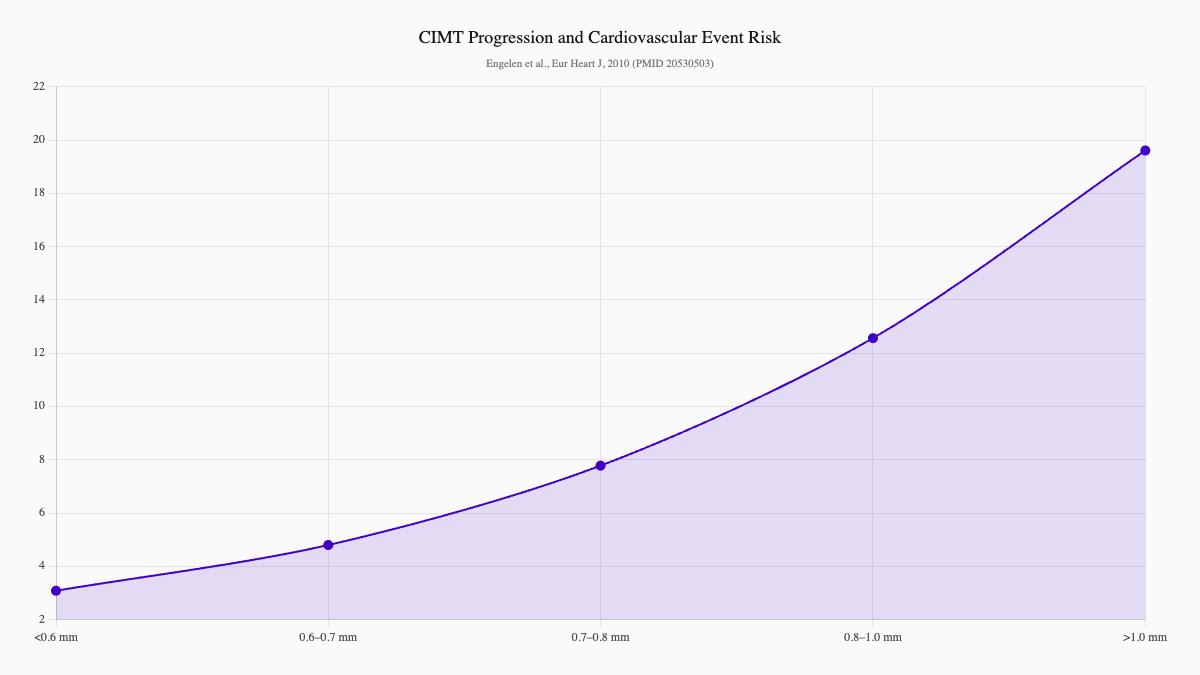
The Carotid Atherosclerosis Progression Study (CAPS) followed nearly 5,000 individuals without pre-existing vascular disease for 10 years. CIMT was significantly and independently predictive of future cardiovascular events. Adding CIMT to standard Framingham risk modeling reclassified 8% of subjects — with meaningful real-world impact on who gets treated (Baldassarre et al., Eur Heart J, 2010; PMID: 20530503).
Baseline CIMT also matters for ongoing monitoring. The PROG-IMT Collaboration confirmed that common carotid IMT is associated with future cardiovascular events in high-risk populations — making it a valuable tool for tracking whether your arteries are actually responding to treatment over time (Lorenz et al., PLoS One, 2018; PMID: 29649236).
This is exactly why Renew Health includes CIMT in our prevention programs annually. One snapshot isn't enough. You need to see the trend.
A Patient Story: Maria's Wake-Up Call
Maria was 52 when she joined Renew Health's prevention program. She was an executive who exercised regularly, ate a relatively balanced diet, and had no known medical issues. Her primary care provider had never raised concerns — her cholesterol was "borderline but acceptable" and blood pressure was normal.
Standard cardiology would have told Maria she was fine. Her Framingham risk score would have placed her in a low-to-intermediate category.
But CIMT told a different story.
The test revealed soft plaque buildup in her carotid arteries, with an IMT measurement of 0.82 mm — well above the healthy threshold of 0.50 mm. Her arterial age calculated to 67 years — 15 years older than her chronological age.
With this information, Renew Health's team put a targeted prevention plan in motion: prescription therapy to address the inflammation driving her plaque, evidence-based supplements to support arterial health, and specific dietary modifications. Within 18 months, follow-up CIMT imaging showed measurable progress — her plaque had stabilized and her arterial age dropped to 61.
The takeaway: CIMT gave Maria a window to act — before a heart attack struck without warning. Waiting for symptoms or relying on traditional risk calculators alone can be a dangerous gamble.
Who Should Consider CIMT Testing?
CIMT isn't just for people who already have obvious risk factors. According to the American Heart Association and American College of Cardiology, CIMT screening is particularly useful for:
- Adults 45 and older who appear healthy but may have hidden risks
- People with intermediate Framingham Risk Scores — adding CIMT significantly improves future heart disease prediction
- Adults under 60 with any single cardiovascular risk factor (high cholesterol, high blood pressure, smoking)
- Women under 60 with two or more risk factors (diabetes, smoking, high cholesterol, or excess weight)
- Anyone with a family history of early heart attack or stroke (first-degree relative before age 55 for men, before age 65 for women)
How Does CIMT Compare to CT Calcium Scoring — Why Does CIMT Come First?
You might have heard of CT calcium scoring (CAC) — it's another heart test that looks for plaque. But here's the critical difference:
| Feature | CIMT | CT Calcium Scoring |
|---|---|---|
| Radiation | None | Yes |
| Plaque detected | All types (including soft) | Calcified only |
| Timing | Early detection | Late-stage detection |
| Best for | Primary screening | Confirmation |
CIMT is our primary screening tool because it finds soft plaque — the most dangerous kind — before it ever calcifies. CT calcium scoring only sees plaque after it's been there for years. By then, you've already missed your best window for prevention.
What Is the Renew Health Approach?
At Renew Health, we use CIMT as the cornerstone of a comprehensive prevention program that tracks your vascular health year over year.
Here's how we do it differently:
- Advanced imaging — We use edge-detection software for precise, reproducible measurements
- Yearly tracking — We repeat CIMT annually to verify your treatment is actually working
- Comprehensive assessment — We scan the common carotid artery, bulb, and internal carotid artery for the most accurate risk picture
- Personalized action plans — Your results drive specific recommendations for prescription therapy, supplements, diet, and exercise
Our team has over 20 years of experience in cardiovascular prevention. Not a single patient has developed a heart attack, stroke, or dementia under our care.
How Do You Understand Your Results?
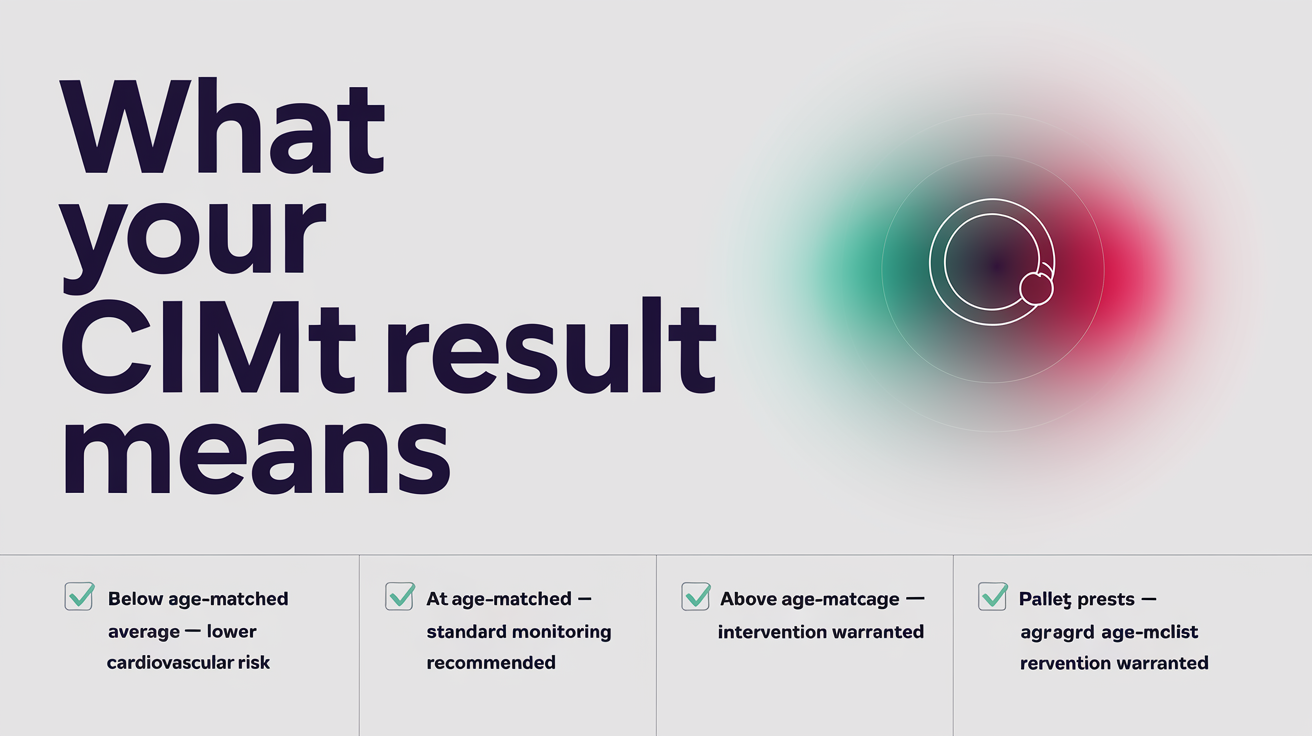
IMT Thickness Categories:
- Less than 0.50 mm — Normal. Thin, healthy artery walls. Low risk.
- 0.50–0.75 mm — Moderate thickening. Increased risk — lifestyle changes typically recommended.
- Greater than 0.75 mm — Elevated. Significant artery wall thickening. Higher risk for heart disease and stroke.
Four Possible Outcomes:
- Normal CIMT, no plaque — Best outcome. Keep doing what you're doing.
- Abnormal CIMT, no plaque — Early thickening. Monitor closely, make lifestyle adjustments.
- Normal CIMT, with plaque — Plaque exists despite normal thickness. Requires attention.
- Abnormal CIMT, with plaque — Highest risk category. Active intervention needed.
When plaque is detected, we also assess:
- Plaque type: Soft (S), Heterogeneous (H), or Calcified (C)
- Plaque size: Plaque greater than 2.0 mm indicates an urgent need for accelerated workup
What Happens If Your CIMT Shows Problems?
The good news: early detection means you have time to act. Treatment approaches include:
- Prescription therapy — Medications to lower inflammation and stabilize plaque
- Evidence-based supplements — Nutrients with clinical support for arterial health
- Dietary modifications — Targeted nutritional changes to slow or reverse plaque progression
- Exercise programming — Personalized activity recommendations based on your results
Most patients see measurable improvement within 12–24 months with consistent treatment. The earlier you catch it, the more you can do.
What Should You Expect During Your CIMT Test?
The test is simple and comfortable:
- Lie down on an exam table (about 10–15 minutes total)
- Gel applied to your neck — smooth, cool, won't stain clothing
- Transducer moved along your neck — gentle pressure, no pain
- Images captured from multiple angles for comprehensive assessment
- Gel wiped off — you're done
- Return to normal activities immediately — no downtime
No preparation needed. No fasting required. No radiation exposure.
Ready to See What Your Arteries Look Like?
If any of this resonated with you — if you've been told your numbers are "fine" but something still feels off, or if you simply want a clearer picture of your actual heart health — CIMT testing might be the most important step you take this year.
Early detection isn't just about finding problems. It's about giving yourself the best possible chance to prevent them.
Take the next step:
- Learn more about CIMT testing at Renew Health
- See our pricing and programs
- What a CIMT visit costs
- Schedule a consultation to find out if CIMT is right for you
References
-
Naqvi TZ, Lee MS. Carotid intima-media thickness and plaque in cardiovascular risk assessment. JACC Cardiovasc Imaging. 2014;7(10):1025–1038. https://pubmed.ncbi.nlm.nih.gov/25051948
-
Baldassarre D, et al. Is carotid intima media thickness useful for individual prediction of cardiovascular risk? Ten-year results from the Carotid Atherosclerosis Progression Study (CAPS). Eur Heart J. 2010;31(16):2041–2048. https://pubmed.ncbi.nlm.nih.gov/20530503
-
Lorenz MW, et al. Predictive value for cardiovascular events of common carotid intima media thickness and its rate of change in individuals at high cardiovascular risk — Results from the PROG-IMT collaboration. PLoS One. 2018;13(4):e0191172. https://pubmed.ncbi.nlm.nih.gov/29649236
-
Kieltyka L, et al. Use of carotid intima-media thickness and vascular age to modify cardiovascular risk prediction. J Ultrasound Med. 2006;25(9):1161–1168. https://pubmed.ncbi.nlm.nih.gov/16950473
Ready to see your actual risk?
Advanced metabolic testing, arterial imaging, and a personalized prevention plan, built around your numbers.
View Memberships