Stress Is Silently Damaging Your Heart — Here's What Actually Works
Andrew founded Renew Health to change how cardiovascular disease is detected and treated.
You probably already know that stress is "bad for you." But here's what most people don't realize: chronic stress doesn't just make you feel anxious or exhausted — it's actively remodeling your arteries, spiking your blood pressure, and setting the stage for a heart attack or stroke, often years before any symptom appears.
The problem isn't occasional stress. The problem is the low-grade, unrelenting kind — the kind that never fully turns off. Work deadlines, financial pressure, relationship strain, poor sleep. Your body responds to all of it the same way: by flooding your system with cortisol and adrenaline, day after day, with no real recovery.
At Renew, we see the cardiovascular damage from chronic stress directly. When we run a CIMT scan — our gold-standard test for early arterial disease — patients who report high chronic stress consistently show more arterial wall thickening than their numbers alone would predict. The arteries don't lie.
This post breaks down exactly how stress injures your cardiovascular system, what to watch for, and — most importantly — the stress management techniques that have real clinical evidence behind them.
Why Isn't Your Doctor Testing for Stress — and Why Does That Matter?
Standard cardiovascular risk assessments focus on cholesterol, blood pressure, blood sugar, and smoking. These matter. But they miss a growing body of evidence showing that psychological stress is an independent risk factor for heart disease — one that explains why people with "perfect" labs still have heart attacks.
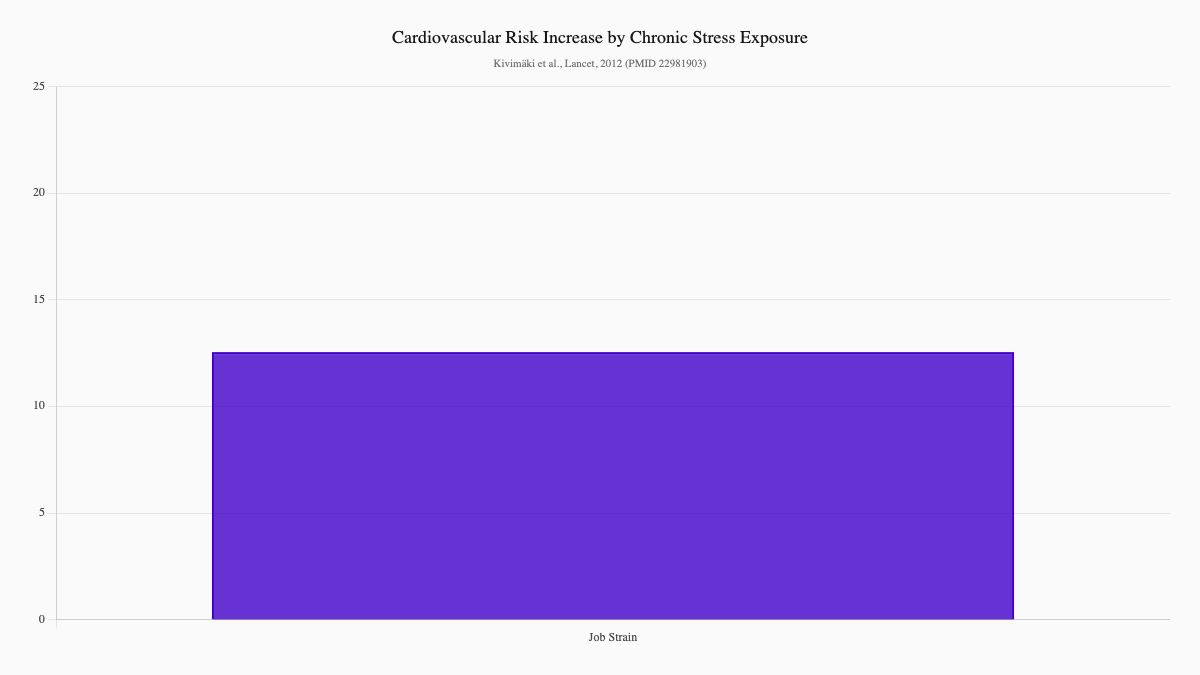
A landmark meta-analysis of over 197,000 working adults found that job strain was associated with a 23% increased risk of coronary heart disease — independent of traditional risk factors including age, sex, blood pressure, and cholesterol. (Kivimäki et al., 2012, The Lancet)
Yet most cardiovascular risk calculators don't include a single question about stress.
How Does Stress Injure Your Heart?
When you encounter a stressor, your brain — specifically the hypothalamus — activates two parallel emergency systems: the sympathetic nervous system (immediate) and the HPA axis (delayed).
The sympathetic surge releases adrenaline and noradrenaline within seconds. Heart rate spikes. Blood vessels constrict. Blood pressure rises. This is designed for short-term survival — to help you run from a threat.
The HPA axis response releases cortisol over the next 20–40 minutes. Cortisol mobilizes glucose for energy, dampens inflammation in the short term, and helps you stay alert.
This system is elegant when stress is brief and infrequent. But under chronic activation, it becomes destructive:
Cortisol damages the endothelium. The inner lining of your arteries — the endothelium — is exquisitely sensitive to sustained cortisol elevation. Cortisol inhibits nitric oxide synthesis, impairs the endothelium's ability to dilate blood vessels, and promotes the infiltration of LDL cholesterol particles into the arterial wall. The result is accelerated atherosclerosis. A 2022 review in Trends in Endocrinology & Metabolism identified cortisol as "a core hormonal mediator of allostatic load" directly linking chronic stress to hypertension, dyslipidemia, and cardiovascular events. (Ortiz et al., 2022, Trends Endocrinol Metab)
Chronic stress drives systemic inflammation. Sustained sympathetic activation triggers the release of pro-inflammatory cytokines, activates bone marrow to produce more white blood cells, and drives those cells into arterial walls and atherosclerotic plaques — destabilizing them. Unstable plaque ruptures. That's what causes most heart attacks.
The autonomic nervous system loses balance. Chronic stress chronically elevates sympathetic tone while suppressing parasympathetic (vagal) tone. This reduces heart rate variability (HRV), increases the risk of arrhythmia, and leaves the heart less resilient to acute challenges.
A 2024 review in Nature Reviews Cardiology confirmed that "haemodynamic, vascular and immune perturbations triggered by stress are especially implicated" in CVD risk, and emphasized that stress response physiology deserves far more attention in clinical prevention than it currently receives. (Vaccarino et al., 2024, Nat Rev Cardiol)
What Are the Warning Signs That Stress Is Affecting Your Cardiovascular Health?
Stress-related cardiovascular damage is usually silent. But these patterns in patients should raise concern:
Physical signs:
- Persistently elevated blood pressure, especially variability throughout the day
- Resting heart rate above 80 bpm without other explanation
- Poor heart rate variability (low HRV on wearables or EKG)
- Central weight gain, particularly belly fat accumulation
- Chronic fatigue, especially difficulty recovering from moderate exertion
- Frequent tension headaches or chest tightness without cardiac cause
Lab patterns:
- Elevated fasting glucose or hemoglobin A1c trending upward (cortisol drives insulin resistance)
- High-sensitivity CRP above 1.0 mg/L (stress-mediated inflammation)
- Low HDL with elevated triglycerides (stress disrupts lipid metabolism)
- Morning cortisol dysregulation (either excessively high or flat/low diurnal pattern)
Behavioral patterns:
- Sleep under 6 hours per night, or frequent waking between 2–4 AM
- Reliance on caffeine or alcohol to regulate energy and mood
- Persistent anxiety, irritability, or feeling "wired but tired"
The CIMT connection: At Renew, we've observed that patients with high perceived chronic stress frequently show carotid intima-media thickness (CIMT) measurements above age-matched norms — even when standard labs look acceptable. This is the test that catches what blood panels miss.
What Did the CIMT Scan Reveal? A Patient's Story
Sandra came to Renew at 52 for what she described as a "tune-up." She ran a marketing agency, worked 60-hour weeks, slept five or six hours a night, and had been doing this for years. Her primary care doctor had told her cholesterol was fine, blood pressure was borderline but "not bad enough to treat."
What her standard workup hadn't captured was the toll those years of unrelenting stress had taken on her arteries. Her CIMT showed early but measurable plaque formation — more than expected for her age. Her hs-CRP was 2.8 mg/L. Her morning cortisol was elevated and her diurnal curve was blunted.
Sandra had no idea her arteries were under attack. She'd assumed stress was just something you lived with.
We built her a cardiovascular prevention plan that included specific, evidence-based stress management protocols alongside targeted interventions for her inflammation and arterial health. Within eight months, her hs-CRP had dropped to 0.9 mg/L. Her follow-up CIMT showed stabilization. And she told us — somewhat sheepishly — that she was sleeping seven hours a night and it had changed her life.
What Actually Works for Stress Management? Evidence-Based Techniques for Cardiovascular Health
Here's the honest version: most stress management advice is vague. "Take a walk." "Try yoga." The clinical reality is that some interventions have genuinely strong evidence and some don't. Here's what we recommend and why.
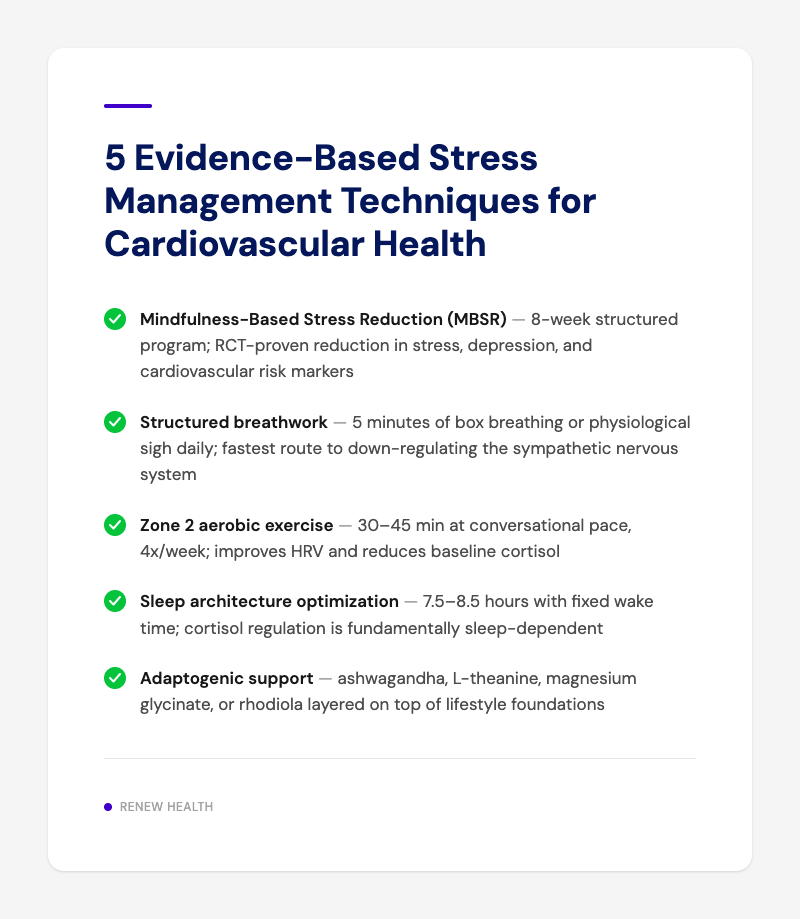
1. Mindfulness-Based Stress Reduction (MBSR)
MBSR is the most rigorously studied mind-body intervention for cardiovascular outcomes. An 8-week structured program, it combines body scanning, mindful movement, and sitting meditation with stress education.
A randomized controlled trial in cardiac patients found that MBSR significantly reduced perceived stress and depression scores compared to controls — with particular improvements in psychological wellbeing that are directly linked to cardiovascular risk reduction. (Nijjar et al., 2019, Sci Rep)
Practical application: Formal MBSR programs run 8 weeks and require a real time commitment (~2.5 hours/week plus daily practice). Apps like Waking Up or Insight Timer offer solid foundations. The research favors consistent daily practice over occasional longer sessions.
2. Physiological Sighing and Structured Breathwork
Controlled breathing is one of the fastest routes to down-regulating the sympathetic nervous system. The key mechanism: extending the exhale activates the parasympathetic nervous system via the vagus nerve, rapidly reducing heart rate and cortisol.
- Box breathing: Inhale 4 counts, hold 4, exhale 4, hold 4. Used by Navy SEALs for acute stress control.
- Physiological sigh: Double inhale through the nose, extended exhale through the mouth. Stanford research by Andrew Huberman's group showed this is the fastest way to reduce physiological arousal in the moment.
- 4-7-8 breathing: Inhale 4 counts, hold 7, exhale 8. Particularly effective before sleep.
We recommend 5 minutes of structured breathing before bed as a minimum daily practice — it's the single simplest cardiovascular intervention with near-zero barrier to entry.
3. Zone 2 Aerobic Exercise
Exercise is one of the most powerful stress modulators we have. Zone 2 cardio — sustained aerobic activity at a conversational pace (roughly 60–70% max heart rate) for 30–45 minutes — dramatically improves HRV, reduces baseline cortisol, and promotes neuroplasticity in stress-regulating brain regions.
Critically, intensity matters: high-intensity exercise too frequently can actually compound cortisol dysregulation in people who are already overstressed. If your patient is reporting chronic fatigue with high stress, 60-minute high-intensity interval training five days a week is not the answer. Zone 2, four days a week, is.
4. Sleep Architecture Optimization
Cortisol regulation is fundamentally a sleep-dependent process. During deep slow-wave sleep, cortisol levels reach their daily nadir. Chronic short sleep or poor sleep quality elevates morning cortisol, disrupts HPA axis regulation, and drives the inflammation and insulin resistance associated with cardiovascular risk.
Non-negotiable minimum: 7 hours. Target: 7.5–8.5 hours for most adults under sustained stress load.
Key levers:
- Fixed wake time (the most important anchor)
- No screens 30–60 minutes before bed
- Cool room temperature (65–68°F optimal for sleep onset)
- Eliminate alcohol: it fragments sleep architecture even at low doses
5. Targeted Adaptogenic Support
Several nutraceuticals have credible evidence for modulating the HPA axis and reducing cortisol:
- Ashwagandha (KSM-66 or Sensoril): Multiple RCTs show significant reductions in serum cortisol and self-reported stress. Typical dose: 300–600 mg daily.
- L-theanine: Found in green tea, promotes calm alertness without sedation. Synergistic with moderate caffeine.
- Magnesium glycinate: Deficiency is common in chronically stressed individuals; supplementation supports HPA regulation and sleep quality. Dose: 200–400 mg at night.
- Rhodiola rosea: Adaptogen with evidence for reducing stress-related fatigue and improving stress tolerance. Dose: 200–400 mg in the morning.
We don't recommend these as replacements for structural interventions. They work best layered on top of sleep, exercise, and breathing practices.
How Does Renew Measure Stress's Impact Directly?
At Renew, we don't ask you to estimate your stress on a 1–10 scale and call it a day. We measure how your biology has actually responded to chronic stress:
- CIMT scan: Direct visualization of arterial wall thickness and plaque — shows cumulative cardiovascular stress over years, not just what's happening right now. Learn more about CIMT testing →
- High-sensitivity CRP: Quantifies the inflammatory burden that chronic stress drives
- Cortisol diurnal curve: Morning and evening cortisol measurements to assess HPA axis regulation
- Fasting insulin and HOMA-IR: Cortisol-driven insulin resistance is often the first metabolic domino to fall
- Heart rate variability assessment: Objective marker of autonomic nervous system balance
- Comprehensive lipid panel with LDL particle size: Stress-driven lipid abnormalities are frequently missed by standard cholesterol panels
This is how we identify exactly where chronic stress has done damage — and build a personalized plan to address it.
What Should You Do Starting This Week?
You can't eliminate stress. But you can systematically reduce your cardiovascular exposure to it. Here's how to start:
- Start with sleep. Pick a fixed wake time and protect it for two weeks. Everything else builds on this foundation.
- Add 5 minutes of structured breathing before bed tonight. Box breathing or the physiological sigh. Set a timer.
- Schedule three Zone 2 walks this week. 30 minutes each, conversational pace. That's it.
- Get a CIMT scan. If you're dealing with chronic stress — especially combined with any metabolic risk factors — this is the test that shows you what's actually happening in your arteries, before it's too late.
Ready to Find Out What Chronic Stress Has Done to Your Arteries?
A CIMT scan at Renew takes less than 30 minutes, uses no radiation, and gives you a direct picture of your cardiovascular age — not your calendar age. Paired with our comprehensive biomarker panel, it's the most honest assessment of how stress, inflammation, and metabolic health have shaped your heart disease risk.
The best time to find out was 10 years ago. The second best time is now.
→ Book your cardiovascular assessment at Renew
References
-
Kivimäki M, et al. Job strain as a risk factor for coronary heart disease: a collaborative meta-analysis of individual participant data. The Lancet. 2012 Oct 27;380(9852):1491–7. PMID: 22981903
-
Ortiz R, et al. Cortisol and cardiometabolic disease: a target for advancing health equity. Trends Endocrinol Metab. 2022 Nov;33(11):786–797. PMID: 36266164
-
Vaccarino V, et al. Stress and cardiovascular disease: an update. Nat Rev Cardiol. 2024 Sep;21(9):603–616. PMID: 38698183
-
Nijjar PS, et al. Randomized Trial of Mindfulness-Based Stress Reduction in Cardiac Patients Eligible for Cardiac Rehabilitation. Sci Rep. 2019 Dec 5;9(1):18415. PMID: 31804580
Ready to see your actual risk?
Advanced metabolic testing, arterial imaging, and a personalized prevention plan, built around your numbers.
View Memberships